Author: nelly

  • Best in Uganda As HTTC Presents 782 Names,782 Stories & A Day of Tears of Joy in Jinja City On November 20th, 2026.

    Best in Uganda As HTTC Presents 782 Names,782 Stories & A Day of Tears of Joy in Jinja City On November 20th, 2026.

    There will be tears of joy on November 20, and they will fall freely on the campus of the Hotel and Tourism Training College (HTTC) in Jinja City, because graduands will hug their instructors with gratitude, and they will hold their parents, some single mothers and single fathers, their guardians, relatives and friends, who sacrificed land, money and meals to keep them in school.

    Some graduands will cry for another reason, as they remember the odd jobs that kept them going, working as maids, washing clothes for neighbors, carrying luggage as porters, or at building sites as helpers and riding boda-boda at night, all just to pay tuition and remain in class.

    It will be the kind of happiness that is almost too much to carry, the kind that writers have tried for centuries to capture, and it will recall a moment in Lorraine Hansberry’s play A Raisin in the Sun, when Mama Younger holds the dream of a new house in her hands and can hardly believe it is real, because after years of waiting and praying, the blessing arrives so suddenly that joy itself feels like disbelief.

    That is how November 20 will feel in Jinja, like a dream that has finally refused to remain a dream, as 782 graduands walk across the stage at the College’s 17th Graduation Ceremony, which will be presided over by the Minister of Tourism, Wildlife and Antiquities, Col. (Rtd) Tom Butime, under the theme Advancing Service Excellence and Innovation for Africa’s Hospitality and Tourism Future.

    As you read this article, know one thing that changes the meaning of that day completely, because all the students called graduands here are already working, in kitchens and bakeries, at front desks and in housekeeping corridors, in restaurants, lodges and tour operations, doing the very work their certificates will soon confirm, so November 20 will not be their beginning, but their coronation.

    The numbers tell a powerful story, for of the 782, 553 are apprentices who benefited from sponsorship by the International Labour Organization(ILO), the Ministry of Tourism, Wildlife and Antiquities, and Inter-Seed Sector Development under the Enabel-supported WeWork project, while the remaining 229 are regular students, and of the whole group, 561 are female and 221 are male, which means about 72 percent of this graduating class are women, a quiet revolution in an industry where women have long carried the work while men took the titles.

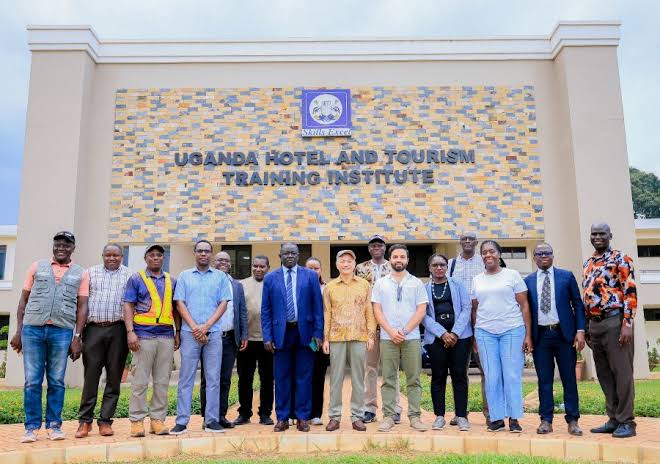
    To feel the weight of November 20, you must know the place, because HTTC, once called the Uganda Hotel and Tourism Training Institute, is Uganda’s only government-owned institution for tourism and hospitality training, and the lone government school charged with training the labour force for the whole sector.

    In tourism circles across the region, it is now fondly referred to as the Utali College of Uganda, a comparison that carries real meaning, because Utali College in Kenya has long been the benchmark for hospitality training in East Africa, and it is not an exaggeration to say that HTTC has earned a place among the best in East Africa and Africa.

    It has earned that reputation not by claiming it, but by building it, through disciplined training, through a working hotel that doubles as a classroom, and through networking with internationally respected institutions in the United States, Europe and Asia, partnerships that expose its trainers and students to global standards, global kitchens, and global expectations, while keeping their feet firmly on Ugandan soil.

    It began 35 years ago as an ILO project at Fairway Hotel in Kampala, before moving to Jinja, to the Crested Crane Hotel, and it was established in 1989 as a pilot school under the International Labour Organization and United Nations Development Programme, taken over fully by government after the Fairway Hotel was repossessed, formalized by Statute Number 14 of September 1994, which transferred the Crested Crane Hotel and its assets to the new institute, and revived in mid-1996, before receiving a clear mandate through the UHTTI Act of 2015 and being rebranded in August 2025 to HTTC, to match the new TVET law that puts skills first.

    The Principal Richard Kawere has always put the philosophy simply, that students must touch, practice and feel, because hospitality cannot be learned only from a blackboard, but must be learned from a hot kitchen and a full restaurant, from a guest who arrives late, tired and hungry, and from a room that must be made perfect in twenty minutes.

    Today the College trains about 1,500 students, and it counts over 5,000 alumni working in hotels and tourism establishments across Uganda and beyond, and the 782 are the latest proof that the model works.

    It’s important to note that November 20 matters far beyond Jinja, because it lands in the middle of Uganda’s biggest economic question, which is how a country that adds 1.2 million job seekers every year, with projections showing only half that number of jobs available, can still create work at scale.

    Tourism has emerged as the clearest answer, for it is already Uganda’s fifth-largest source of jobs, directly employing 876,512 workers, with every tourist dollar turning into 2.64 times as much spending in the local economy, and the sector earned $1.6 billion in 2025.

    Uganda received 1.37 million international visitors in 2024, who generated about Shs4.8 trillion, roughly $1.28 billion, or 16 percent of total exports, before arrivals rose to about 1.64 million in 2025, with receipts reaching about UGX 5.83 trillion, or US$1.62 billion.

    Yet a painful gap remains, because long-haul arrivals from the UK and US were just 26,416 in 2024, compared to nearly half a million for neighbouring Kenya, and the average tourist stays just 8.8 days in Uganda, against 12.1 days in Kenya, and what makes a tourist stay three more days is not a mountain or a river, but a person.

    It is the guide who knows birds by call, not just by book, the chef who can cook matoke and pasta with equal respect, the receptionist who solves a problem before it becomes a complaint, the housekeeper whose room makes a guest extend a night, and the driver who makes a long journey feel short and safe, which is why the World Bank has warned that Uganda ranks 122nd of 140 countries on qualified tourism labour, and has called for specialist curricula for birding, adventure and cultural interpretation, the precise skills that serve high-yield, long-stay visitors.

    November 20 is Uganda’s answer to that gap, and it is 782 answers walking across one stage.

    Every great graduation has names that become legend, and according to Daniel Kazungu, the Institute Public Relations Officer, Ms Ssembatya Anna Maria emerged as the overall best graduand with a CGPA of 4.86, while Catherine Nabutiti topped the diploma category with a CGPA of 4.84.

    Those are not just exam marks, Daniel Kazungu says they are battle marks, earned at 5 a.m. in kitchens, in laundries where linen must be perfect, at front desks where tired guests are sometimes angry, and on field trips where a tour must be both accurate and alive.

    Kazungu says Ms Anna Maria is not an exception to the system, but proof of it, because she learned to set a table and then learned to read a guest, she learned food safety and then learned patience, and she learned theory and then learned to apply it when the power goes off, the guest is allergic, the van is late, and the show must still go on.

    Her success answers a question many parents still ask, whether a daughter can truly build a career from this path, and the answer is written in the 561 women who will graduate, women who are already proving in kitchens, bakeries, front offices, tour operations and housekeeping leadership that hospitality is not a fallback, but a profession.

    When Anna Maria and Catherine walk elegantly across that stage, they will not walk as job seekers, but as workers already in service, carrying certificates that will only confirm what employers already know.

    That distinction matters because the job market has moved, and it no longer asks only what papers a person holds, but what a person can actually do, a shift that education leaders in Uganda are now naming openly.

    Onesimus Oyesigye leads the Uganda Vocational and Technical Examinations Board, and he says the world now uses a skills economy, where they used to ask for qualifications, but now, when you present the paper, they ask what you can do, and skills defeat poverty.

    A 2024 tracer study supports him, for it found that 90 percent of TVET graduates outperform university-trained counterparts in practical skills, that 63 percent secure employment within one year, and that 95 percent of employers are satisfied with TVET graduates’ hands-on competence.

    Academic papers are still important, because they open doors, signal discipline, and prove a person can learn and finish, and in hospitality they matter for promotion, licensing, working abroad, teaching others, and starting a business that banks will trust.

    Some experts now say papers alone are no longer enough, because no guest asks for a transcript before eating your food, and no tourist asks for a CGPA before trusting you in Bwindi, and what they ask instead, with their eyes and their wallets and their reviews, is whether you are competent, clean, kind and on time, and whether you can solve their problem.

    That is why Uganda’s TVET reforms push for 70 percent practical training and 30 percent theory, judging learners not just on what they know, but on what they can do.

    HTTC understood this shift long before it became fashionable, because its apprenticeship model combines work with education and leads to a recognised qualification, and through Enabel and ISSD, the College trains hundreds of apprentices, many of them young people who, after Primary Seven, could not access formal education.

    The College serves those who passed well, and it also serves those the formal system left behind, giving them a second road into dignity and income, and that is precisely why its graduands are already working, because the apprenticeship was never a classroom exercise, but a job with training attached.

    If skills are the new currency, two qualities are the new bank account, discipline and multi-tasking, and discipline in hospitality is not abstract, but the daily practice of reporting at 6 a.m., wearing the uniform correctly when no supervisor is watching, washing hands, checking temperatures, labelling food, recording stock, refusing to cut corners when tired, and keeping a guest’s privacy, which HTTC apprentices swore to uphold when they took an oath before placement in hotels across Jinja.

    Multi-tasking is now equally real, because the modern worker is not a single-task worker, but a receptionist who must check in a guest, answer WhatsApp, handle a complaint, upsell a tour and calm a child, all with a smile, a chef who must cook, cost, plate, manage waste and supervise a junior, and a guide who must tell stories, manage safety, handle first aid and manage time so the group catches the boat back.

    Technical skill alone is not enough, for employers also want soft skills such as communication, time management, flexibility, self-discipline, innovativeness and resilience, because a brilliant worker who cannot communicate or keep time will not last long.

    Employers test this in week one, when they watch attitude and ask whether you will show up, greet and take correction without sulking, when they watch hygiene and safety and ask whether you understand that one dirty chopping board can close a hotel, when they watch communication and ask whether you can explain a menu, apologise without blaming and write a clear handover note, when they watch adaptability and ask whether you can move from housekeeping to restaurant service when the hotel is full, and when they watch entrepreneurship and ask whether you can see a gap and turn it into income.

    Daniel Kazungu says the 782 have been trained for exactly that test, because their training included hotel attachments, kitchens, restaurants, tour companies and travel systems, the places where theory either works or fails, and because they are already working, employers have already seen the answer.

    The message to them is simple, that their papers have opened the door, but their skills are already keeping them in the room, and they should not despise small beginnings, because the best general managers started as waiters and housekeepers, the best tour operators started as drivers and porters, and the best entrepreneurs started by selling one cake or one tour, and doing it so well that customers came back with friends.

    They should not wait to be employed to be useful, because Uganda’s tourism sector needs founders, not just employees, young people who will start guesthouses in their villages, run catering for weddings, guide birders in Mabira, bake for Jinja’s cafes, and market Busoga’s culture to the world with professionalism.

    They should not stop learning, because technology is changing hospitality through online bookings, digital payments, AI for customer service, food safety apps and energy-saving kitchens, and the worker who stops learning in 2026 will be outdated by 2028, while the worker who keeps learning will never lack work.

    Above all, they should not forget discipline, because in a world of shortcuts, discipline is the real distinction, and punctuality is a skill, cleanliness is a skill, honesty is a skill, and kindness under pressure is a skill that no machine can replace.

    November 20 is therefore not just a celebration, but a test for the country, because HTTC has already removed one excuse by placing its students in work before graduation, and proving that training and employment are one continuous road.

    The Government of Uganda and hotels must now meet them halfway, along with banks and tour operators, by offering internships that become jobs, start-up capital that is accessible, standards that reward quality, and marketing that brings more tourists to stay longer and spend more.

    The College itself still needs support, and through Principal Kawere, it has asked for increased funding, because it needs modern kitchens and training restaurants, language labs and ICT, and trainers who are regularly retrained, and a Centre of Excellence cannot run on goodwill alone.

    But the biggest investment is not in buildings, but in belief, belief that a certificate in pastry or tour guiding is not a failure option, and that housekeeping or front office is not for those who missed university, but a first-choice profession for a country that wants to be known for service excellence.

    On November 20, when Minister Butime presides and Dr James Musinguzi of the Uganda Wildlife Authority delivers the commencement lecture, that message should ring clearly across Jinja and across Uganda.

    So let Jinja City countdown to November 20 with pride, to the music and the ululation, to the tears of parents who sacrificed everything, and to the moment when 782 names are called, 782 workers already in service being formally recognized for what they already do every day.

    Let it count down to the moment when, according to Kazungu, Anna Maria’s name will be called as overall best with her 4.86, and to the moment when, according to Kazungu, Catherine’s name will be called as best in diploma with her 4.84, and to the moment when the other 780 names are called and remembered not as statistics, but as cooks, bakers, waiters, housekeepers, receptionists, guides, managers and entrepreneurs in the making.

    Like Mama in A Raisin in the Sun, they will look at what they have achieved and find it almost too wonderful to believe, and like her, they will discover that the tears were never wasted, because Jinja has spoken, the Nile City has not just trained workers but sent them out, and Uganda’s tourism future will be built by hands that can do, hearts that can serve, and minds that can adapt.

    Papers are important, but November 20 will prove something more powerful, that skills pay, discipline sustains, and work, real work already begun, is the true graduation, and on that day, Jinja will not just graduate 782 students, but present to Uganda a workforce that is already working, already serving, and already ready.

  • Prof Lubogo Calls For Africa To Move Beyond Disability Rights On Paper, Urges Ubuntu-Driven Equality And Inclusion.

    Prof Lubogo Calls For Africa To Move Beyond Disability Rights On Paper, Urges Ubuntu-Driven Equality And Inclusion.

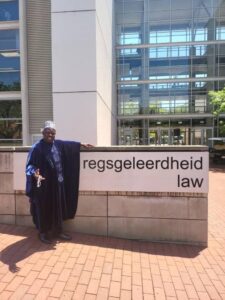
    Uganda’s Prof. Isaac Christopher Lubogo went to Pretoria with a complaint many in the hall already knew from their own lives, but had not heard stated so plainly. Africa has the laws. What Africa does not yet have is the daily practice that makes those laws mean something in ordinary life.

    The address came at the 14th Annual Disability Rights in Africa Conference, held on 5-6 November 2026 at the Centre for Human Rights, University of Pretoria. The theme was Equality and Non-Discrimination: Realizing the Rights of Persons with Disabilities in Africa.
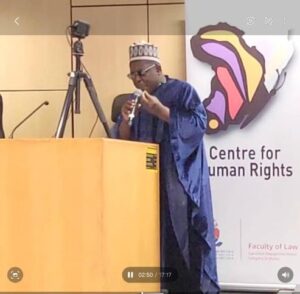
    Judges, academics, activists, policymakers and persons with disabilities from across the continent filled the room. The occasion was not used to list treaties. The question placed before the audience was sharper: what have those treaties changed on the ground for people who live with disability every day?

    The starting point was simple. A person can be recognized by the Constitution and still be shut out of the classroom, the office, the taxi, the court and the community meeting. That gap between legal status and daily life became the thread running through the whole presentation.

    How The Argument Was Carried.

    To carry that message across difficult ground, legal jargon alone would not have been enough. Literary tools were used the way a careful driver uses a strong vehicle on a bad road, because the politics of disability in Africa is full of potholes, diversions and unpaved stretches where a technical argument alone will break down. Antithesis, repetition, rhetorical questions, parable and proverb allowed the argument to move quickly and safely from philosophy to law, from law to budget, and from budget to the human being waiting outside the building.

    The point landed because the audience could test it against their own countries. In Kampala, Nairobi, Accra, Lagos, Pretoria, Lusaka, Harare and Dar es Salaam, the statutes look strong, while the buildings, the budgets and the attitudes often do not. Africa, the argument insisted, should stop measuring progress by how many laws have been passed, and start measuring it by whether a person with a disability can enter a public building, get a job, learn, get treatment and take part in decisions without a struggle.

    That shift from paper to practice shaped the delivery. Those present describe a presentation that was slow and deliberate, with pauses that allowed each point to settle. A phrase was repeated until it settled, and the line of argument moved between law, philosophy and lived experience without breaking. The voice dropped when humiliation was described and rose when dignity was described. There was no shouting and no pleading, because the audience was kept returning to one question: if the right exists, why does the person still have to fight for it?
    A large part of that effect came from antithesis, the art of placing a claim next to its opposite so the contrast cannot be missed. A person is present in law but absent in life, visible in documents but invisible in decisions, and a citizen on paper but a stranger in practice. The method worked because the opening half was true, since Africa does have constitutions and Acts, while the closing half forced the room to face what those documents have not delivered. The contrast was not decoration. It was the argument itself.

    A Story About Existence.

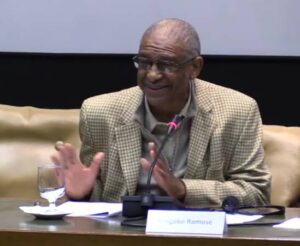
    The opening came from a story rather than a statute, borrowed from the South African philosopher Professor Mogobe Bernard Ramose, who as a child listened to his mother talk about the men who had wanted to marry her before she married his father. The boy began to wonder what would have happened if his mother had chosen differently, and what chain of choices and chances had made his own life possible.

    That childhood wonder was turned toward disability. The question, the presentation argued, is not only whether a person exists, but what kind of existence society offers that person after birth. A person can be counted in a census and left out of a budget, mentioned in a constitution and left out of a classroom, invited to a consultation and ignored in the decision. The physical fact of being alive does not settle whether a person is allowed to live with dignity.

    For context, Prof Magobe Bernard Ramose is a South African philosopher, one of the key thinkers who have popularized African philosophy and specifically Ubuntu philosophy, internationally. He is the professor of philosophy at the University of South Africa in Pretoria.
    From that story came a distinction that stayed with the audience. A person can be legally recognized and still experience a form of social non-existence, because the law says the person belongs while the school, the workplace and the meeting say otherwise. The hall was asked to sit with that contradiction before moving to solutions, because any solution that ignores it will only produce another law that looks good on paper.

    Humanity Is Not Negotiable.

    The next claim followed directly. Persons with disabilities do not need society’s permission to be human, because their humanity is not granted by Parliament, by a court, by a charity or by a community meeting. It is inherent and cannot be taken away by administrative delay. What society must do is organize its institutions, relationships and laws in a way that respects that humanity in practice.

    Here the language of maxims took over, because maxims travel where long definitions cannot. The old Roman axiom was recalled: Ubi jus ibi remedium, where there is a right, there must be a remedy. A right without a remedy is a proverb without a practice.

    The English maxim that has guided courts for centuries was also invoked: justice delayed is justice denied. A quota published late, a ramp promised for next year, a sign language interpreter who never arrives, all belong to the same family of delay. The delay was answered with a mantra, repeated until the hall could carry it home: Humanity is not negotiable under any law.

    That sounds obvious until it is tested against daily life. In much of Africa, a person with a disability still has to negotiate entry into a building, a seat in a taxi, a job interview, a hearing in court, a marriage, and the right to be treated as an adult rather than a perpetual child. No other group is asked to negotiate so hard for what the Constitution already promises without condition.

    The pressure in this part of the speech came from anaphora, the deliberate return to a single verb until its weight could be felt. To beg for a ramp, to beg for a job, to beg for a classroom: the repetition was not accidental, but a device for making the audience hear how a rights-holder is reduced to a supplicant in everyday encounters, and for exposing the indignity of a system that turns entitlement into supplication.

    Once that pressure had built, the release came in a declaration that reset the terms of debate, namely that humanity is not negotiable under any law, and the burden was then shifted with equal clarity, because it is not persons with disabilities who must prove they deserve to belong, but society that must prove it is removing the barriers it built.

    Ubuntu As Law, Not Slogan.

    If humanity is not negotiable, what philosophy should guide the law? For Lubogo, the answer is already African, and it is Ubuntu.

    Ubuntu is often summed up in the maxim umuntu ngumuntu ngabantu, a person is a person through other persons. In public life it has been used so often in speeches, brochures and political rhetoric that it risks becoming empty, and the argument made in Pretoria was that Africa has wasted its most powerful philosophical resource by treating Ubuntu as a slogan for kindness, instead of using it as a legal principle with real consequences.

    The reading offered was direct and practical. Human identity, dignity and personhood are formed through relationships, mutual recognition and shared responsibility. If I am a person through other persons, then my dignity depends on how you treat me, my belonging depends on whether you make room for me, and my humanity is not complete if you exclude me from common life.

    That reading fits the social model of disability. That model does not treat disability only as a medical problem inside a person’s body, because it looks at how inaccessible environments, discriminatory attitudes, institutional practices and social arrangements create exclusion. Put the two together and the conclusion is clear. A society that systematically excludes persons with disabilities is not just being unkind. It is failing in its basic duty to recognize the humanity of all its members.

    For that reason, Ubuntu should become an interpretive principle for legislation, judicial decisions, public policy and institutional conduct. It should not replace the Convention on the Rights of Persons with Disabilities, the CRPD, or the African Disability Protocol.

    It should strengthen how Africa interprets and applies them, and it should give African judges an African language for universal rights, while giving African legislators an African philosophy for African solutions. Africa does not need to import dignity. It needs to apply the dignity it already claims in its own traditions.

    The claim was grounded in African wisdom as well as in law. The hall was reminded of the saying that a single hand cannot nurse a child, and of the proverb that when spiders unite, they can tie up a lion. Both sayings carry the same Ubuntu logic: personhood is collective work.

    They were paired with the legal axiom that the law must follow the person, not the file, because a file can be closed while a person is still waiting outside. The proverbs were not ornaments. They were bridges over the potholes of technical language, allowing judges, chiefs, teachers and activists to meet on the same road.

    The point was made concrete through cases where Ubuntu has already shaped South African law. In S v Makwanyane (1995), Ubuntu featured in the Constitutional Court’s reasoning on human dignity and the rejection of the death penalty. In it informed a humane approach to eviction. In Dikoko v Mokhatla and Everfresh Market Virginia v Shoprite, it informed discussions on reconciliation, good faith and relationships.

    If Ubuntu can be used to abolish the death penalty and to humanize evictions, the question followed, why can it not be used to order a school to build a ramp, to order an employer to provide reasonable accommodation, and to strike down laws that use degrading language?

    What The Law Already Says.

    That test matters because the legal architecture is already in place. The CRPD was adopted in 2006 and entered into force in 2008. It is built around dignity, equality, accessibility, participation and non-discrimination, with Article 5 specifically guaranteeing equality and non-discrimination.

    In 2018, the UN Committee issued General Comment No. 6, which set out inclusive equality through four linked dimensions: redistribution, recognition, participation and accommodation. It addressed not only direct discrimination, but also structural disadvantage, harmful stereotypes, exclusion from decision-making and the denial of reasonable accommodation.

    At continental level, the African Union adopted the African Disability Protocol on 29 January 2018. It entered into force on 3 May 2024 after the fifteenth ratification. Uganda is among the states that have ratified it.

    The Protocol responds to disability challenges within African social, cultural, legal and institutional contexts, including harmful practices, customary law, access to justice, and the recognition of persons with disabilities as both rights-holders and duty-bearers.

    These are real gains, and they came from decades of work by activists, lawyers, organizations of persons with disabilities and their allies. The warning from Pretoria was that celebration without implementation is dangerous, because it creates the appearance of progress while daily life stays the same for the people the laws were meant to serve.

    A July 2026 UNDP policy brief made the same point from a different angle. Despite the Protocol’s entry into force, most African Union member states had yet to ratify it. The brief also pointed to the economic cost of exclusion, estimating potential losses of between 3 and 7 per cent of GDP when persons with disabilities are shut out of labour markets. Exclusion, in that reading, is not only a rights violation. It is also economic self-harm for the whole continent. A ramp costs a fraction of a building, an interpreter costs a fraction of a meeting, and a Braille textbook costs a fraction of an education budget. Here another old maxim did useful work: prevention is better than cure, and a small accommodation today prevents a large injustice tomorrow.

    Uganda: Promise And Gap.

    From the continent, the lens turned to Uganda, and the picture drawn was both hopeful and troubling. Article 35 of the Constitution recognizes the rights of persons with disabilities and places an obligation on society and the state to take appropriate measures to ensure they realize their full potential. Article 78 provides for their representation in Parliament, which gives them a formal voice in law-making.

    The Persons with Disabilities Act, 2020 added further protection. Section 9 prohibits discrimination in employment, requires employers to provide reasonable accommodation where necessary, and provides tax deductions of up to 10 per cent on chargeable income for qualifying employers employing persons with disabilities.

    Section 9(6) then requires the responsible Minister, in consultation with the National Council for Persons with Disabilities and employers’ organizations, to determine the employment quota and publish it through a statutory instrument at least once every two years.

    At the time the presentation was prepared, the statutory instrument needed to make that quota work had not been identified. The point was presented not as an attack, but as an accountability question, because a quota that is never published is not a quota, but a promise deferred, and a right delayed is a right denied in practice.

    The employment data underline the point and give it a human weight. An ILO assessment referencing Uganda’s 2020 disability situation analysis reported that only 34 per cent of young men and 30 per cent of young women with disabilities were employed, compared with 53 per cent and 40 per cent respectively among young men and women without disabilities. These are not just figures on a page, because they are young Ugandans who went to school, qualified, applied, were interviewed and were rejected, not because they lacked ability, but because the system lacked accommodation.

    The audience was asked to test Uganda’s promise against its buildings. How many schools have accessible classrooms, accessible toilets, sign language interpreters, Braille materials or teachers trained in inclusive education? How many district headquarters, hospitals, courts and police stations can a person using a wheelchair enter without being carried? How many roads, taxis, markets, churches and mosques were built with persons with disabilities in mind? Those questions were left unanswered, because the silence that followed was part of the method. This was Socratic questioning, the art of asking a cascade of questions until the listener convicts himself with his own answers.

    Courts: Declaration Without Delivery.

    The same gap appears in the courts, where law often stops at declaration. Purohit and Moore v The Gambia (2003) was examined, in which the African Commission addressed the treatment and indefinite detention of persons with mental disabilities under The Gambia’s Lunatics Detention Act. It was an important affirmation of rights and dignity, but a progressive decision does not automatically dismantle the institutions that caused the exclusion. A judgment that is not implemented is a declaration without delivery, and justice on paper becomes injustice in practice for the person still locked out.

    A similar point was made about Uganda through CEHURD v Attorney General (2015), where the Constitutional Court addressed degrading statutory language relating to persons with disabilities. The case was presented as an illustration of dignity and recognition in judicial reasoning, with the careful clarification that it was not expressly framed as Ubuntu jurisprudence, and the discussion was then linked to litigation concerning inaccessible public buildings, where the argument of limited resources is often raised by the state as a defense for continued exclusion.

    On that argument the position was blunt and unwilling to accept delay as a defense. Resource constraints are real and budgets are limited, but they cannot become a permanent excuse for exclusion. A government that can find money for a new highway, a new stadium and a new office block cannot claim it has no money for a ramp.

    A government that can find money for workshops, travel and allowances cannot claim it has no money for sign language interpreters. When resource constraints are used to justify indefinite exclusion, they stop being an explanation and become discrimination under another name. The principle was summed up with the maxim: what the law promises, the budget must prove, because a budget is a moral document written in numbers.
    The Ubuntu-Inclusive Equality Model.

    From critique, the presentation moved to construction, and the main contribution was the Ubuntu-Inclusive Equality Model, which links African philosophy to the practical obligations in the CRPD and the African Disability Protocol. The model was refused a dry checklist form, because it was presented as a living web where each strand holds the others.

    Redistribution, in this telling, is not charity but duty. Resources, accessible infrastructure, inclusive education, employment opportunities, assistive technologies and support services are not favours a generous state hands out. Under Ubuntu, they are what a community owes its members if every person is to take part meaningfully. A society that builds a school without a ramp has not just made a design error, because it has broken a communal obligation to its own children.

    That duty only makes sense when it is tied to recognition, which must go beyond admitting that persons with disabilities exist and must confront stigma, discrimination, paternalism and harmful stereotypes while respecting dignity, individuality and autonomy in the same breath.

    Recognition, as developed in Pretoria, means seeing persons with disabilities as individuals with aspirations, abilities, choices and contributions, rather than as objects of pity, burdens, perpetual recipients of aid, or problems to be solved, and it means understanding that they are not “the disabled” but persons who happen to be teachers, lawyers, farmers, traders, mothers, fathers, students and leaders, for whom disability is part of experience rather than the whole of identity, so that when you look at a person with a disability, you see a person first and always.

    Recognition without participation, however, turns into performance. Persons with disabilities must not merely be beneficiaries of policies designed by others, because they must actively take part in shaping decisions that affect their lives, including representation in governance, public consultations, legislative processes, institutional leadership and community decision-making. Nothing about us, without us, is not a slogan, because it is a precondition of legitimacy.

    A policy drafted without persons with disabilities is illegitimate, no matter how well-intentioned. A building designed without consulting them will be inaccessible, no matter how modern. A court decision made without hearing them will be incomplete, no matter how learned.

    Holding the web together is accommodation as a reciprocal duty. Reasonable accommodation should not be treated as a special favor or an inconvenience that persons with disabilities must repeatedly justify. It should be recognized as an essential condition of equal membership, and schools, workplaces, public institutions and service providers must organize their environments to accommodate human differences. When a school provides Braille, it is not doing a favor, because it is fulfilling a duty. When an employer provides a screen reader, it is not being generous, because it is being just. When a court provides a sign language interpreter, it is not being kind, because it is being lawful.

    Accommodation is not an extra, because it is equality in action. The insistence throughout was that the strands cannot be separated. Without redistribution, recognition is empty, without recognition, participation is tokenistic, and without participation, accommodation is misdirected.

    Ubuntu Must Protect Autonomy.

    A warning was then added that prevented the model from becoming sentimental. Ubuntu must never be used to override individual rights, justify paternalism, legitimize harmful cultural practices or deny persons with disabilities their legal capacity. This matters in societies where family, clan, elders and community leaders exercise real influence over personal decisions. In many African communities, decisions about where a person with a disability will live, whether they will go to school, whether they will marry, whether they will work and how their money will be used are made by others, often with good intentions, but often without the person’s consent.

    Genuine Ubuntu, the argument ran, must respect the autonomy, will and preferences of the individual. Community responsibility should strengthen personal agency, not replace it. That position fits the CRPD’s emphasis on equal recognition before the law under Article 12 and the importance of supported decision-making. Ubuntu should not become an excuse for deciding on behalf of persons with disabilities, because it should provide a foundation for ensuring they are supported to make and take part in decisions about their own lives. Ubuntu without autonomy is not Ubuntu at all, because it is control dressed in cultural clothing. True Ubuntu liberates rather than imprisons, and it expands freedom rather than narrowing it.

    That section drew quiet recognition in the hall, particularly from activists who have fought paternalism inside families as much as discrimination outside them. It was the presentation at its most careful, defending African philosophy while refusing to let it be used as a shield for abuse within the home.

    What Africa Must Do Next.

    From that warning the lens widened again to the continent. Ghana and Kenya were pointed to as examples of the same pattern. Ghana has a Persons with Disability Act. Kenya has a constitution that guarantees disability rights. South Africa has a White Paper on the Rights of Persons with Disabilities. Yet in all three, persons with disabilities still face inaccessible transport, unemployment, stigma and exclusion. The pattern is continental and the failure is systemic, not accidental.

    The conclusion from those examples was that disability inclusion cannot be achieved through legislation alone. It requires political commitment, financial resources, effective institutions, public accountability and a philosophy that treats inclusion as an obligation rather than generosity. From that diagnosis came priority interventions for Africa’s next decade. African legislatures must establish clear and workable implementation mechanisms, so statutory commitments do not remain dependent on discretionary administrative action. A law without a deadline is a wish, and a quota without a statutory instrument is a mirage that fools no one who needs it.

    Courts and litigators should use Ubuntu as an interpretive principle when enforcing equality obligations. Judges must be willing to say exclusion is not just unlawful, because it is also un-African in the deepest sense. Law reform institutions should strengthen supported decision-making and move away from substitute decision-making that undermines autonomy. No one should lose legal capacity because they have a disability.

    Organizations of persons with disabilities should engage customary and community authorities while safeguarding dignity, participation and autonomy. The conversation must happen in villages, clans, churches and mosques, not just in conference halls in Pretoria. The African Commission on Human and Peoples’ Rights should consider developing interpretive guidance on Ubuntu, the African Disability Protocol and communal responsibility, including recognition of persons with disabilities as duty-bearers, not just recipients, but contributors, leaders and decision-makers in their own communities.

    The Citizenship Test.

    Behind those proposals sits a wider message about citizenship. A person may have the right to education but remain excluded by inaccessible classrooms. A person may possess professional qualifications but remain unemployed because recruitment systems and workplaces are designed without considering disability.

    A person may have the right to take part in public affairs but remain unheard because public institutions fail to provide accessible communication. A person may have the right to health but remain untreated because hospitals have no accessible beds, no sign language interpreters and no staff trained to communicate with persons with intellectual disabilities. A person may have the right to justice but remain unheard because courts have no accessible entrances, no Braille judgments and no accommodations for persons with psychosocial disabilities.

    These realities expose the limits of measuring equality by counting constitutional provisions, legislative reforms or policy declarations. For Lubogo, the true measure of a just society is not how many laws it has passed, because it is whether persons with disabilities can enter public institutions, access essential services, take part in decisions, pursue their aspirations and live without constantly having to defend their humanity.

    That test applies beyond government and reaches into everyday institutions. A bank that builds a branch without a ramp is not just inaccessible, because it is telling persons with disabilities their money is not welcome. A school that refuses a child because of disability is not just discriminatory, because it is telling that child their future does not matter.

    A church that has no sign language interpreter is not just unprepared, because it is telling Deaf congregants their worship does not count. These are not small omissions, because they are daily messages of exclusion that accumulate over a lifetime.

    Parallelism was used here, the same sentence shape repeated three times, to make the moral arithmetic unavoidable. The bank, the school, the church. The money, the future, the worship. The device carried the argument faster than any statistic could, because it moved the audience from institution to institution without losing speed on the rough road of policy debate.

    The audience was not left with despair, because the close offered a programme that moved from institution to institution, refusing to let any sector hide behind another. Parliaments were called upon to publish the quotas, pass the regulations, set the deadlines, allocate the budgets and hold ministers accountable when they fail.

    Courts were called upon to be courageous, to use Ubuntu, to order implementation, to refuse to accept resource constraints as a permanent excuse for discrimination, and to remember that justice delayed is justice denied for the person waiting outside. Employers were urged to stop seeing disability as a risk and start seeing ability as an asset, to provide reasonable accommodation without being begged, and to recruit on merit and not on prejudice. Schools, hospitals and public institutions were urged to audit their buildings, policies and attitudes, and to ask whether a person with a disability can enter, take part and thrive there.

    Communities, families and traditional leaders were called upon to stop making decisions for persons with disabilities and to start making decisions with them, to listen, to respect autonomy, to reject harmful practices and to embrace the true meaning of Ubuntu. Persons with disabilities themselves were called upon to claim their space, to organise, to litigate, to advocate, to lead and to refuse to accept that belonging is a favour to be begged for. Belonging is a right to be claimed by every citizen without apology.

    Postscript From Old Trafford, Two Days Later.

    The conference closed on 6 November. Two days later, on Sunday 8 November, many of those same delegates were watching a very different kind of public theatre at Old Trafford, where a surprisingly struggling Manchester United hosted a fired-up Aston Villa. The timing matters, because the football did not interrupt the message from Pretoria. It confirmed it, after the fact, in a language everyone understands.

    Villa scored twice inside four minutes, United fought back to 2-2, Villa went 4-2 up, and United somehow rescued a 4-4 draw with two goals in stoppage time from Joshua Zirkzee and Patrick Dorgu. The draw left United in the bottom three heading into the international break.

    The humour was not lost on the Pretoria delegates who follow football. United’s defence, they joked, was like a building without a ramp: everybody could see the entrance, nobody could get through it safely, and the manager kept insisting the plan was working. Michael Carrick, who said “we’re making it hard for ourselves” and “we never give up,” sounded like a government spokesperson explaining why a disability law passed ten years ago still has no regulations. Villa fans taunted him, while some United fans had already left early after an anti-ownership protest, only to miss the comeback.

    The joke, if Lubogo had told it, would then have been turned back on the room. United, the punchline would run, at least got a second half. Persons with disabilities are still waiting for the first half to start. A football team can concede twice in four minutes and still be given another chance. A wheelchair user denied a ramp is told to wait for the next budget, the next term, the next government. The difference is that Carrick gets 90 minutes to fix his mistakes. Many citizens get a lifetime of excuses.

    Conclusion: Move Your Feet.

    The presentation brings together constitutional law, international human rights standards, African regional instruments and indigenous philosophy. Its central claim is that Ubuntu should not merely decorate existing human rights instruments with African cultural language. It should help strengthen their interpretation and ensure their promises are reflected in the daily experiences of persons with disabilities across the continent.

    The challenge, therefore, is not simply to enact more laws or produce more policy documents. It is to build societies in which accessibility is normal, participation is meaningful, accommodation is expected, dignity is respected and exclusion is actively challenged by institutions and citizens alike.

    Belonging must not depend on usefulness, participation must not depend on permission, equality must not depend on repeated pleading, and rights must not remain hostage to indefinite postponement. A person with a disability does not need society’s permission to be human, because that humanity already exists and cannot be granted by office or title.

    The responsibility of society is to organize itself in a way that respects, protects and gives practical effect to that humanity. That is the promise of Ubuntu jurisprudence and the challenge placed before Africa’s governments, courts, institutions and communities.

    The question that remains is not whether Africa has the laws, because it has them in abundance. The question is not whether Africa has the philosophy, because it has it in Ubuntu. The question is whether Africa has the will to act on what it already knows. Lubogo believes it does, but will must be proven not in Pretoria conference halls, but in Ugandan classrooms, offices and health centres, in Accra markets and in Kenyan matatus, in every place where a person with a disability still has to fight to belong.

    As the old African saying warns, when you pray, move your feet. Africa has prayed in its constitutions. It has prayed in its protocols. The time has come to move its feet, to build the ramp, to hire the interpreter, to publish the quota, and to open the door. For as another proverb reminds us, a child who is not embraced by the village will burn it down to feel its warmth, and Africa cannot afford to leave any of its children outside in the cold.

    TEU Editor’s Note: This article is based on Lubogo’s conference presentation delivered at the 14th Annual Disability Rights in Africa Conference, University of Pretoria, 5-6 November 2026, with context from the University of Pretoria conference programme, UN CRPD General Comment No. 6 (2018), Uganda’s Persons with Disabilities Act, 2020 (Section 9), the UNDP July 2026 policy brief on the African Disability Protocol, and ILO observations on disability employment in Uganda.

     

  • Jinja Readies for Third Mega Darusu As Khadi Basoga Pushes Unity And Warns School Girls Against Sugar Daddies Trap.

    Jinja Readies for Third Mega Darusu As Khadi Basoga Pushes Unity And Warns School Girls Against Sugar Daddies Trap.

    Hundreds of thousands of Muslim believers from Busoga and beyond are expected to converge on Mvule Crescent in Jinja City on Saturday, 21st November 2026 for the Third Mega Darusu, a full day of Islamic teaching that has grown into one of the largest religious gatherings in Eastern Uganda.

    The event will run from 7:30am to 6:00pm under the theme Unity In Achieving Happiness In Both Worlds, with free entry, breakfast and lunch for participants, and a livestream by Qibla Islamic Media for those who cannot travel to Jinja.

    The announcement was made by Jinja District Khadi, Sheikh Ismail Ada Basoga, during an exclusive interview with The Exposure Uganda at his renovated office at Mvule Crescent, the same ground that will host the gathering.

    From Lubas Road To A Home At Mvule Crescent.

    The office itself tells part of the story of the district. For years, Jinja Muslims hired a small room along Lubas Road to serve as their district office, a room that was squeezed, noisy and difficult to use for any serious conversation.

    People came there for guidance on marriage, family disputes and religious matters, but they found little privacy and little dignity in the place that was supposed to represent them. Sheikh Basoga says he understood the problem the moment he stepped into the office, because the noise from the road made listening difficult and the size made it hard to receive visitors with the respect they deserved.

    He took a radical and strategic decision to move the office to Mvule Crescent. The new office has since been renovated and refurbished into a spacious, quiet and welcoming space where elders can sit and talk, youth can ask questions, women can seek advice in confidence, and visitors from other districts can find the leadership with ease.

    The community now calls the place a home, not just an office, and Sheikh Basoga says the move was about respect for the community rather than about luxury.

    What Darusu Means.

    ‘Darusu’ is a word that many non-Muslims hear but few fully understand. It is the plural of ‘Darasa’, which in school means a lesson, and in Islam means a teaching session where a Sheikh explains what the Quran and Hadith say about belief, worship, family and daily life.

    One Darasa is one lesson, while Darusu is many lessons, and Mega Darusu therefore means a large gathering where many Sheikhs teach many lessons to many people in one day. That is what will happen in Jinja, where the programme will not be a short sermon but a full day of teaching from morning to evening.

    Why Unity Is The Theme.

    Sheikh Basoga says the theme was chosen deliberately because it speaks directly to the reality of Jinja Muslim District, which covers Greater Jinja. Muslims in the district pray in different mosques, follow different Sheikhs and belong to different groups and sects, a division that has weakened the community and made joint planning, support for orphans and widows, and school building more difficult.

    The theme points to the two worlds that Islam teaches about. The first is Duniya, this life, with school fees, rent, business and family responsibilities, while the second is Akhirah, the life after death, where each person will answer for what they did in this life.

    Sheikh Basoga says a Muslim must seek happiness in both worlds, because a person cannot neglect family and community here and still expect mercy there, just as a person cannot chase only this world and forget accountability in the next. His message is that Muslims in Jinja may differ in mosques and groups, but they worship one Allah, follow one Prophet and read one Quran, and unity can therefore bring happiness at home and before Allah, while division risks both.

    Unity You Can Now See In Jinja.

    Sheikh Basoga is quick to point out that unity is no longer just talk, and he credits the progress to the guidance of Allah and to regular engagements that have slowly steadied the followers. He remembers a time when division ran deep, when youth could not pray with elders in the same mosque, when people chose a mosque by group rather than by distance, and when many Muslims could not even greet one another.

    That picture has changed. In the past, a Muslim would see another Muslim and look away, unwilling to say Asalam Alaykum because of petty differences, yet today, when Muslims meet, they greet each other loudly and happily, often in chorus.

    The greeting itself carries deep meaning. Asalam Alaykum means peace be upon you, while the full form, As-salamu Alaykum Wa Rahmatullahi Wa Barakatuh, means peace be upon you, and the mercy of Allah and His blessings. It is more than a casual hello, because it is both a prayer and a promise, in which the speaker says the other person is safe from his tongue and his hand.

    The reply, Wa Alaykum As-salam Wa Rahmatullahi Wa Barakatuh, means and upon you be peace, and the mercy of Allah and His blessings. Sheikh Basoga uses the greeting as a test, because when Muslims stop greeting each other, the heart is broken, and when they greet each other again, the heart has healed.

    He admits the work is not finished, because conflicts will remain due to human nature, politics, money and leadership ambitions. But Jinja Muslims have agreed on one thing, that faith is paramount, that faith is bigger than differences, and that faith is bigger than any individual.

    They can disagree on small issues, hold different views and compete for leadership, but they will not allow those disagreements to stop them from praying together, greeting each other and learning together as one Ummah.

    A Leadership Born In Tension.

    To understand Sheikh Basoga, it helps to go back to 2020, the year he became Khadi. His rise followed weeks and months of tension, because the seat had become envious and contentious, and key players fought over it in a contest that left wounds and broken friendships.

    He found a divided house, where Imams were not talking to each other, mosque committees distrusted the district leadership, young people did not know who to follow, and ordinary Muslims were tired of wrangles. He chose a different path, and he decided he would not heal Jinja through revenge or through attacks on rivals, but through teaching, by returning to Darasa and reminding people that leadership in Islam is a trust from Allah rather than a prize to fight over.

    Mega Darusu grew from that choice. The first edition brought people together, the second brought more, and the third is now expected to draw crowds from Kamuli, Iganga, Mayuge, Bugiri, Luuka, Buyende, Namutumba, Kaliro, Jinja City and Jinja District, together with visitors from Kampala.

    What Will Be Taught On The Day.

    The programme covers the daily life of a Muslim. Teachers will handle Tawhid, belief in the Oneness of Allah, Fiqh, how to perform wudhu, Swalah, fasting, Zakat and Hajj correctly and with understanding, and Akhlaq, character, how to speak truthfully, keep promises, respect parents, love a spouse and raise children with care and discipline.

    They will also teach on family, marriage, youth discipline, leadership and the role of Muslims in building a peaceful Uganda. The speakers include Sheikh Luutu Sulaiman Wandera, the main speaker, Imam Ahmed Kyeyune, Sheikh Hamza Kayiira, Sheikh Shafiq Mafu, Sheikh Burhan Byerimba and Sheikh Omar Mapo, all hosted by Sheikh Basoga.

    He has asked all Imams, Sheikhs, women leaders, youth leaders and ordinary Muslims to attend as students, not spectators, to ask questions and to go home with answers for their homes, marriages and businesses. The event also matters for Jinja City, because hotels, restaurants, transport operators and market vendors will benefit from the visitors.

    Warning For the Long Holiday: A National Crisis Hitting Home.

    The tone of the interview changed when Sheikh Basoga spoke about the long holiday. UCE and PLE candidates are already back home, UACE candidates will soon join them, and thousands of children are now home, many idle, while parents work in gardens, shops and offices.

    Sheikh Basoga warned men who think money gives them a right to exploit school girls. Some give a girl 5,000 shillings, 10,000 shillings, a phone, a chapati or a soda, and believe they have bought her future, yet he called that foolishness rather than manhood.

    He said silence from parents or poverty in a home is not permission. Defilement is a sin before Allah and a crime under Ugandan law, and it carries heavy penalties, including prison. Money and influence cannot shield a man who harms a child, because every act returns to the person who did it, often through his own family.

    His warning is not abstract. It sits inside a dropout and teenage pregnancy crisis that Uganda is now openly calling a national emergency, and Busoga is among the worst hit regions.

    The numbers tell the story. In the latest PLE cohort, more than 1.7 million pupils enrolled for P1 in 2019, yet the Uganda National Examinations Board registered only 920,833 candidates, or 53.8 percent of those who started, for the exams that began this month. A separate analysis of the 2017 cohort found that 2,070,455 pupils started P1, but only a little over 900,000 sat PLE this year, meaning about 1,149,622 children dropped off along the way. Over the last 30 years, more than 12.4 million children have dropped out before P7, according to an analysis of Ministry of Education enrolment figures and UNEB registration data.

    To explain his point, he told a story from the time of Prophet Muhammad, (peace be upon him), recorded in the books of Hadith and narrated by Abu Umamah al-Bahili.

    People often ask who the boy was, but the Hadith gives no name, and it describes him only as a young man, a shabb in Arabic, an ordinary youth from Quraysh who came to the Prophet and asked for permission to commit zina, fornication.

    The companions were shocked and wanted to chase him away, but the Prophet did not chase him. He called him closer, made him sit down, and asked him whether he would like it for his mother, his daughter, his sister and his aunt. The boy answered no to each question, and the Prophet told him that other people feel the same about their mothers, daughters, sisters and aunts.

    The Prophet then placed his hand on the boy’s chest and prayed, O Allah, forgive his sin, purify his heart and guard his chastity. The narrator says the boy left changed, and after that day, there was nothing he hated more than zina.

    Sheikh Basoga says the story speaks to Jinja today, because the girl a man sees in a trading centre is someone’s daughter and someone’s sister, and if another man did the same to his own daughter, he would not celebrate, but would be angry.

    He asked parents to stay alert, to know where their children sleep, who they move with, who gives them money and what they do on phones. He asked them to talk openly about defilement, teenage pregnancy, HIV and school dropout, and to build homes where a child can report a man who approaches her without fear of beating or blame.

    He asked boda-boda motorists, shopkeepers, bar owners and lodge/guest house operators not to help these men, not to rent rooms to men who bring young girls, not to sell alcohol to minors, and not to look away. Such cases should be reported to parents, local leaders, police and religious leaders, because protecting children is the duty of the whole community.

    He urged school girls to value their education and to understand that their bodies are a trust from Allah. They should avoid risky places and avoid gifts from men who want something in return, because a man who truly loves a girl will wait for her to finish school, approach her parents with respect and marry her honorably, while a man who wants her for a few minutes does not love her.

    He urged young men to learn from the story, to understand that desire is natural but must be controlled, and to put their energy into education, work, sports, business and worship. They should respect other people’s daughters as they want their own sisters and daughters to be respected.

    As a final call, Sheikh Basoga closed with an invitation for Muslims to come and learn, to come and unite, and to come and be strengthened. Jinja, he said, can show Uganda that Muslims can sit together, learn together and live together.


  • Justice Wagona Pulls The Plug: Balyeku Petition Dismissed With Costs, Batuwa’s Mandate Affirmed.

    Justice Wagona Pulls The Plug: Balyeku Petition Dismissed With Costs, Batuwa’s Mandate Affirmed.

    He went to court to remove Batuwa, he left paying Batuwa.

    After weeks of courtroom warfare, after affidavits piled upon affidavits, after photocopies, disputed tally sheets, claims of a secret second count and whispers of ballot boxes opened in the dark, the High Court in Jinja has spoken, and it has spoken with a hammer, not a whisper.

    In a 164-page judgment, Justice Vincent Wagona did not merely dismiss Hon Balyeku Moses Grace, he demolished him. Page after page, paragraph after paragraph, exhibit after exhibit, the judge threw out Election Petition No. HCT-03-CV-EP-0003-2026, Balyeku Moses Grace v Batuwa Timothy Lusala and the Electoral Commission, in its entirety and ordered Balyeku to pay the legal costs of both Batuwa and the Electoral Commission.

    It was not a judgment on a technicality, it was a judgment on the merits. The High Court found that Balyeku, the petitioner, failed to discharge the onus probandi, the burden of proving his claims. He failed to meet the statutory threshold set by Parliament under Section 80(1)(a) of the Parliamentary Elections Act. And he failed, fatally, on his own numbers.

    In the language of election law, Balyeku did not prove non-compliance, that election officials broke the electoral law, let alone substantial effect, that any mistake actually changed who won. And where he invited the court to re-compute the outcome, the re-computation enlarged, not erased, Batuwa’s victory. This was not a judicial reprieve for Batuwa, not a lucky escape given by the judge. It was a judicial affirmation of the popular will, the court confirming what the voters had already decided on 16 January 2026.

    Jinja South: The Political Battleground.

    That verdict takes us back to Jinja South Division West, a constituency that has become the centre of national attention. It is no backwater but a bellwether constituency, a seat whose result often shows which way the whole country is leaning. It sits in a city that has become Uganda’s most watched urban political theatre, a former NRM bastion, a former stronghold where the ruling party used to win easily, now contested street by street, parish by parish, by the opposition National Unity Platform.

    Six parishes, 63 polling stations, 32,313 registered voters and nine candidates on the ballot. The Electoral Commission declared Batuwa Timothy Lusala of NUP with 4,900 votes, Balyeku Moses Grace of NRM with 3,083 votes, a margin of 1,817 votes. In electoral arithmetic, a margin of 1,817 in a parliamentary race is not marginal. It is a decisive mandate, a clear instruction from voters that Batuwa should represent them. It is not within the margin of administrative error. It is a political statement.

    Balyeku, however, cried foul. He sought to vitiate the result, to make it legally useless, to have it declared null and void ab initio, void from the very beginning as if it never legally existed, and to have himself declared the duly elected MP or, in the alternative, as a second choice, to have a fresh election ordered.

    His case rested on three pillars. The first was an incomplete tally, that not all polling stations were counted. The second was ultra vires second tally, that the Returning Officer acted beyond her legal power when she allegedly counted again on 6 February 2026. The third was altered results, that the results were changed afterwards, culminating in the Gazette of 2 March 2026, the official government publication where final election results are printed. All three pillars collapsed under judicial scrutiny.

    The Missing Stations And The Man Utd Joke.

    Turning to that first pillar, the claim of missing stations, the court found a story very different from the one Balyeku told. His headline claim was seductive in its simplicity: ten polling stations were excluded, and those ten would have flipped the seat. He listed Rippon Nile Avenue Gardens, Mvule PMM Secondary School, Ambercourt St John Church, Kimaka Glory Be to God Church East, St Gonzaga Catholic Church, National Housing Destitute Home Kateyamba Centre and four others in Nalufenya. He argued that with all ten, he would win by 1,030 votes. With only four, he would still win by 18 votes.

    It was a counterfactual, a what-if argument based on what might have happened, built on speculation. The court treated it as such. And here Balyeku’s what-if deserves a football translation, because Jinja understands football better than it understands election law.

    His argument was exactly the famous TikTok joke among Manchester United fans today. You have heard it. You have laughed at it. It goes like this: If Arsenal lose all their remaining games, and if Man City lose all their remaining games, and if Man United win all their remaining games, then Man United can easily take the trophy.

    On TikTok, it is comedy. In court, Balyeku tried to make it jurisprudence, a serious legal argument. The logic is the same. The fantasy is the same. If this happens, and if that happens, and if the other thing also happens, then I win. It is mathematics built on miracles.

    It is a title challenge built on other teams collapsing. Just like United fans know deep down that Arsenal and City are not going to lose every game, the court knew that Balyeku’s ten stations were not going to deliver him a miracle. A what-if is not evidence. A TikTok joke is not a tally. And a court, unlike TikTok, does not award trophies for imagination.

    Justice Wagona found that the evidential record supported the exclusion of only four stations, not ten. And crucially, the reason for exclusion was not conspiracy but administrative default, officials simply failing to deliver results to the tally centre. That is maladministration, poor management and mistakes by officials, not malpractice, deliberate cheating. In election jurisprudence, the way courts have interpreted election law over time, the distinction is everything. Maladministration does not ipso facto nullify an election, it does not automatically cancel an election just because it happened. Malpractice, if proved to have substantially affected the result, might.

    At St Gonzaga, the failure was even more profound. The original blank Declaration of Results Forms, the official forms on which polling station results are written and signed, disappeared before completion. Police opened Kiira Central Division CRB No. 223/2026. Electoral materials were impounded, seized and kept by police. No results were ever recorded. You cannot add what was never recorded. You cannot claim victory from a vacuum.

    The Phantom Second Tally.

    From the missing stations, the story moves to the most explosive allegation of all, the alleged secret second count. The most incendiary allegation was that of a clandestine re-tally, a secret recount done in hiding, that the Returning Officer, acting ultra vires, beyond the power the law gave her, and without jurisdiction, without legal authority, reopened ballot boxes on 6 February 2026 and manufactured a new result after Batuwa had already been declared.

    If proved, that would have been a constitutional anathema, something totally unacceptable under the Constitution, a direct assault on the sanctity of the ballot, on the trust that must protect every vote. But the petitioner offered no direct evidence. No eyewitness. No impounded ballot box. No chain of custody broken on record. What he offered was hearsay upon hearsay, rumour built on rumour, an unrecorded telephone conversation whose date he could not recall.

    Batuwa and the Electoral Commission, the respondents defending the case, countered with a coherent, contemporaneous account, a clear story that matched what happened at the time. They said the figures announced at 6:45 p.m. on 16 January were provisional, temporary and not final, a running tally. The final declaration was at 9:45 p.m., on 59 stations. The 6 February document was not a fresh tally but an administrative copy, just a photocopy for office filing, of a return already printed on 22 January.

    Justice Wagona accepted that account. He found as a fact that there was one final declaration, and only one. In legal terms, the allegation of a second tally was not proved on a balance of probabilities, not proved to be more likely true than not, let alone to the heightened standard required in election petitions where allegations verge on criminality. The court will not nullify a parliamentary mandate, it will not cancel the authority voters gave to an MP, on the strength of a phone call the petitioner cannot date.

    Where The Case Died: The Documents.

    From that phantom tally, the judgment then turns to where the case truly died, in the documents themselves. Here the judgment turns from political drama to forensic demolition, to a careful, piece-by-piece destruction of the evidence. Election petitions are won or lost on primary evidence, the original, first-hand proof.

    The Declaration of Results Form is the sacred text of the polling station. It is a public document. Secondary evidence, copies like photocopies, is admissible, allowed to be used in court, only if a proper foundation is laid, only if the person explains legally why the original is not available. Balyeku laid no such foundation.

    On the affidavits, the written sworn statements of witnesses, Wagona was generous. He rejected Batuwa’s argument that identical paragraphs rendered affidavits defective. Similarity of language, he held, goes to weight, how much the judge trusts it, not admissibility, whether the court is allowed to look at it at all, where personal knowledge is shown. The affidavits survived. The documents did not.

    The court expunged the uncertified photocopies, it removed them completely from the court record as if they were never presented, of DR Forms, tally sheets and return forms. Why? Because the petitioner failed to produce the originals or explain their absence in law. Worse, his own witnesses conceded under cross-examination, when they were questioned toughly by the other side’s lawyers, that the originals remained in their personal custody, yet were never produced despite challenge. That is evidential suicide, killing your own case by hiding your best proof. In the eyes of the court, it invites an adverse inference, the judge is allowed to assume the hidden evidence would have hurt your case.

    Then came the serial numbers. Per the Commission’s official packing list, each DR Form bore a unique distinguishing serial number, a special number that should be different for every polling station so forms cannot be confused or duplicated. The photocopies tendered by Balyeku’s witnesses bore identical serial numbers for the same stations. Identical serials, different witnesses and same stations.

    Justice Wagona called it what it was: a grave reliability concern. The foundation of Balyeku’s alternative arithmetic, his 1,030-vote victory, his 18-vote victory, was built on documents the court could not trust and would not admit. Once expunged, there was nothing left to compute. The petition was bereft of documentary substratum, left with no documentary base to stand on.

    But Justice Wagona did not stop at expungement. He did what a thorough election court must do: he tested the petitioner’s hypothesis against the best available evidence. That evidence came, ironically, from Batuwa, certified DR Forms, forms officially stamped and confirmed as true copies, properly admitted, properly proved.

    At Rippon Nile Avenue Gardens, Balyeku got 43 votes, Batuwa got 81. At Mvule PMM Secondary School, Balyeku got 35, Batuwa got 77. At National Housing Kateyamba Centre, Balyeku got 39, Batuwa got 64. In total, Balyeku got 117, Batuwa got 222. The three stations Balyeku claimed as his reservoir of stolen votes, his secret store of votes that would save him, delivered a two-to-one verdict for Batuwa.

    The court then performed the re-computation. The declared result was Batuwa 4,900, Balyeku 3,083, margin 1,817. The adjusted result, after adding the three stations, was Batuwa 5,122, Balyeku 3,200, margin 1,922. The margin widened by 105 votes. This is the locus classicus, the classic example that lawyers will quote in future, of a petition defeating itself. The petitioner asked the court to add the missing votes. The court added them. The petitioner lost by more. It was, in political terms, a self-inflicted wound. In legal terms, it was conclusive proof of no substantial effect, final proof that the mistakes did not change the winner.

    The Law Is Unforgiving.

    From the numbers, the judgment then moves to the law itself, and the law is unforgiving. Justice Wagona anchored his reasoning in Section 80(1)(a), Parliamentary Elections Act, the high watermark, the highest standard a petitioner must reach. The section does not ask: Were there errors? It asks: Did the non-compliance substantially affect the result? Did the mistakes actually change who won? Procedural irregularity, a small mistake in following procedure, without substantial effect, is legally sterile, it cannot produce any legal result, it cannot cancel an election.

    The court found that candidates and agents were present at the tally centre, results were read aloud, objections were entertained. The process was transparent, open for all to see, even if imperfect. It distinguished the authorities, it showed why previous court decisions were different, relied on by Balyeku, Apollo Kantinti v Sitenda Sebalu and Wakayima Musoke Nsereko v Kassule Robert Sebunya, on the ground that those cases involved large numbers of affected voters and omitted results capable of placing the margin in serious doubt, capable of making people genuinely unsure who won.

    Here, the omitted results were known, proved, and they fortified the declared winner, they made Batuwa’s victory even stronger. There was, therefore, no basis to invoke Section 82, no legal reason to use that section, to set aside the election, to cancel it. The petition had to fall.

    That brings us to the orders, and the orders were short, sharp and final. The court made two consequential orders. First, petition dismissed in its entirety, the whole case thrown out completely. Second, petitioner to pay costs to both respondents, Balyeku must pay the legal bills of Batuwa who was represented by his fellow NUP bed fellow Hon Abed Nasser Mudiobole and the Electoral Commission represented by Okello Oryem. Costs, as every practitioner knows, follow the event, the loser pays the winner’s costs, unless there are special circumstances, special reasons to do otherwise.

    Unforunately, Justice Wagona found none. The petition had consumed extensive affidavit evidence, numerous witnesses, voluminous exhibits, a huge amount of documents, and detailed submissions. The petitioner who forces that expenditure and fails must bear it.

    This is not mere punishment. It is a deterrent signal, a warning to others, to future litigants, people who want to bring similar cases: do not come to court with photocopies and phone calls and expect to overturn the people’s verdict, the decision voters made.

    The Political Fallout.

    And so we come to the political fallout, because this was never just a court case. It was a political earthquake in Jinja. For Batuwa Timothy Lusala, this is total vindication, complete clearing of his name. His mandate is no longer merely declared. It is judicially affirmed, confirmed by a court. He enters Parliament not under a cloud, not under suspicion, but under a court seal, with the authority of the judiciary behind him.

    For the NRM in Jinja, this is a double defeat, electoral in January, judicial in November, and a financial liability in costs. It raises an uncomfortable intra-party question, a difficult question inside the party itself: was this petition a genuine pursuit of justice, or a face-saving litigation, a court case filed just to save face and appease a bruised base, to calm disappointed supporters?

    For the Electoral Commission, this judgment is a full vindication. When a court upholds a declaration after a full trial, after 164 pages of scrutiny, after testing every allegation of a second tally and every disputed form, the Commission’s image is not damaged, it is strengthened.

    Its tally is confirmed, its declaration is confirmed, and public trust in its work is reinforced, not weakened. The Commission walks out of Jinja with its credibility intact, its process validated, and its authority to declare results for Jinja South Division West affirmed by the High Court.

    For Jinja South Division West, the ruling brings legal certainty, everyone now knows legally who the MP is, and political closure, the political fight is over. No fresh tally. No by-election, no new election to fill the seat. No Gazette cancellation. The constituency can now move from litigation, from fighting in court, to representation, to being served by its MP, from courtroom to service delivery.

    In the end, this judgment will be cited for years, not because it is novel, new and strange, but because it is orthodox, it follows the traditional, accepted rules of election law, a masterclass in election law orthodoxy. It restates three immutable principles, three rules that cannot be changed. First, he who alleges must prove. If you make a claim, you must prove it.

    The burden never shifts. Second, photocopies are not proof. Without foundation, without originals, without unique serials, they are inadmissible chaff, useless material the court cannot use. Third, arithmetic is destiny. In the end, the numbers decide.

    If your missing stations give your opponent more votes, you have no case. Balyeku came to court alleging a stolen election, claiming the election was taken from him unfairly. He left with a court finding that, if anything, the election had under-counted his opponent’s win, the official count had actually given Batuwa fewer votes than he deserved.

    From Tears To Tears: The Winter Continues.

    And here, the story turns from law to the human tragedy of a political career caught in a long winter. For Balyeku Moses Grace, this ruling does not just end a petition. It extends his political darkness and coldness for another five years, five more years in the political cold, outside Parliament, outside power, outside the room where decisions for Jinja South Division West are made.

    It is a darkness he knows too well, because he has been here before. Way back in 2021, on this same political pitch, in this same constituency, against this same opponent, he suffered his first uncontested defeat, a defeat that was clear and not seriously disputed, a loss that sent him into tears then.

    Now, in 2026, history has repeated itself, only crueler. Then, he lost at the ballot. Now, he has lost at the ballot and at the bar, both in the election and in court before lawyers. Then, he wept for a lost seat. Now, he must weep again, and pay for weeping.

    For it is from tears to tears, from one sorrow to another sorrow without a break. From the tears of January, when the voters rejected him, to the tears of November, when the judge rejected his petition. And this time, the tears come with a bill.

    He must now part with millions of cash, millions of shillings in legal costs, to his most fierce and bitter rival, to Batuwa Timothy Lusala, the man who has beaten him twice, the man he went to court to remove, the man he must now pay. That is the ultimate political humiliation, the deepest shame in politics: to fund your conqueror. To lose the seat, lose the case, and then pay the winner for the privilege of losing.

    In Jinja’s political folklore, in the stories people will tell for years, this will be remembered as the petition that proved Batuwa won twice, once at the ballot box, once at the bar, once in the election and once in court before lawyers. It will be remembered as the day the court did not just confirm a winner, it closed a chapter.

    It will be remembered as the day Balyeku learned that you cannot win in court what you have already lost at the ballot, and you cannot buy back with photocopies what the people have already taken away with votes.

    Batuwa stays. Balyeku pays. The seat is settled. And for Balyeku, the winter continues for another five years, longer, colder, and now, more expensive than ever before.

    Source Note: Based on the judgment in Balyeku Moses Grace v Batuwa Timothy Lusala and the Electoral Commission, HCT-03-CV-EP-0003-2026, delivered by Justice Vincent Wagona, 5 November 2026. Allegations are distinguished from findings. No independent verification beyond the supplied judgment.

    We Expose, You Decide.

  • Rwakakamba Vs Kiyingi, When Two Protagonists Spit Fire: Pressure Group or Presidential Ambition Machine? The Debate Uganda Cannot Avoid.

    Rwakakamba Vs Kiyingi, When Two Protagonists Spit Fire: Pressure Group or Presidential Ambition Machine? The Debate Uganda Cannot Avoid.

    From The Exposure Uganda (TEU) Newsroom.

    At The Exposure Uganda (TEU), we have been following with keen interest the issues surrounding the ongoing endorsements, the debate around the Patriotic League of Uganda (PLU), and the constitutional questions that continue to arise from them.

    This is a debate that has not stayed in one place. It has moved from opinion pages to WhatsApp groups, to radio talk shows, to newsrooms, to Parliament corridors, to homes across the country. Some Ugandans discuss it openly. Others discuss it quietly. Others choose not to discuss it at all. That in itself tells us how sensitive, and how important, this conversation has become.

    At the center of the latest round of this debate are two voices.

    On one side is Morrison Rwakakamba, who wrote in The Independent on 3 November 2026 defending the UPDF Chief of Defense Forces (CDF) General Muhoozi Kainerugaba, fondly referred to as “Gen MK” and the Patriotic League of Uganda (PLU).

    Rwakakamba who is the CEO of Prescot 15 Investment Advisory and immediate former chairman URA, argues that PLU is a lawful pressure group, that Gen Muhoozi enjoys constitutional freedoms of association and expression, and that the legal gaps in Uganda’s electoral and party laws require political dialogue rather than judicial intervention.

    On the other side is Hon Asuman Kiyingi, senior advocate, former Member of Parliament (Bugabula South in Kamuli district), former Cabinet Minister and former Deputy Chairperson of the Leadership Code Tribunal.

    His argument is that the classification of PLU as a pressure group does not answer the military question, that Article 208(2) requires the UPDF to remain non-partisan and subordinate to civilian authority, and that Uganda needs an authoritative judicial interpretation alongside genuine national dialogue.

    TEU, a revolutionary digital news platform does not take a side in this exchange. Our role is to ensure that Ugandans have access to the full arguments, in full, so that each reader can judge for themselves.

    What follows below is Hon Kiyingi’s rejoinder to Rwakakamba, reproduced verbatim, in his own words, without editing or summarizing.

    We invite you to read it in full, and to follow this debate with us as it continues to unfold.

    READ ON VERBATIM:

    Rwakakamba’s Civilian-Clothes Constitution: Why Military Law Cannot Be Suspended For Muhoozi.

    Constitutional freedoms do not exempt serving military commanders from non-partisanship. Morrison Rwakakamba’s defense of General Muhoozi Kainerugaba confuses civic association with military immunity, presidential awareness with constitutional compliance, and political dialogue with the enforcement of existing law.

    By Asuman Kiyingi

    Morrison Rwakakamba’s response to my article, published in The Independent on 3 November 2026 under the title “Kiyingi’s sweeping claim against Muhoozi seeks to mask gaps in the law and electoral institutions”, advances an extraordinary constitutional proposition: that Uganda’s serving Chief of Defense Forces (CDF) may direct nationwide presidential succession mobilization without violating military neutrality, provided the vehicle is described as a civic pressure group operating outside military establishments and command.

    His defense rests on three propositions: that the Patriotic League of Uganda (PLU) enjoys statutory exemption as a pressure group; that General Muhoozi Kainerugaba exercises constitutional freedoms independently of his military command; and that supposed legal ambiguities require political dialogue rather than judicial intervention.

    None answers two fundamental questions. Is General Muhoozi a serving member of the Uganda Peoples’ Defense Forces (UPDF)? If so, can he lawfully direct partisan presidential mobilization while remaining bound by Article 208(2) and military legislation?

    Rwakakamba, who has publicly identified himself as a patriotic cadre, is entitled to defend PLU. But political affiliation cannot substitute for constitutional reasoning. His accusation that my arguments are sweeping is misplaced when his defense separates legal provisions that must be interpreted together.

    The controversy is not whether soldiers possess constitutional rights or pressure groups may lawfully exist. It concerns whether those freedoms authorize conduct incompatible with military obligations.

    A Pressure-Group Exemption Is Not Military Immunity.

    Rwakakamba relies heavily on section 1(2) of the Political Parties and Organizations Act, Cap. 178, which excludes pressure groups and civic organizations from the statutory definition of political organizations.

    Section 1(1) defines political organizations by their objectives, while section 1(3) recognizes pressure groups seeking to influence public opinion and government action.

    Political advocacy alone therefore cannot disqualify PLU from being a pressure group. Its objectives, structures and activities require examination, particularly its mobilization for a named presidential successor.

    But Rwakakamba overlooks a fundamental distinction.

    Even assuming PLU is a lawful pressure group, its classification does not automatically authorize a serving military commander to direct its partisan activities.

    Section 16 restricts participation by Defense Forces members in political parties and organizations. Its application to PLU raises questions concerning the organization’s legal character.

    Independently, Article 208(2) requires the UPDF to remain non-partisan, national, patriotic, regular and professional, and subordinate to civilian authority.

    That constitutional obligation cannot be displaced by an organizational exemption under ordinary legislation.

    A familiar interpretive principle captures the danger: Quando Aliquid Prohibetur Ex Directo, Prohibetur Et Per Obliquum, a Latin for ‘what the law prohibits directly cannot be accomplished indirectly’.

    (Editor’s Note: For example, if the law says you cannot enter a house through the front door, you cannot climb in through the window and say you did not use the front door. In a nutshell if the law says a serving General cannot run a presidential campaign, he cannot run it through a pressure group and say he did not run as a general).

    Rwakakamba disagrees and says this maxim does not create a new prohibition. He says you cannot use a Latin saying to invent a crime where the statute does not forbid it.

    Kiyingi replies in his rejoinder:

    The maxim does not invent prohibitions. It prevents established restrictions from being defeated through artificial changes of form.

    If particular partisan activities are prohibited to a serving commander, conducting them through a civic pressure group does not automatically make them lawful.

    The law must examine substance, not merely labels. The maxim does not invent prohibitions. It prevents established restrictions from being defeated through artificial changes of form.

    If particular partisan activities are prohibited to a serving commander, conducting them through a civic pressure group does not automatically make them lawful.

    The law must examine substance, not merely labels.

    Constitutional Rights & Military Obligations.

    Rwakakamba invokes Articles 29 and 38, protecting expression, association and political participation.

    These rights are fundamental but operate within the Constitution as a whole.

    Article 43 permits lawful limitations justified by the rights of others and the public interest, provided they are acceptable and demonstrably justifiable in a free and democratic society.

    Article 208(2) establishes military non-partisanship, while Article 210 authorizes Parliament to regulate military organization and discipline.

    The objective is not to extinguish soldiers’ citizenship but to prevent the coercive institutions of the state from becoming instruments of partisan competition.

    An ordinary soldier expressing a political opinion is not equivalent to the CDF directing a nationwide movement promoting his presidential succession.

    Rwakakamba’s suggestion that Muhoozi acts exclusively in his private capacity whenever he wears civilian clothes is untenable.

    Military obligations arise from continuing military status, not the uniform worn.

    The UPDF Act, Cap. 330, provides the statutory framework for military service and discipline. Section 97 addresses relevant restrictions concerning political office and military service.

    The distinction between formal presidential nomination and preceding political mobilization is important.

    Rwakakamba argues that Muhoozi has not presented himself for nomination. But presidential campaigns do not begin when nomination papers reach the Electoral Commission.

    Political structures, endorsement campaigns and mobilization networks are established much earlier.

    If military neutrality became enforceable only upon formal nomination, a serving commander could organize an entire presidential campaign while retaining military command, retiring shortly before nomination.

    That interpretation would severely weaken Article 208(2).

    The question is whether Muhoozi’s present activities comply with military law, not whether he is already a nominated candidate.

    What The Courts Actually Decided.

    The Supreme Court’s decision in Attorney General v Major General David Tinyefuza, Constitutional Appeal No. 1 of 1997, is instructive.

    The Court considered whether Tinyefuza had ceased being a soldier following his appointment as Presidential Adviser and attempted resignation.

    It rejected the proposition that military status could terminate independently of applicable legal procedures.

    Military membership and accompanying obligations are determined by law, not an officer’s preferred description of his position.

    Although Tinyefuza did not determine whether a serving CDF could chair a presidential pressure group, it undermines the suggestion that military obligations disappear whenever an officer claims to act privately.

    The Tumukunde litigation addressed military status, constitutional rights, parliamentary representation and military discipline.

    More directly, in Kasozi and Others v Attorney General, the Constitutional Court rejected partisan political activity “within the army”.

    Rwakakamba construes that formulation as though the prohibition ends at the barracks gate.

    That is an artificial geographical interpretation of an institutional constitutional obligation.

    Military non-partisanship concerns the character and conduct of the institution and its members, not merely where activities occur.

    Neither Tumukunde nor Kasozi establishes unrestricted partisan freedoms for serving commanders outside military installations.

    Nor does Article 78, providing for UPDF representation in Parliament, authorize serving officers to direct presidential succession campaigns.

    Constitutionally authorized parliamentary representation cannot become unlimited partisan political liberty.

    Museveni’s Letter: The Smoking Gun Rwakakamba Misreads.

    (Editor’s Notes for context: Why Kiyingi Calls M7’s Letter A Smoking Gun.

    Kiyingi is not saying Museveni confessed to a crime, rather he is saying Museveni’s letter of 11th October,2026 to the NRM CEC is the smoking gun because:

    It acknowledges PLU is mobilizing for MK’s presidency in 2031, it invites the CEC to discuss MK’s suitability and it also proves that the organized succession mobilization around the serving CDF had reached the Commander-in -Chief himself.

    In Kiyingi’s words: “It establishes presidential awareness and organized political direction not by itself, criminal liability”. So, the smoking gun is not proof of guilt, it is proof of awareness and organization.

    Rwakakamba says Kiyingi misread the letter, Kiyingi says Rwakakamba misses the point-because the letter itself is the proof that this was not just supporters acting alone.)

    Rwakakamba accuses me of mischaracterizing President Museveni’s letter of 11 October 2026 to the NRM Central Executive Committee.

    Yet the letter acknowledges PLU’s mobilization for Muhoozi’s presidency in 2031–2036 and invites consideration of his suitability.

    Its significance is not that the President confessed to a criminal offence.

    It establishes that organized succession mobilization surrounding Uganda’s serving CDF had reached the Commander-in-Chief and become a matter for deliberation within the ruling party’s highest leadership.

    Subsequent developments reinforce its importance.

    On 29 October, Muhoozi directed PLU members to concentrate on presidential endorsements rather than discussing his father’s CEC paper. On 31 October, PLU Secretary General Twalla Fadil issued instructions attributed to Muhoozi concerning digital endorsements, regional and district structures and registration of political cadres.

    These developments challenge Rwakakamba’s suggestion that PLU mobilization consists merely of unsolicited enthusiasm by independent supporters.

    The smoking gun establishes presidential awareness and organized political direction—not, by itself, criminal liability.

    Why has the Commander-in-Chief not confronted the implications for military neutrality?

    Presidential awareness, political accommodation or institutional silence cannot confer legality upon unconstitutional conduct.

    When Private Politics Intrudes Into Public Power.

    Rwakakamba’s private-capacity defense becomes less convincing when tested against Muhoozi’s interventions in civilian governance.

    Consider his public declaration that PLU would approve new Resident District Commissioners.

    Article 203 vests RDC appointments in the President. A civic association may recommend candidates. But what constitutional authority permits PLU, under the serving CDF, to claim an approval role in presidential appointments?

    Consider also the reported ultimatum to Hon Justine Nameere, State Minister for Local Government.

    Following statements allegedly attributed to her and considered derogatory to the CDF, Muhoozi reportedly demanded an apology and threatened her with dismissal.

    Article 113 establishes the framework for appointing ministers, while the Constitution regulates termination of ministerial appointments. The CDF possesses no independent constitutional authority to dismiss a minister.

    These incidents cannot be explained away as private civic advocacy.

    They raise serious questions about military influence over civilian executive authority.

    A pressure group may lobby government. It cannot acquire constitutional powers over public appointments or ministerial tenure.

    This is precisely why civilian supremacy matters.

    The ULS, Constitutional Litigation & Foreign Examples.

    Rwakakamba attacks the Uganda Law Society’s Executive Order RNB No. 13 of 2026, arguing that the Society has assumed prosecutorial powers.

    Calling a legal opinion an Executive Order does not make it binding.

    The ULS cannot prosecute by proclamation or exercise the Director of Public Prosecutions’ constitutional powers.

    But its statutory mandate permits it to identify constitutional concerns, advise government and call upon competent authorities to act.

    Recommending investigation or prosecution is not itself prosecution.

    Article 137 separately provides for resolving questions requiring constitutional interpretation.

    A properly constituted petition concerning Article 208(2) does not usurp the DPP’s powers.

    Neither does the dismissal of Male Mabirizi’s private criminal complaint establish that Muhoozi’s PLU activities comply with the Constitution.

    Criminal liability and constitutional compliance involve different legal questions.

    Rwakakamba’s objection to judicial intervention mistakes constitutional adjudication for political persecution.

    His comparative examples fare no better.

    United States Department of Defense Directive 1344.10 distinguishes permissible personal political expression from restricted partisan campaign activity by serving military personnel.

    Kenya’s Constitution, under Article 239(3), similarly restricts partisan conduct by national security organs and their members when exercising official functions.

    These examples distinguish citizenship from partisan military involvement.

    Egypt’s military-led development, which Rwakakamba praises, cannot determine Uganda’s constitutional obligations.

    Economic performance does not override Article 208(2).

    Welcome Dialogue, But Not Militarized Succession.

    Rwakakamba invokes the Consociational Democracy Agreement (CDA) associated with General Salim Saleh and Professor Ogenga Otunnu as an alternative to constitutional litigation.

    I welcome serious national reconciliation initiatives.

    Having recently obtained a substantial document containing the CDA’s proposed dialogue framework, which I am yet to examine fully, I recognize that it deserves informed engagement.

    However, important questions remain. How does the CDA relate to the National Consultative Forum and the Inter-Party Organization for Dialogue (IPOD)?

    How will civil society, religious and cultural institutions, academia, professional associations, women, youth, organized labour, business and communities beyond established political elites participate?

    Who will determine representation, control the agenda and guarantee independence?

    The CDA should become part of transparent, inclusive national dialogue culminating in a genuinely representative National Conference.

    Such a conference must confront constitutional reform, civilian supremacy, electoral credibility, judicial independence, accountability, federalism, decentralization and peaceful political transition.

    Above all, dialogue must not become a political cover for legitimizing a predetermined militarized Muhoozi succession.

    National reconciliation cannot be purchased by sacrificing constitutional principles.

    Political negotiations and constitutional accountability are complementary, not competing obligations.

    The Choice Between Military Command And Partisan Ambition.

    The controversy is not hostility towards Muhoozi or opposition to his future presidential ambitions.

    The Constitution does not disqualify a citizen merely because he is the President’s son or has served in the military.

    But political ambition must operate within the law. Muhoozi cannot claim the advantages of military command while treating its constitutional obligations as optional during partisan mobilization.

    Rwakakamba’s defense asks Ugandans to accept that a serving CDF may direct a presidential succession movement privately while its institutional implications remain legally irrelevant.

    That proposition is constitutionally unsustainable.

    PLU’s classification as a pressure group does not settle the military question. Presidential awareness does not confer constitutional immunity. Nor can dialogue substitute for judicial determination of existing legal obligations.

    Uganda requires authoritative judicial resolution alongside genuine national dialogue capable of producing a broader political settlement.

    Our constitutional history warns against confusing military authority with political entitlement.

    Military law does not end at the barracks gate. The Constitution does not change when the Chief of Defense Forces changes his clothes. And what the law prohibits directly cannot be legitimized indirectly through a political pressure group.

    The writer is a senior advocate, former Member of Parliament, former Cabinet Minister and former Deputy Chairperson of the Leadership Code Tribunal.


  • Archbishop Bagambaki Mugume Preaches Moriah: When the Promise Becomes the Sacrifice.

    Archbishop Bagambaki Mugume Preaches Moriah: When the Promise Becomes the Sacrifice.

    If theology is ‘Faith Seeking Understanding’, then philosophy is ‘the language’ in which it learns to think, because without philosophy, theology can only repeat what it has heard, whereas with philosophy it can ask why it is true, what it means, and whether it can hold together when it is placed under pressure.

    It was on that mountain of reasoned faith that the Ecclesiastical Patriarch of the Five-Fold Episcopal World Federation (FFEWF) built his latest sermon, in which he argued that God does not test a man before blessing him but after blessing him, precisely to discover whether he loves the gift more than the Giver.

    +The Most Rev. Archbishop Elect Professor Mugume Bagambaki Richard, who is also Archbishop of Upper City Covenant Churches (UCCC) and President and Chancellor of UCCSAT University, preached from Genesis 22:1-24 under the theme The Mountain Where God Will Provide — When the Promise Becomes the Sacrifice, a text he described as the hardest chapter in the Bible because it moves without warning from laughter to silence.

    Genesis 21, he told the congregation, is laughter, for Isaac is born, the covenant at Beersheba is sealed and a tree is planted, while Genesis 22 is silence, for God says, kill the laughter. If Genesis 20 tested Abraham’s integrity and Genesis 21 tested his family, he said, Genesis 22 tests his faith itself, which is why in Hebrew tradition the chapter is called The Akedah — The Binding, the most sacred chapter for Jews and the most prophetic for Christians.

    The Language Behind The Sermon.

    Before he climbed Moriah with the congregation, Archbishop Mugume paused to lay the foundation on which the whole sermon would stand, because the story of Abraham cannot be understood by feeling alone. It needs a language that can carry it.

    Theology, he explained, is the study of God as He has revealed Himself in Scripture, in creation, in history, and supremely in Jesus Christ. The word itself comes from theos, meaning God, and logos, meaning word, reason, or discourse, so theology is literally reasoned speech about God. It is faith seeking understanding, which means it takes what God has said and asks what it means, how it fits together, and how it should shape the way we live.

    Philosophy, by contrast, is the love of wisdom, from philo, meaning love, and sophia, meaning wisdom. It is the disciplined art of asking the deepest questions clearly: What is true? What is real? What is good? What is logical?

    Philosophy trains the mind to define terms before debating them, to distinguish ideas that look alike but are not the same, and to test whether a belief can survive its own contradictions. Where theology supplies the revelation, philosophy supplies the reasoning.

    When we say, therefore, that philosophy is the language of theology, we mean that theology cannot speak clearly without it, because revelation always arrives in human words, and human words need definition, logic, and order if they are to carry divine truth without distortion.

    Theology says God is love, and philosophy asks what love means, how it differs from sentiment, and how it can be both just and merciful at the same time. Theology says God tested Abraham, and philosophy separates a test from a temptation, showing that a temptation pulls a man down in order to destroy him while a test pulls the truth out of him in order to reveal him.

    That distinction became the key to the whole sermon, for to confuse a test with a temptation is to misread Moriah entirely.

    Where Is Moriah?

    A central part of the sermon was historical geography, and Archbishop Mugume traced Abraham’s journey from Beersheba in southern Israel to Moriah, a distance of about 80 to 90 km to the north, which on foot, with a donkey, with wood and with a young man, amounts to exactly a three-day journey, matching Genesis 22:4, where Abraham lifted up his eyes on the third day and saw the place afar off.

    He identified Moriah today as Temple Mount –Haram al-Sharif -in the Old City of Jerusalem, Israel, and he cited 2 Chronicles 3:1 as proof, where Solomon began to build the house of the LORD at Jerusalem in Mount Moriah, where the LORD had appeared unto David his father.

    Today, he noted, that site holds the Dome of the Rock, which Jewish tradition holds to be the rock on which Abraham bound Isaac and which Muslim tradition holds to be the place from which Mohammed ascended, while the same Moriah range includes Calvary (Golgotha), where Jesus carried His cross.

    “The mountain Isaac carried wood up is the same mountain Jesus carried His cross up,” the archbishop said, adding that some scholars believe Isaac was bound on the exact spot where Jesus would later be crucified. He explained the name Moriah as coming from Moreh (Teacher), Yah (Yahweh), Ra’ah (to see) and Yireh (to provide), a meaning confirmed in Genesis 22:14 as YHWH Yireh — The LORD Will Provide / Will Be Seen.

    A Test After Blessing.

    Theologically, the Archbishop argued that God does not test before blessing but after blessing, in order to see whether a person loves the gift more than the Giver, and he grounded that claim in the Hebrew word in verse 1 for “tempt,” which is nissah– to test as gold is tested in fire, rather than to lure to sin as in James 1:13. God, he said, was not seeking information He lacked but proving in history what faith looks like when it is fully formed.

    It was here that he answered the question that hangs over the whole chapter: does faith seek God or does faith seek reason? Faith, he said, seeks God. Reason seeks to understand the God whom faith has already found.

    That is the classical order behind Anselm’s definition of theology as fides quaerens intellectum , faith seeking understanding, and not understanding seeking faith.

    Faith is first relational. It is trust, surrender, and encounter. Abraham did not climb Moriah because he had reasoned his way to God. He climbed because God had spoken, and he trusted the Speaker even when the command made no sense, which means faith moved before reason could explain it.

    Reason comes second, but it is not second-rate, for once faith has found God, reason asks who this God is, whether He is coherent, whether He is good, and whether we can speak of Him without contradicting ourselves.

    If faith seeks reason alone, it becomes philosophy without worship — clever, but cold. If faith seeks God without reason, it becomes feeling without foundation — warm, but easily misled. But when faith seeks God and reason seeks understanding, then Moriah makes sense, for Abraham believed God could raise Isaac from the dead (Hebrews 11:17-19) before resurrection had ever happened. Faith trusted. Reason followed. And the ram was revealed only after both had done their work.

    He drew attention to Genesis 22:2, “Take now thy son, thine only son Isaac, whom thou lovest,” and asked why God calls Isaac the only son when Ishmael existed, answering that in covenant terms Ishmael had been sent away and God counts only the promise, not the flesh. “Whom thou lovest,” he added, is the first mention of ahav, love, in the entire Bible, and it is a father’s love for a son.

    He described Abraham’s obedience in verses 3-6 as mature faith, noting that Abraham argued for Sodom in Genesis 18 and negotiated in Genesis 20 but does not argue here, because he has learned that obedience delayed is disobedience, which is why he rose up early in the morning.

    Isaac, he noted, was no longer a baby but a young man in Jewish tradition, between 25 and 37, who carried the wood up Moriah just as Jesus would carry His cross up the same mountain in John 19:17.

    Where Is the Lamb?

    The heart of the sermon was the dialogue in verses 7-8, in which Isaac asks, “Where is the lamb?” and Abraham answers, “God will provide himself a lamb,” a sentence which in Hebrew, Elohim Yireh Lo HaSeh, can mean both that God will provide FOR Himself a lamb and that God will provide HIMSELF as the lamb, two meanings that are both true and are fulfilled in John 1:29, “Behold the Lamb of God!”

    This is philosophy at work inside the story itself, for one sentence carries two meanings that do not cancel each other out, since God provides the sacrifice and God is the sacrifice, and the grammar itself holds the gospel. Without philosophy, we would flatten that mystery. With philosophy, we can hold it, explain it, and defend it.

    He then walked the congregation through the binding in verses 9-10, the intervention in verses 11-12, the provision of the ram caught in a thicket in verses 13-14, and the covenant oath in verses 15-24, noting that the ram’s horns caught in the thicket prefigure the crown of thorns and that the ram was a substitute for Isaac just as Christ is substitute for humanity.

    Quoting verse 12, “Thou hast not withheld,” he asked what the congregation was withholding from God, whether money, church or title, and insisted that God wants nothing withheld.


    The archbishop closed with four applications for FFEWF, UCCC, UCCSAT University and the wider Body of Christ, and he did not present them as isolated points but as one journey up the same mountain, where each lesson prepares the heart for the next.

    First, God tests after promise, not before, because after Isaac is born, after the church grows and after the title is given, God asks for it back, not because He is cruel but because He wants to know whether we love the gift more than the Giver. This is the foundation of the whole sermon, for until we understand that blessing invites testing, we will mistake every test for punishment and miss the purpose behind it.

    From that testing, we move to the second lesson, which is obedience that rises early, because once God has spoken, Abraham does not consult Sarah or call a council meeting, since some obedience cannot be shared, and the two young men are left at the bottom of the mountain because Moriah is lonely and only father and son go up. The test reveals the heart, but obedience proves it, and true obedience does not wait for permission, applause, or consensus.

    And when obedience has taken us up the mountain, we discover the third lesson, which is that Jehovah Jireh is not in Beersheba but in Moriah, because in Beersheba Abraham dug a well and planted a tree, which is provision by effort, while on Moriah God provides a ram, which is provision by sacrifice, and a man will not see the ram until the knife is raised, since provision comes at the point of total surrender.

    In other words, Beersheba teaches us to work for provision, but Moriah teaches us to surrender for it, and the church that only knows Beersheba will always be tired, while the church that knows Moriah will always be supplied.

    That surrender then leads us to the final lesson, which is that the Lamb question still echoes, because the world still asks where the lamb is to stop war in Gaza and to heal Uganda, and the answer is that God HAS provided Himself a Lamb, for Jesus died on Moriah, so no more Isaac is needed and no more child sacrifice is required. The journey that began with a test ends with a Lamb, and the God who asked for Isaac becomes the God who gives His own Son, so that what Abraham could not finish, God finished Himself.

    Moriah In 2026: The Ancient Mountain In A Modern War.

    Moriah has never stopped being Moriah. In 2026 it remains the most contested piece of land on earth, a 35-acre ridge in Jerusalem where Temple Mount, Al-Aqsa, the Dome of the Rock, Jewish longing for a Third Temple, Muslim guardianship, Christian pilgrimage, and international politics all collide on the same rock where Abraham once raised a knife.

    It is a mountain that the world cannot divide, cannot ignore, and cannot fully possess, because every faith claims it, every army has fought over it, and every headline still returns to it, as if history itself is still circling the place where God said, “In the mount of the LORD it shall be seen.”

    But Archbishop Mugume insisted that Moriah is not only a place on a map in Israel. It is also a place in every heart, for every believer has a personal Moriah where God asks for the Isaac that has become too precious. For him, he said, it was surrendering ambition to be recognized as Patriarch, while for a pastor in Luweero with a church of 10, it is offering that church back to God, and for a mother, a businessman, or a bishop, it is laying down whatever has quietly taken God’s place.

    “We must build altar on Moriah — not in Gerar fear, not in Beersheba comfort, but in Jerusalem surrender,” he said.

    Conclusion: The Altar That Still Speaks.

    Genesis 22 does not end with a death. It ends with a resurrection. Isaac, who died three days in Abraham’s heart, walked back down the mountain alive. The ram died so that Isaac could live. Christ died so that we could live. And that is why Moriah still speaks.

    It speaks to the man who has built his life around a gift and forgotten the Giver. It speaks to the church that has mistaken growth for God’s approval. It speaks to a generation that wants provision without surrender, blessing without binding, and a crown without a cross.

    But Moriah will not be cheapened. It demands the knife before it reveals the ram. It demands the altar before it reveals the provision. It demands the laying down before it permits the lifting up.

    So, the question that Isaac asked his father on the way up the mountain is still the question God is asking His church on the way up today: Where is the lamb? And the answer is still the same: God will provide Himself a Lamb, and He already has.

    Lay Isaac down. Raise the knife. Do not withhold. For the God who asked Abraham for his only son did not withhold His own, and the mountain where Abraham wept is the mountain where the world was redeemed.

    The service ended with the declaration: My Moriah Is My Altar Of No Withholding.

    +The Most Rev. Archbishop Elect Professor Mugume Bagambaki Richard is Patriarch of FFEWF, Archbishop of Upper City Covenant Churches, and Chancellor of UCCSAT University. WhatsApp +256775050183.


  • Jinja Headteacher Faces Gallows For Defiling Student As Father Goes On the Run For Turning Daughter’s Pain Into ATM.

    In a rather bizarre incident that exposes how far some guardians have fallen, a headteacher who should be guarding learners with books and guidance is now accused of preying on one.

    Ronald Kaweesa, 44, Headteacher of Kiko Primary School in Busede Sub County, Jinja District, is in police custody for allegedly defiling a child aged 16 in Senior Three in Buwuma East Village, Butagaya Sub County, in early October 2026.

    By definition and by law, this is a minor who is not an adult, not capable of giving consent to sex, not capable of entering a sexual relationship, not capable of marriage, and not capable of making an informed decision to leave school for a man old enough to be her father.

    She is by law a child, a person below 18 years who is supposed to be in school uniform worrying about examinations, not in hospital beds and police interview rooms nursing trauma and fear.

    And in a second betrayal that is as sickening as the first, her biological father, the man who should be demanding justice, is now wanted by police for allegedly leading a team that was negotiating cash compensation from Kaweesa to bury the case.

    This is contained in a press release issued Tuesday 3rd November,2026 by the Kiira Regional Police Spokesperson SP James Mubi.

    According to police, Kaweesa has been arrested while the father faces imminent arrest for attempting to commercialize his daughter’s suffering.

    The Kiira Regional CID Officer, D/SSP Daniel Batte, said a child must never be an instrument of personal gain, stressing that the child’s safety, dignity and right to justice takes precedence over money, family reputation or relations.

    The Kiira Regional Child and Family Protection Office led by SP Agnes Nampijja confirmed the victim is receiving medical attention and psychological support under the UN principle of the best interest of the child, while the Regional Police Commander Kiira, SSP Charles Nsaba, warned all school directors, headteachers and administrators to prioritize institutional accountability and ensure safe learning environments for learners.

    What is Defilement under Ugandan Law.

    Police are not describing this as a love affair gone wrong. Under Ugandan law it is a capital felony. The Penal Code Act Cap 128 defines defilement as any sexual act with a child below 18 years, whether the child appears to have consented or not. The law is emphatic that a child cannot consent to sex.

    The law provides for simple defilement where any person performs a sexual act with a child below 18 years. This offence attracts life imprisonment on conviction.

    The offence becomes aggravated defilement under the Penal Code Amendment Act of 2007 where the victim is below 14 years, where the offender is infected with HIV, where the victim has a disability, where the offender is a serial offender, or crucially where the offender is a parent, guardian, teacher, headteacher, employer or any person in authority or control over the child.

    Ronald Kaweesa, by virtue of being a headteacher aged 44, falls squarely in this category because he wields immense power over admissions, academic progression, lawful discipline and the overall future of learners. A girl under his educational jurisdiction cannot freely say no to such authority.

    Aggravated Defilement carries the death penalty upon conviction. That is the sentence Parliament reserved for those who betray trust at the highest level. Even an attempt to commit the offence (Attempted Defilement) carries up to 18 years imprisonment.

    For the father and his negotiating team, the law creates separate offences. Receiving or agreeing to receive money or any reward to conceal a felony is compounding a felony.

    Conspiring to defeat justice, concealing knowledge of a felony and demanding money with menaces are all offences under the Penal Code. These carry up to 7 years imprisonment. In addition, under the Children Act, a parent who fails to protect a child and uses a child for material gain commits child exploitation and neglect.In simple terms, you cannot sell your daughter’s trauma.

    What the UN Principle Cited by SP Nampijja Says.

    SP Nampijja said her office continues to prioritize the UN principle of child welfare and justice, commonly known as the best interest of the child. This is not a slogan for workshops. It is binding international and national law.

    It is enshrined in Article 3 of the United Nations Convention on the Rights of the Child and Article 4 of the African Charter on the Rights and Welfare of the Child, both ratified by Uganda and domesticated in the Children Act Cap 62.

    The principle states that in all actions concerning children, whether undertaken by public or private social welfare institutions, courts of law, administrative authorities or legislative bodies, the best interests of the child shall be a primary consideration.

    Applied to the Kiko case, it means the 16-year-old girl’s medical care, psychological healing, education and right to justice must come before her father’s appetite for cash, before the clan’s desire to protect its name, and before Kaweesa’s job.

    It also means you do not sit a traumatized child under a mango tree to negotiate how much her pain costs in millions of shillings. It means police must shield her from bribes, intimidation and re-victimization.

    That is why D/SSP Batte insisted that a child must never be an instrument of personal gain. Accepting money to kill a defilement case re-traumatizes the girl and leaves Kaweesa free to prey on the next child at Kiko Primary. That is why police have placed the victim under protection rather than on a negotiation table.

    What the Teaching Service says.

    Beyond being criminal, the alleged act is a complete betrayal of the Teaching Service Code of Conduct and Ethics.

    The Education Service Code, the Education Act of 2008, and the Ministry of Education and Sports Guidelines on Prevention of Sexual Exploitation and Abuse of 2018 are unequivocal.

    The Code provides that a teacher shall not have sexual intercourse or engage in any sexual relationship with a learner under his or her charge and shall not sexually harass, molest, defile or exploit a learner, with consent being immaterial.

    Even if Kaweesa were to claim that the girl agreed or that she is his girlfriend, the Teaching Service considers it defilement because power destroys consent. A learner can never freely consent to a headteacher.

    The Code also places a duty of care on every teacher to protect learners from harm and to report any abuse he or she knows or suspects. A headteacher is the chief child safeguarding officer in the school.

    He is supposed to be the one who prevents and reports abuse, not the one who commits it. Corporal punishment itself is outlawed under the Children Act and Ministry guidelines, which require positive and non-violent discipline through guidance and counselling. If even caning a child is prohibited, defiling a child is an abomination.

    Furthermore, a teacher is required to be a model of decency, morality and integrity and is forbidden from using his office to gain sexual favours.

    The punishment under the Teaching Service, separate from the criminal process, is severe. It includes interdiction and suspension, dismissal from service with loss of all benefits, de-registration from the teachers’ register which means the person can never teach again in any school in Uganda, whether public or private, and blacklisting on the Ministry of Education sexual offenders register.

    As RPC SSP Charles Nsaba warned following the disturbing news, a school where the headteacher defiles learners is not a school. It is a hunting ground. Institutional accountability is not optional.

    Holiday Warning.

    The RPC cautioned parents to remain vigilant and to use the holiday period to instil discipline, teamwork, leadership, digital literacy, volunteering spirit, communication skills, negotiation skills and the ability to create alternative solutions to challenges.

    He said this applies to all learners who are on holiday or about to go on holiday, urging parents not to leave children unsupervised with persons whose character is unknown.

    In the disturbing incident, two fathers have failed one child, the headteacher who was a father figure to all children at Kiko Primary School and the biological father who allegedly tried to cash in on her pain.

    Ronald Kaweesa remains in custody at Kiira Regional Police Headquarters pending sanctioning of his file by the Resident State Attorney and production before the Chief Magistrates Court in Jinja.

    Police say investigations continue, but the message from Kiira is clear. Defilement is not negotiable and childhood is not for sale.


  • Nile Cancer Run 2027 To Be Bigger, State House & Parliament Expected to Join Hands- RHHJ Board Chair.

    Nile Cancer Run 2027 To Be Bigger, State House & Parliament Expected to Join Hands- RHHJ Board Chair.

    The Nile Cancer Run 2027 will be bigger, more amplified and will likely attract State House and Parliament of Uganda among other national partners, the Board Chairman of Rays of Hope Hospice Jinja (RHHJ), Rev. Canon James Kivunike, has said.

    Rev. Can Kivunike said this today, Tuesday 3rd November, 2026 during the evaluation meeting for members of the Organizing Committee of the Nile Cancer Run 2026 held at the hospice offices on Plot 18B,Kiira Road in Jinja City. The meeting comprised stakeholders from the media, corporate world, scouts and artists as well as staff and friends of RHHJ.

    According to Rev. Can Kivunike, who was delivering his closing remarks, the 2027 edition is set to build on the massive turnout recorded on Saturday 24th October 2026, when more than 1,500 people participated as walkers, riders and runners, making the annual noble event colorful and successful.

    He appreciated the efforts of the organization staff and committee members and noted with happiness that the fan base of participants this year expanded to include foreign expatriates, investors and tourists, some who participated alongside their spouses and children as young as below 10 years.

    The meeting, which was chaired by the Executive Director, Ms. Sylvia Nakami, who was flanked by the volunteer medical doctor and chief fundraiser from overseas, Dr. Margrethe Junicer, and Ms. Irene Naleba who served as minutes secretary, highlighted success stories, confessed gaps and charted a clear way forward.

    Forget the former things.

    Rev. Can Kivunike, a man of the cloth as he is, spiced his message with reference to Isaiah 43:18-19 which says: “Forget the former things; do not dwell on the past. See, I am doing a new thing! Now it springs up; do you not perceive it? I am making a way in the wilderness and streams in the wasteland” (NIV).

    He told the members gathered at Plot 18B that they should expect God to do something new which has already started with the massive turnout and support from sponsors like never before.

    To appreciate his message, Rev. Can Kivunike took the committee through the context of Isaiah 43, which is part of what scholars call Second Isaiah, chapters 40-55, written to Israel while they were in exile in Babylon after Jerusalem was destroyed in 586 BC.

    In verses 14-17, he explained, God reminds them how He once made a way through the sea — the Exodus from Egypt — and drowned Pharaoh’s army. But fast forward to verses 18-19, God is speaking to Israel while they are in exile in Babylon. They are stuck remembering Egypt, the Red Sea and all the old miracles.

    “God is saying do not let memory of the old Exodus become a prison that blinds you to what He wants to do now,” Rev. Can Kivunike said at Plot 18B today.

    He likened RHHJ and the Nile Cancer Run as a ministry and a tool that God has chosen to use to amplify health especially cancer related issues like cervical cancer, breast cancer in women and prostate cancer for men among others which have caused untold sufferings on thousands of people in Busoga and millions countrywide.

    Why the Run matters — How cancer Devastates.

    That ministry, he argued, is urgent because of how cancer devastates families in Busoga. The devastation is not just medical but economic, social and spiritual.

    Cervical cancer, which is the leading cancer killer among Ugandan women, preys on young mothers. Caused by persistent Human Papilloma Virus (HPV), it finds fertile ground in Busoga where screening is still low and HPV vaccination has not reached every girl.

    The result is that women from Namutumba, Bugweri and Mayuge arrive at Jinja Regional Referral Hospital when the disease has eaten deep, bleeding heavily, in constant pain, isolated by stigma. Families sell land, goats and household property to raise transport to the Uganda Cancer Institute in Kampala for radiotherapy, only to return home needing palliative care. Rays of Hope Hospice Jinja, operating from Plot 18B, becomes the last station of hope.

    Breast cancer, the most common cancer in women nationally, devastates differently. Women often notice a painless lump but keep quiet for months thinking it is a boil, fearing that reporting it means losing the breast. By the time they report, the cancer has ulcerated and spread to the bones. Treatment comes with abandonment. Some husbands leave. Children drop out of school to become caregivers.

    For men, prostate cancer is the silent killer. It is now the leading cancer among Ugandan men yet few men discuss it. In Busoga, a man in his 60s who struggles to urinate will endure it silently until he cannot urinate at all or his back is paralyzed from metastasis to the spine. He moves from being the provider to being bedridden, draining savings meant for grandchildren.

    Beyond the big three, liver cancer linked to hepatitis, esophageal cancer that makes swallowing impossible, and Burkitt lymphoma in children, continue to ravage communities.

    That is why, Ms. Nakami emphasized at the same meeting today, every kit bought matters. Each kit bought by someone who could not run because of other equally pressing tasks enabled another person to walk, run and ride for the cause.

    The Missing Politicians.

    The evaluation meeting however noted one painful gap. Everyone in the meeting was concerned that the politicians from the Busoga sub-region where cancer is a big challenge were visibly absent both in the Run and contributions apart from a few.

    Members resolved to engage them at another level while aware quite a number of them were having sleepless nights over court cases hanging over them while constituency demands from residents was also cited as another factor.

    The committee placed this in its proper Ugandan political context. In Uganda any politician who does not attend a marriage introduction and wedding ceremony, burial, baptism, dedication service for candidates and other such functions are always punished during the next cycle of elections.

    Although attending or contributing to such social functions are not part of their roles and responsibilities, it has increasingly become difficult for the politicians to explain and so they simply struggle to cope with the same.

    Conclusion: Media pledges to keep Cancer on Air.

    In a powerful conclusion that lifted the meeting from evaluation to commitment, the media fraternity pledged to continue making cancer-related issues as part of their radio programming menu until every listener is fully sensitized.

    Leading the pledge, Smart FM Manager, Mr. Michael Muwanguzi, announced that majority of his staff are already on board and that there is a 5 or so minute segment in their daily programmes by presenters dedicated to cancer awareness.

    As he put it, besides being broadcasters and journalists, any one of them can be a patient, so the message, like they say charity begins at home, must begin with radio workers themselves.

    “Before we sensitize the listener, we must sensitize the newsroom and production room as well as the accounts and sales and marketing departments. Any of us can be the next patient. That is why at Smart FM we have made it intentional — every presenter will have about five minutes daily to talk cancer, screening, early signs and hope,” Muwanguzi said at Plot 18B today.

    His announcement was met with applause and quickly adopted by other media representatives present, who agreed to integrate cancer information into talk shows, news bulletins and community announcements.

    Other radio stations that were appreciated for doing commendable roles include Busoga One FM, NBS FM, Baba FM, Bridge FM plus other outlets including online newspapers, vloggers as well as Tik-tokers.

    For Ms. Nakami and Dr. Margrethe Junicer, that pledge was perhaps the biggest harvest of the day. A run ends in hours, but a radio message runs every day, reaching gardens, boda-boda stages, markets and kitchens where cancer decisions are made.

    Main sponsors are : Murchison River Lodge, Bank of Uganda, Bank of Africa, Arken Farm, Nzuri Timber, Nilus Group Limited, Sanlam, Yalelo Uganda, Cavendish University, St. Francis Health Care Services Njeru, Grace Laboratories, Asante International School, Mother Kevin Secondary School, His Heart for Africa, Jinja City Council, JIPRA, Health First Gym & Fitness Centre, APCA,  International Institute of Health Sciences, AJK Group Limited, JPC, 2 Friends, Enimiro Uganda and the many individuals who purchased running kits for themselves and families.

    As a morale booster, Rev. Can Kivunike encouraged them to expect even a bigger and more amplified Nile Cancer Run 2027 which will likely attract even State House and Parliament of Uganda, among others to come on board.

    He closed his remarks at Tuesday’s meeting with the same scripture he opened with: that God is making a way in the wilderness and streams in the wasteland, and that RHHJ and its partners are part of that new thing springing up in Jinja.

    The 1,500 footprints from 24th October may have faded from the tarmac, but at Plot 18B today, the message was clear: the next chapter will be louder, and this time, it will be on air every day.


  • When The Pulpit Becomes the Shrine: Prof. Bagambaki Deconstructs the African Apostolic Ego.

    It is the image that has unsettled WhatsApp groups, pulpits and theological classrooms in equal measure in recent weeks, a clergyman in a sharp suit and clerical collar standing behind a sacred pulpit with a weathered Holy Bible clutched tightly in one hand while his other hand is raised high holding a beaded traditional gourd staff adorned with cowrie shells.

    Many who saw it called it syncretism, and they were not wrong, yet according to one of Uganda’s most acclaimed theologians and philosophers, the Church has only diagnosed the surface symptom while ignoring the far more dangerous disease spreading beneath the skin of African Christianity.

    That theologian is The Most Rev. Archbishop Elect Professor Mugume Bagambaki Richard, the Ecclesiastical Patriarch of the Five-Fold Episcopal World Federation and President and Chancellor of UCCSAT University, who in his newly released Patriarchal Theological Dissertation Volume 7 titled Syncretism of Leadership — When The Pulpit Becomes The Shrine argues that the real crisis is no longer about a preacher who holds the gourd but about a generation of preachers who have themselves become the gourd.

    Before unpacking that crisis, Prof. Bagambaki pauses to remind the ordinary reader what the pulpit actually is and why it is deliberately higher, especially in mainstream and historic churches.

    The word itself comes from the Latin pulpitum, which means a raised platform or scaffold, and from the earliest centuries of Christianity it was designed to be a place of proclamation that physically lifts the Word above the people so that the voice of God, not the personality of the man, could be heard clearly.

    In Anglican, Catholic, Lutheran, Presbyterian and Methodist traditions, the pulpit is intentionally built higher for reasons that have survived centuries, for audibility because before microphones the preacher’s voice could only travel across a stone cathedral if he stood above the crowd, for visibility because the congregation needed to see the reader as a sign that the Word was coming from outside themselves, and most importantly for theology because elevation symbolizes that the message does not originate from the preacher’s charisma but from above, from heaven itself, which is why Reformers like John Calvin and Thomas Cranmer emphasized that height not to exalt the preacher but to exalt Scripture, and why many ancient pulpits are carved with the words Verbum Dei Manet in Aeternum — the Word of God endures forever — with a heavy Bible chained to it as if to say this platform belongs to the Book, not to the man.

    That is why, Prof. Bagambaki argues, when the pulpit becomes the shrine the tragedy is double, because a sacred space architecturally designed to show that God’s Word is above man is now being used to show that man is above God’s Word, and a platform historically built to make the preacher small and Christ big is now being used to make the preacher big and Christ small, and in African traditional thought where height means authority, where the chief sits higher than his subjects and the shrine is always elevated on a hill, when an apostle refuses to leave the pulpit and places his own portrait or his own anointing oil on it, he unconsciously reverts to that ancient kingship code where height means ownership and the pulpit stops being a place of proclamation and becomes a personal throne.

    In this masterful dissertation, Prof. Bagambaki introduces a phrase he believes will define theological debate in Africa for the next decade, a phrase he calls Syncretism of Leadership, which he defines not as the old mixing of Christianity with African Traditional Religions(ATRs) where a man goes to church on Sunday morning and to the shrine on Sunday night, but as the far more subtle replacement of the final authority of Scripture and the internal witness of the Holy Ghost with the final authority of the anointed leader’s own calling, elevation and personal experience.

    It is that dangerous shift where the leader’s story becomes more authoritative than the Bible’s story, where what God supposedly told him privately in his bedroom is treated as more binding than what God has already said publicly in His Word, and where the question ordinary believers are no longer allowed to ask is the most biblical question of all, which is where is it written.

    This, Prof. Bagambaki argues with deep historical and philosophical grounding, is not apostolic at all but royal, not Pentecostal but monarchical, because it is a direct importation of pre-colonial kingship into ecclesial life where traditional or cultural leaders in Uganda and Africa were once regarded as unquestionable, where their word was law precisely because they were chosen by ancestors and therefore could not be challenged by commoners.

    What happened at conversion, the Professor contends, is that Africa never fully dismantled that throne, we only changed the title of the man sitting on it and replaced the royal crown with a clerical collar, so that today the Apostle sits exactly where the kings once sat, unquestioned, uncorrected and final, while the congregation, conditioned by centuries of monarchy, still bows.

    That kingship syncretism, he further explains, manifests itself in ways every churchgoer can recognize, at the level of doctrine where a leader claims his private revelation is superior to Scripture and that Paul had revelation for his time but he now carries seven dimensions of grace for Africa, which is nothing less than a rebirth of ancient Gnosticism, at the level of practice where a leader’s personal habit is elevated into law so that if he drinks water during the sermon all his sons must drink water the same way, and at the deepest level of identity where the leader no longer points people to Christ but presents himself as the mediator through whom blessings must flow.

    Once that identity syncretism has taken root, the next stage is always commercialization of access, because the same leader who teaches that you are cursed if you do not tithe will soon teach that you need a special seed for a visa, a special anointing for a plot of land, a special sacrifice for a car, and a special prophetic declaration for marriage, and in that moment the pulpit stops being a place of proclamation and becomes a shrine where the priest must be paid before the deity can be accessed, where people are no longer discipled to pray in the name of Jesus but conditioned to pay through the name of the man of God.

    To prove that this is not merely a modern Ugandan problem but a biblical problem as old as the Church itself, Prof. Bagambaki transports his readers back to the year 49 AD, to a small but explosive crisis in Antioch that nearly split the early Church and which theologians often describe using the German phrase Sitz im Leben, meaning the real-life situation behind the text.

    On one side stood Peter, who was of the 12, who had walked with Jesus in the flesh, who held the keys of the Kingdom, who preached the first sermon at Pentecost and who had received the historic vision of Cornelius in Acts 10 where God told him in Acts 10:15 what God has made clean do not call common.

    On the other side stood Paul, a latecomer by every human standard, a former persecutor of the Church, not of the 12, whose gospel came through revelation in the Arabian desert.

    The Bible records in Galatians 2:11-14 that when Peter first came to Antioch he ate freely with Gentile believers, but when certain influential men came from James, who was Bishop of Jerusalem and the brother of Jesus and who belonged to what was called the circumcision party, meaning devout Jewish believers who taught that yes Jesus is Messiah but you must also be circumcised and keep the Law of Moses to be truly saved, Peter withdrew and separated himself and stopped eating with Gentiles, and the text adds painfully in Galatians 2:13 that even Barnabas was carried away with their hypocrisy.

    Why would Peter bow, and Prof. Bagambaki argues that Peter succumbed to fears identical to what African pastors face today, the fear of the seniority system where James was senior and from the mother church, the fear of the establishment where Jerusalem was wealthy and powerful while Antioch was merely a missionary outpost, and the confusion of authority where Peter elevated delegated human authority from men who came from James above the divine authority of the Holy Spirit who had already given him his own vision.

    Is this not Uganda today, the Professor asks with pastoral anguish, where a young prophet may know the truth about grace yet when a Papa with ten thousand members arrives who teaches that if you do not tithe you are cursed, the young prophet withdraws and begins preaching tithe-curse himself simply to keep favor and platform, and then adds visa-curse and plot-curse and car-curse because that is what the big ministry does.

    Yet Paul won, and the Professor explains how a junior apostle managed to correct a senior pillar who walked with Jesus and still be vindicated by history and by Council, by deploying weapons Africa must urgently recover, beginning with the primacy of canonical revelation over seniority where Paul declared in Galatians 2:6 that those who seemed influential added nothing to me because God shows no partiality, which means anointing does not equal authority and a bishop with thirty years can be wrong while a young evangelist with two years can be right if he is biblical.

    Paul also deployed the courage to oppose face to face, captured in the Greek phrase kata prosopon which means to his face, in his presence, because Paul opposed Peter to his face in Galatians 2:11 rather than gossiping behind his back, unlike the current African practice where ecclesial wars are fought through WhatsApp groups and pulpit subliminals, and he added the wisdom of appeal to council rather than to personality, because he refused to make the battle about Peter versus Paul and said let us go to Jerusalem, and in Acts 15:6 the apostles and elders gathered and the final decision was not made by Peter alone or Paul alone but by Scripture when James quoted Amos 9:11-12, by the Holy Spirit when the Council declared in Acts 15:28 it seemed good to the Holy Spirit and to us, and by collective eldership, and this, Prof. Bagambaki says, is the theological reason for the existence of the Five-Fold Episcopal World Federation, because Africa does not need apostolic monarchs but Acts 15 councils where no single man is final.

    And Paul kept his focus on gospel truth rather than tribal triumph, because his motive was not to shame Peter but to ensure believers were not acting in line with the truth of the gospel as stated in Galatians 2:14, and if blessing comes by Papa’s blessing, the Professor paraphrases Galatians 2:21 and Galatians 5:2, then Christ died for nothing and will be of no advantage to you.

    The dissertation closes with a declaration that has stunned many precisely because it comes from a man with dozens of peer-reviewed works, when he declares publicly that he himself is not final authority, that the Bible alone is final authority and that he remains merely a servant of the Bible who, if he teaches contrary to Scripture, should be withstood to his face and corrected.

    He says he chooses not to be Peter who withdrew in Galatians 2:12 but Peter who later repented and wrote in 2 Peter 3:15 that our beloved brother Paul also wrote to you according to the wisdom given him, proving that true leadership ultimately repents and honors truth above ego.

    Prof. Bagambaki has announced that Volume 8 will be a practical manual on how to organize an Acts 15 Council in every district as a way of de-monarchizing the African Church, ahead of his historic Patriarchal Consecration slated for 14th December 2026 at Kimaka Faith Ministry International Cathedral in Jinja City.

    For pastoral and academic engagement, the Patriarchal Office remains reachable on WhatsApp +256775050183 and fivefoldepiscopalworldfederati@gmail.com


  • From Caged Toilets To Chained Pens: A Public Toilet Is Not Your Supermarket-Mercy Mulumba Tells off Bad-Mannered Ugandans.

    From Caged Toilets To Chained Pens: A Public Toilet Is Not Your Supermarket-Mercy Mulumba Tells off Bad-Mannered Ugandans.

    By Percy Mulamba Munawankyo.

    In Kampala, Jinja and most cities and towns today, you will find toilets locked inside iron cages like suspected criminals, bank pens chained like dogs on a leash, and hotel sandals deliberately mismatched because a matching pair will never see the next morning.

    That is not a joke from a comedy show, it is how businesses are surviving bad manners in Uganda, and it is the blunt picture social commentator Mercy Mulamba Munwankyo has painted in her viral article titled What Happened To Our Manners that every Ugandan needs to read before entering the next public washroom or bank hall.

    What is striking, Mercy Mulamba argues in her piece, is that this is not about poverty or lack of education, but about a slow collapse of consideration for the next person, and it is visible in the smallest places.

    It all started with a toilet, or more precisely with what she found inside it when no one thought anyone was watching.

    Mercy Mulamba says he walked into a spotlessly clean washroom of a beautiful hotel in Kampala, where the tiles were shining, the air smelled fresh and the tissue was neatly packed, only to open the inner door and find a scene that looked like two people had fought inside that small cubicle and the toilet had lost, an experience so jarring that it pushed her to sit down and write.

    That single experience forced him to ask a bigger question, because in his view, the bathroom is just the mirror, the real problem shows up everywhere else once you start looking closely.

    He highlights that the simplest duty of flushing has become a serious problem because people use a public toilet and walk away as if pressing a button requires too much energy, leaving their waste seated there for the next person, yet flushing is not a favour you do for the hotel but basic respect for whoever will enter after you.

    And if you think that is the worst of it, Mercy Mulamba then turns to what he calls the disappearing act.

    Like they say in Luganda, “Akabwa keeko akaluma omwami,” it is the small dog that bites the owner, and in this case, it is the small shameful thefts that are bleeding businesses slowly without ever making police headlines.

    Toilet rolls are rolled into handbags, air fresheners are plucked off walls, liquid soap bottles and small towels vanish from washrooms, while in restaurants toothpicks, serviettes, spoons and forks are pocketed, and in hotels, towels, bedsheets and pillowcases are folded neatly into suitcases as if they were part of the booking.

    “Some people, once they see a small security gap, will pick anything,” Mercy Mulamba writes, explaining why many hotels now deliberately provide sandals of different colors and sizes in the same room, one blue and one brown, not because they failed to buy matching pairs but because they have learned that a matching pair will be carried away.

    It does not end in hotels either, he observes, because the same sticky fingers have followed us to places, we consider serious.

    He says it is the same reason banks now chain pens on a small string, handcuffing a pen to the counter, not for decoration but because management knows that if the pen is left free, even a respectable looking customer will use it and slip it into a pocket, and by the end of the year the losses become a real cost that finance officers have to explain.

    From pens to porcelain, the story only gets more absurd, he writes.

    In her article, he singles out the most shocking illustration from The Forest Mall in Lugogo, where management was forced to weld iron cages around toilet cisterns and taps, putting actual iron bars around a toilet like a police cell, because people were dismantling the entire flushing system and walking away with it.

    Yet beyond stealing, Mercy Mulamba is also troubled by how we use what we do not steal.

    He captures her own views on squatting on toilet seats, especially among ladies who fear infections, which she dismisses as misplaced because medical professionals have clarified that a clean, dry toilet seat does not transmit sexually transmitted infections, advising that if one is uncomfortable, the decent thing is to lay tissue on the seat rather than climbing with shoes.

    And just when you think you have heard it all, there is more on the floor and in the basin.

    He mentions spitting on washroom floors and washing feet inside hand-washing basins, noting that while we all respect prayer and cleanliness, the hand basin is meant for hands only and serious mosques and malls have provided proper designated places for ablution.

    From the washroom, Mercy Mulamba walks us straight into our noisiest habit, the phone.

    He turns to phone manners, a part of her commentary that has struck a chord with many Ugandans who travel in taxis or attend meetings and weddings, because everyone has met that one person who turns a public space into his private sitting room.

    “You are in a taxi or bus, a meeting, a conference or a hotel lobby, and someone’s phone rings and the whole place must stop to listen because he shouts as if he is on a radio call commanding troops on a frontline,” he writes, describing how business deals and family quarrels are broadcast on loudspeaker, when lowering the voice and stepping outside would have been enough.

    If loud phones invade our ears, Mercy Mulamba adds, careless seating invades everyone else’s space.

    On seating manners, Mercy Mulamba says some people walk into a hotel lounge, remove their shoes and throw their feet on the table or spread across three chairs, forgetting that the table is where someone else will eat and the chair where they placed shoes is where another guest will sit.

    And as if that was not enough to worry about, the disrespect has spilled into queues and offices.

    Mercy Mulamba also touches on queuing culture and office behavior, where people jump lines at clinics and banks with the excuse of being busy, and where colleagues in open offices play music loudly without earphones or eat strong-smelling food at their desks without caring about neighbors, forgetting that shared space requires shared consideration and patience.

    Finally, he brings the conversation to places where we are supposed to be at our best.

    He mentions littering and church and mosque etiquette, where people drop sweet wrappers and water bottles in clean compounds even when bins are close, or arrive late and push through a silent congregation, making noise and stepping on feet, as if courtesy ends at the church gate or the mosque entrance.

    Why Etiquette Still Matters and Why It Costs Nothing But Buys Everything.

    But Mercy Mulamba does not end her piece with complaints, she ends it with a reminder that lands harder than the shame.

    In his powerful conclusion as a man who has covered hospitality and public spaces in Kampala for years, she reminds Ugandans that good manners are not a Western import or a sign of being overly strict, but a universal language of respect that the whole world understands from Kigali to Singapore and from Nairobi to New York.

    Etiquette matters because public spaces are shared property, and the way we treat a shared toilet, a shared pen, a shared chair or shared air in a taxi determines whether that space remains usable for everyone or collapses under selfishness and a mindset that says someone else will clean up after me.

    There is an old wise saying that civility costs nothing but buys you everything, and Mercy says it is true in ways we often ignore when we think being rude, loud or aggressive shows we are powerful or well-connected in society.

    Civility costs nothing because you do not need a receipt to flush, to say please, to say sorry, to say thank you, to lower your voice, to keep your feet off the table, or to leave the hotel towel where you found it, yet that same civility buys you respect without you having to demand it, it buys you trust when people see you leave a place cleaner than you found it, it buys you opportunities because no serious investor, employer or tourist wants to return to a hotel where towels disappear or to a mall where toilets are locked in iron cages.

    Above all, civility buys you dignity, the quiet dignity of knowing you behaved well even when nobody was watching, the dignity that makes a stranger want to help you, employ you or recommend you, and that dignity cannot be bought with money, borrowed from a friend or faked with an expensive suit and a foreign accent.

    Uganda wants to be a middle-income country, we want tourists to come to Jinja to see the source of the Nile and to Bwindi to see gorillas, we want to host international conferences in Munyonyo and attract factories in Namanve, yet tourists write reviews about missing bedsheets and caged cisterns, and delegates complain about shouting in boardrooms and sandals that do not match.

    We cannot drive big SUVs, wear expensive suits and speak fluent English with an accent while failing to flush a toilet or return a simple pen, because civilization is not measured by what you drive, where you live or what you wear, but by what you do when the door is closed behind you and you think no one is looking.

    Mercy Mulamba ends his piece with a simple appeal that each Ugandan should carry home training back into public spaces by flushing every time, leaving toilet paper and air fresheners where they belong, leaving towels and bank pens untouched, refusing to squat on toilet seats, lowering the voice on phone calls, joining the queue patiently and keeping feet off tables and chairs.

    “A public toilet is not your supermarket, a hotel is not your boutique, a bank counter is not a pen shop and a taxi is not your sitting room,” he writes, adding that while the message is embarrassing and uncomfortable to hear, it is necessary if Uganda is to become the pleasant, respectful and civilized country we all claim we want on social media but often betray with our daily behavior.