The Exposure Uganda (TEU) Special Report.
In 1965, a young Kenyan then called James Ngugi wrote a small novel that every Ugandan who passed through a Literature classroom at O-Level, A-Level, university or teachers’ college was forced to touch. It was titled The River Between.

The novel was not voluminous. Its power lay in its architecture. Two ridges, Kameno which clung to tradition and Makuyu which had embraced the white man’s school and church, are separated by a river called Honia, which translates as cure. The river that was meant to cure ended up dividing.
Between those ridges stood a boy, Waiyaki. His father Chege, a seer, charged him with a heavy prophecy: you will be our saviour, learn all the wisdom of the white man but do not forget your own. Chege died shortly after, leaving the boy to learn manhood without a father to guide him through responsibility, burden-bearing, home management and firmness when both ridges pulled him in opposite directions.
Waiyaki proceeded to Siriana mission school where he learned to read, to build schools and to fall in love with Nyambura. The tragedy of Waiyaki was not ignorance. He possessed knowledge in abundance but lacked character formation. In trying to please everyone, he ended up building nothing and burning much. The educated boy without guidance matured into a confused man who stood on the ridge uncertain whether to build or to burn.
Anyone who did English Double at university or teachers’ college underlined that sentence. Anyone who did Literature wrote an essay about it, passed and then closed the book, forgetting the boy.
When Waiyaki Walked Into Wairaka.
On Saturday, 24th October 2026, that boy walked into the Church-founed Mwiri Primary School and sat in the Annual General Meeting.
Mwiri PS is not just any school. It sits in Wairaka, Kakira Town Council, Jinja District, on elevated ground overlooking Lake Victoria, directly opposite the Madhavani-built M.M. Wairaka College, on the historic Mwiri ridge that has produced Uganda’s elite for a century.
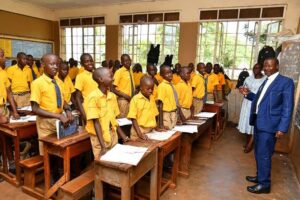
Its Annual General Meeting and Visitation Day was held at the school campus in Wairaka, Jinja district, bringing together parents, teachers, learners and management.
He did not come as Waiyaki. He came as the Ugandan boy child described by Jenifer Menya.
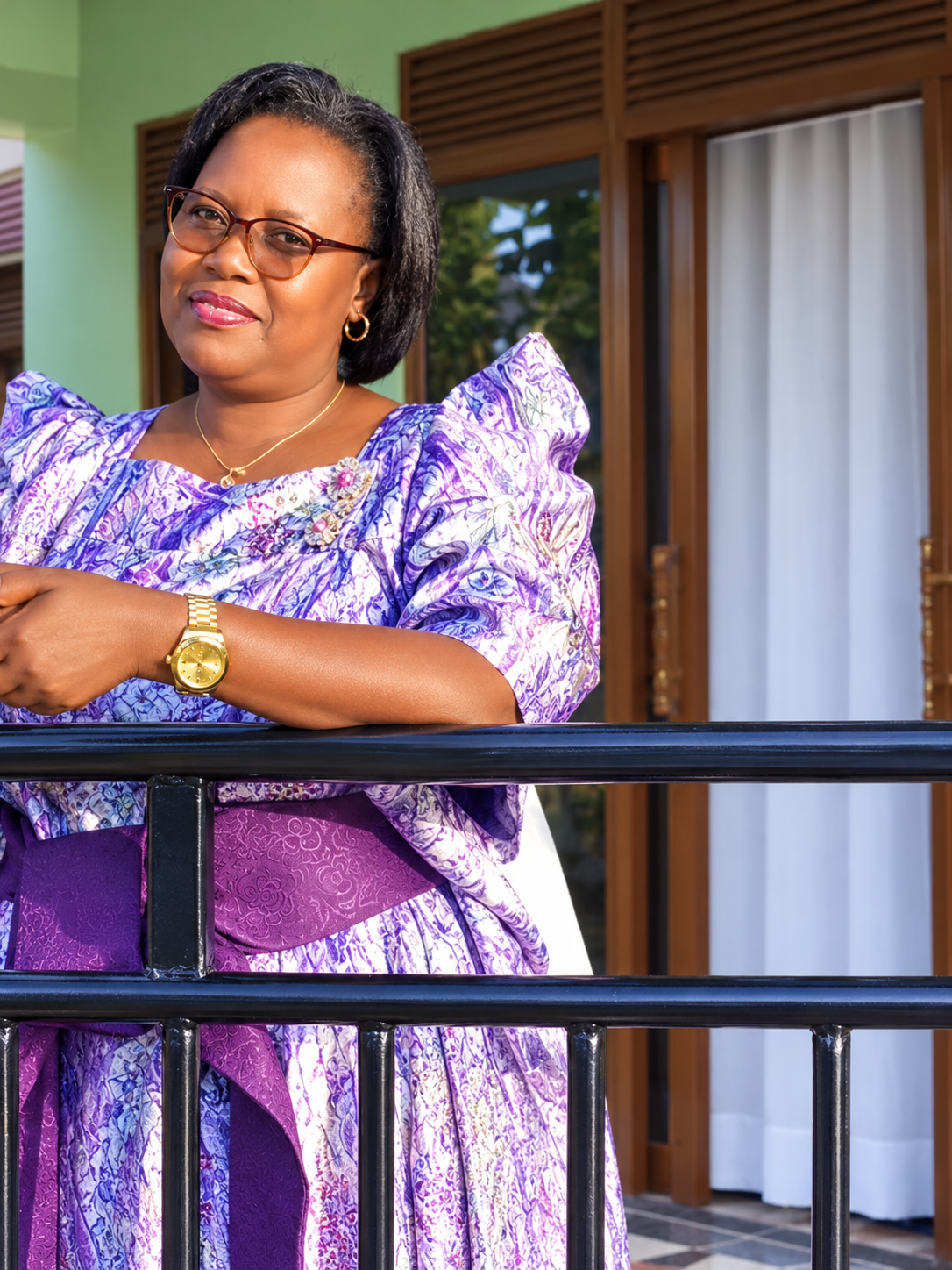
The speaker was not a guest hired for effect. Madam Jenifer Menya is the Chairperson of the School Management Committee (SMC) of Mwiri PS itself, the statutory body that must account for every child in that compound.
She is by profession a teacher of Biology and Agriculture, subjects that deal with life, growth and cultivation, which perhaps explains why she understands growth better than those who only teach facts. Jenifer who has taught in many schools including Jinja SS now heads St Paul Senior Secondary School, Mbulamuti, the historic hill of Uganda’s First Female Speaker of Parliament and now First Deputy Prime Minister and Minister for East African Community Affairs, Kamuli District Woman MP Rt Hon Rebecca Alitwala Kadaga, (Mama Busoga).
Ms. Jenifer Menya, popularly known at school as ‘Mama’ or ‘Madam’ is a mother who has raised her own sons and daughters with discipline and a career teacher whose former students now occupy key positions in public and private spaces across Busoga and beyond.
When she speaks about a boy left to learn alone, she has watched that boy grow from Primary One to Senior Six, in the laboratory and in the garden.
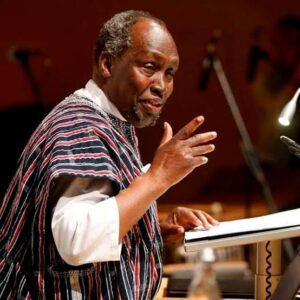
What made her speech historic for anyone who ever did Literature is the contrast in delivery. Ngũgĩ wa Thiong’o is a literary man who wraps truth in proverbs, rivers and ridges. Jenifer Menya is a Biology and Agriculture teacher who believes in calling a spade a spade, because in her subjects, you cannot fake germination.
From James Ngugi to Ngũgĩ wa Thiong’o: Why the Colonial Name Had to Die.
Readers knew him as James Ngugi, but that name tells a colonial story. Born in 1938 in Limuru, Kenya, he was baptized as James Ngugi. James was his Christian colonial’s name. Ngugi was his Gikuyu name. Thiong’o was his father’s name. The full colonial arrangement meant he carried the church and the colony on his head.
He wrote his early novels, The River Between, Weep Not, Child and A Grain of Wheat, as James Ngugi. The rupture came in 1977 when he and Ngũgĩ wa Mirii wrote a play in pure Gikuyu, Ngaahika Ndeenda (I Will Marry When I Want), performed by peasants and workers in his village Kamiriithu, not in English but in the language of their mothers. The play exposed land grabbing and the betrayal of workers. The Moi government considered it dangerous.
On 31st December 1977, he was arrested by the Daniel arap Moi government and detained without trial at Kamiti Maximum Security Prison for a year. Without paper, he wrote his next novel Caitaani Mutharaba-ini (Devil on the Cross) on toilet paper, in Gikuyu. In that cell he reached a conclusion that would define his life: to enslave a people, you take their language and give them your names, making them ashamed of their mother’s tongue.
He dropped James forever. He became Ngũgĩ wa Thiong’o, meaning Ngũgĩ son of Thiong’o, and vowed never to write his creative work in English again. The change was not a pen name. It was a political return home.
Examination Tools You Crammed: What They Really Mean.
For readers who did not do English Double, the tools Ngũgĩ employed matter because Menya deliberately used their opposite.
Allegory is when an entire story stands for another bigger story. The two ridges in The River Between are not just hills. They represent two systems, tradition and colonial modernity. Waiyaki between them embodies every African child caught between two worlds.
Symbolism is when a small object carries a large idea. River Honia, meaning cure, is supposed to heal the division between ridges, yet it physically separates them. The river therefore symbolizes a cure that has become a wound. Education in the novel operates the same way, promising liberation while producing alienation.
Binary Opposition is Ngũgĩ’s central scaffold. He deliberately creates opposites to trap the protagonist: Kameno versus Makuyu, Chege the traditional seer versus Joshua the Christian convert, Muthoni who chooses circumcision versus Nyambura who chooses the church, circumcised versus uncircumcised.
Bildungsroman, often misspelt as Bildungsrooman, is a German coinage meaning a novel of formation. It traces a boy’s growth into manhood. The River Between is a classic Bildungsroman, following Waiyaki from a child listening to Chege’s prophecy to a confused man who loses everything because formation was incomplete.
Foreshadowing is the early hint of a later collapse. Chege tells Waiyaki early that the white man will come and that Waiyaki must learn his wisdom and become a savior. That prophecy foreshadows both rise and failure.
Irony is when the opposite of expectation occurs. Waiyaki seeks education at Siriana to unite his people. Ironically, that same education is what makes his own people distrust him.
Ngũgĩ hides truth in a river so that the reader must dig to find it. That is literature. Jenifer Menya at Mwiri PS does not hide truth in a river. She throws truth in the face.
The Blunt Biology Teacher From Mbulamuti Hill.
Ms. Jenifer Menya did not employ proverbs, innuendos or beating around the bush. As a teacher of Biology and Agriculture who has always insisted on calling a spade a spade, she was blunt, because in Biology you cannot lie about life, and in Agriculture you cannot harvest what you did not plant.
That bluntness is precisely why teachers who did English Double at university or teachers’ college felt they had returned to a Literature class in their olden days as students, only this time the teacher was not asking them to analyze Waiyaki. She was showing them Waiyaki’s grandson in Kakira.
“We in Uganda have placed a lot of focus on the girl child but left the boy child loose,” she told the AGM attendees at Mwiri Primary School.
That single sentence functioned as Ngũgĩ’s prophecy rendered in plain English. Uganda has groomed the girl child, taught her to speak, to study, to dream and to stand, while the boy child has been left loose, wandering without guidance that suits community existence.
The Five Strokes of a Reckless Man.
Because the boy was left loose, the country is now reaping broken homes. According to Menya, it is not surprising that there is an alarming rise in cases of separation, domestic violence and divorce, because unprepared and unpolished boys later become men who marry well-groomed daughters and end up ruining their future and lives.
Unlike Ngũgĩ who would use a symbol, Jenifer Menya used a hammer. She described the modern Waiyaki in five interconnected strokes, each failure breeding the next.
The chain begins with emptiness. He drinks himself silly, not because alcohol is scarce but because values are scarce. A man who has no center will always search for something to fill the emptiness.
From emptiness emerges a home without a manager. Uganda has taught him that manhood is money, that once he drops cash his duty ends. Consequently, he has no idea how families are managed.
The absence of management translates into absence of care. He grows into a husband who does not know care but demands to be cared for, waiting to be served like a child who never left his mother’s hut. The condition is a direct result of never being taught to be responsible for his siblings and therefore never learning how to take care of others.
That same lack of guidance follows him onto the road, which explains reckless driving and frequent accidents. A boy who was never told to slow down at home will not slow down on the highway.
When he finally steps out of the car, appearance tells the same story. He has no ethics and dresses half naked in the name of balance, with trousers sagging and protruding to the disgust of society, confusing exposure with fashion and indecency with confidence.
In Jenifer Menya’s words, they are literally irresponsible and reckless in all ways.
Pampered With Degrees, Starved of Character.
She said Ugandan parents have for years pampered that boy. The country claps when he obtains First Class, posts his degree on social media, buys him a car, builds him a bungalow and excuses his excesses because he is a boy.
Ms. Menya confronted that pampering culture directly at Mwiri Primary School. She told parents and Ugandans who pride themselves in pampering the boy child that life outside the classroom, lecture halls, hostels and family living rooms can have no mercy and is very harsh. Life will not ask for a transcript. Life will ask for software and by software she did not mean a laptop. She meant the software of life: responsibility, ethics, care, family management, hard work, humility, respect, discipline and the ability to bear another’s burden.
These competencies enable navigation beyond first class certificates, diplomas or degrees. A certificate can secure a job, but only software can sustain a marriage, raise a child or prevent a man from killing someone on the road because he was taught that speed equals manhood.
For a teacher of Biology and Agriculture, the metaphor was natural. You cannot get milk from a bull, however well you feed it. You cannot harvest maize where you planted weeds. Uganda has been feeding the boy child with marks while starving him of values.
The Source Is Us: Maids Cannot Wash Character-She says.
Having diagnosed the symptom, Ms. Menya traced the source to the household.
Children are now left to maids, aunts(sengas) and relatives. She cautioned parents against delegating parenting to relatives, warning that sometimes children are abused by members of extended families living with relatives, and even when abuse does not occur, absence itself wounds.
To drive the point home, she distilled it into a truth every mother at Mwiri Primary School understood instantly. A maid can wash a child’s clothes but cannot wash his character. An aunt can cook food for a child but cannot cook his identity. A relative can offer a roof, but only a mother and father can offer direction, because presence is parenting. Character cannot be outsourced.
She reminded the AGM attendees of what classic mothers taught: a home is not built by money alone but by willing hands. She invoked scripture: train up a child in the way he should go so that when he is old, he will not depart from it, and bear one another’s burdens, beginning with a boy learning to bear his sister’s burden.
A Literature Revision Class in Wairaka.
It was at this point that the audience transformed, and this is what made Wanyange different from a routine AGM.
In that gathering sat teachers, many of whom did English Double at the university and teachers’ college, men and women who in their olden days as students sat in Literature classes, underlined Kameno and Makuyu (with colored pencils because highlighters were not common), debated Waiyaki’s failure and wrote essays about Chege’s prophecy. Some teach English and Literature at various school while others are senior education officials.
For them, Ms. Jenifer Menya was no longer delivering an AGM speech. She was inadvertently conducting a Literature revision class. They heard Chege’s voice again: learn all the ways of the white man but don’t forget your own. They saw what happens when that instruction is abandoned.
They nodded not as parents being lectured, but as former Literature students who finally understood why Waiyaki failed. He was the boy left loose. He was never taught to be responsible for his siblings. He was given books but not character.
One teacher whispered to another that this was The River Between live. The boy who stood between two ridges not knowing whether to build or to burn has become the man who stands between marriage and divorce not knowing whether to build a home or to burn it.
Celebration, Condolence and Governance: The Family AGM.
Even as she corrected, Ms. Jenifer Menya also celebrated and condoled, as a family AGM should. The once upon a time famous man Mark Mwanje died in 2025, a P5 pupil Shamol Waisukirawa lost his father and the school matron Beatrice lost her father, among others.
She thanked parents for honoring the invitation to the AGM of Mwiri PS, noting that the gathering provides an opportunity to reflect on progress, assess achievements and challenges and agree on strategies for improvement. School development, she said, is a shared responsibility that requires active participation of management, teachers, parents, learners and stakeholders.
On behalf of the Management Committee, she appreciated the support, commitment and cooperation parents have continued to extend to the school. In the same spirit she commended the Headteacher and the entire teaching and non-teaching staff for dedication to duty.
Saluting the Quiet Spine of Mwiri PS.
She specifically saluted the Mwiri Primary School fraternity headed by the heartwarming Ronald Mwanga, both teaching and support staff, explaining that teachers who prepare lessons at dawn and mark books past midnight, matrons who wake when children cry at night, cooks who feed hundreds, cleaners who preserve dignity, guards and groundmen who keep the compound safe and secretaries who maintain order, constitute the quiet spine of Mwiri PS.
From the school she turned to partners, appreciating the Education Officer for technical guidance and thanking parents and guardians who support children through payment of requirements, provision of learning materials and guidance at home.
Transparency, Headteachers Factory and Fees.
From mourning she moved to governance, stating that the Management Committee recognizes the importance of transparency and accountability and is committed to ensuring that resources entrusted to the school are used responsibly and for the intended purpose.
To demonstrate that commitment, she noted that the school has ensured staff undertake professional development, evidenced by the number of headteachers promoted through Mwiri PS. The school does not just teach children, she said proudly, it makes headteachers, serving as a leadership incubator whose products now lead schools across Jinja and beyond.
On finances, she said the school’s financial prudence speaks volumes and asked parents to trust the committee because the institution trains a whole person, not just a candidate who passes PLE but a person who can think, work, respect and serve.
On fees, she was blunt and visionary at once. She asked parents to dream big and to prepare to add some money next year, not to punish them but to fund better boarding, better feeding, better equipped learning corners and motivated teachers, because excellence has a cost.
Why Wairaka Must Become Uganda’s Fireplace.
Why should Jenifer Menya’s message, spoken on a Primary School compound overlooking Lake Victoria opposite M.M. Wairaka College, generate a national dialogue?
Because what she said at Mwiri PS is not a school issue. It is a national crisis hiding as a domestic complaint.
Every day in Uganda, the country counts divorces, road accidents caused by reckless boys who were never told to slow down, well-groomed girls marrying boys who were left loose and bars full of graduates drinking themselves silly not because alcohol is cheap but because character is absent. The country counts all that and calls it news. Menya called it what it is: failed parenting of the boy child.
This is why her counsel must become an everyday issue among cultural and religious leaders. History should shame Uganda into listening.
Globally, great ideas have never started in State House or the White House. They have always begun around fireplaces on hills. Jesus taught on a hill. Moses received law on a hill.
Gikuyu elders resolved the fate of Waiyaki on a hill. The idea that would save Kenya was born around a fireplace in Kamiriithu village when Ngũgĩ and peasants sat with workers and wrote a play in their own language.
Mbulamuti hill where Ms. Jenifer Menya now heads St Paul Senior Secondary is itself a hill of history, the hill that has offered counsel to millions.
Mwiri hill, the great hill that watches Wanyange and Lake Victoria, has produced this country’s elite. Wanyange and Wairaka form a hill. Mwiri Primary School sits on that hill, overlooking the lake and facing M.M. Wairaka. On that hill, around the fireplace of an AGM, a Biology and Agriculture teacher lit a fire, because she knows that what is not cultivated with intention grows wild.
We Do Not Need Trump or Putin to Teach Us How to Raise Sons.
Ugandan parents should not ignore Jenifer Menya’s counsel and dismiss it as a minor issue during an AGM, something to clap for and forget by the time they reach the Jinja-Iganga highway.
Uganda has developed a habit of waiting for big names to lecture before listening. The country waits for Donald Trump to tweet, for Vladimir Putin to threaten, for Benjamin Netanyahu to bomb, for Macron to speak from Paris, for a policy paper from Italy, France or Germany, for a white expert from an NGO to bring a PowerPoint about the boy child. The nation waits for outsiders to explain how to raise its own sons.
Jenifer Menya has done it without PowerPoint, without a foreign grant and without a proverb to hide behind. At Mwiri PS, in plain English, calling a spade a spade, she told the country that the software of life is more important than the certificate.
Her instruction was simple: do not leave the boy to maids and aunts, do not pamper him with degrees while starving him of responsibility and do not imagine that the classroom will teach him what only the living room, the garden, the kitchen and a parent’s lap can teach.
In Agriculture, you prepare the soil before you plant. In Biology, you nurture life from cell to organism. The boy child needs the same preparation and nurture.
If Uganda does not make this an everyday conversation in cultural palaces, churches, mosques, clan meetings, staffrooms and taxi parks where reckless boys drive, the country will continue to produce Waiyakis.
Boys who stand between two ridges, between a first-class degree and a failed marriage, between a car and a coffin, between money and manhood, not knowing whether to build or to burn.
Ngũgĩ started with a river. Menya ended with a home. The river divided. The home must unite.
Editor’s Note: Why We Write Long At TEU.
Some readers complain. They say articles at The Exposure Uganda are sweet but very long. We plead guilty and we will not apologize, because the complaint itself explains why we must write the way we do.
Add to the lazy and fashionable excuse that people have no time to read long articles.
That excuse would be summarized by lawyer as intellectually dishonest, null and void ab initio, frivolous, vexatious and utterly inconsequential before the bar of serious discourse. It would not survive a minute of cross-examination at the high court of reason and knowledge.
It is not a time problem; it is a discipline problem. The same Ugandan who claims he has no five minutes to read an article that explains his marriage, his son’s reckless driving and his daughter’s future, will spend three hours scrolling TikTok crude jokes and WhatsApp rumors. What we lack is not time. What we lack is seriousness.
Classical journalism has always been anchored on timeless truths that shallow content has forgotten. The New York Times told the world that All The News That’s Fit To Print must be printed. The Washington Post warns that Democracy Dies in Darkness. The Guardian reminds us that Facts Are Sacred, Comment Is Free.
And as George Orwell, the greatest journalist of truth, put it, Journalism is printing what someone else does not want printed. Everything else is public relations. At The Exposure Uganda, we choose journalism. We choose sacred facts over sacred likes.
We believe there is still a cream in Uganda – teachers like Ms. Jenifer Menya who teaches Biology and Agriculture, teachers of English Double, parents, university dons, students, cultural leaders, religious leaders, serious business people, serious youth – who do not just want to know. They want to reflectively read, analyze and pick issues wrapped or blanketed in everyday events. If you have read this story from Mwiri PS to the last line, you are part of that cream.
We cook like a skilled and caring chef. Anyone can boil water; anyone can cook meat or chicken. It takes a chef to make food that guests will remember and return for.
At TEU we live by a simple kitchen truth: Good Food Takes Time. And by the same measure, good journalism takes space. We don’t rush the truth to fit a headline.
We also live by a classroom truth that Jenifer Menya embodies: A teacher of Biology and Agriculture does not just teach life, she nurtures it. In Biology you study life from cell to organism. In Agriculture you prepare the soil before you plant. You cannot fake germination, you cannot harvest maize where you planted weeds, and you cannot get milk from a bull however well you feed it. That is why Menya’s lesson on the boy child hits harder than any NGO PowerPoint. She is not teaching a subject. She is nurturing a generation.
This truth is echoed by a celebrated fellow Biology teacher and Lusoga news guru currently pursuing his PhD, Michael Kifubangabo and who now reads news at Hon Nathan Nandala’s owned Bridge FM, has always told his students:
“Biology teaches us that you cannot neglect the cell and expect to save the body. The boy child is that cell. Ignore him when he is small, and you will spend a lifetime trying to repair the man when he is broken.”
That is the cell Jenifer Menya was talking about at Mwiri PS. That is the cell Uganda has ignored.
At TEU we invest what cheap content never invests: intellect, time, skill, research, language, memory and heart. We take a simple AGM overlooking Lake Victoria opposite M.M. Wairaka College and connect it to Ngũgĩ wa Thiong’o, to Kamiti Prison, to River Honia, to Kameno and Makuyu, to your home. We wrap truth in story so that when you taste it, you will always want more. You may not finish it in one sitting. Save it. Return to it at night. Discuss it around your own fireplace.
We tell it differently. Others report an event. We expose a pattern. Others quote a speaker. We place that speaker in history. Others count words. We make words count.
So, to those who say we are long, we say your hurry is too short. If you want quick jokes, TikTok is free. If you want to understand Uganda, welcome to TEU.
We Expose, You Decide.


