Tag: Kiira Police

  • Kisanja No Sleep: IGP Byakagaba Deploys Hundreds of Detectives To Hunt PDM Thieves In Busoga,10 Already Dumped in Kirinya Prison.

    Hear This Loud and Clear! Attention All PDM Thieves! If you dipped your fingers in PDM money, whether by accident, by greed, or by stubbornness — stop wasting our time with uncoordinated excuses and explanations.

    The Inspector General of Police (IGP) Abbas Byakagaba, on direct orders from the Appointing Authority, President Yoweri Kaguta Museveni — the Commander In Chief and Fountain of Honor, has deployed hundreds of his sharpest, no-nonsense boys and girls on the ground.

    Their mission is simple: Fish out every abuser and saboteur of PDM money and dump them behind the high walls and water of Kirinya Prisons.

    If you treated PDM money like it came from your kiosk, if you stole it, forged it, or shared it with side chicks and alcohol, pack your bags.
    Business as usual is OVER. Kisanja has no sleep for PDM saboteurs

    The warning came to life on Thursday August 7 when 10 suspects were arraigned before Jinja Court over allegations of stealing, forging, and defrauding beneficiaries of the Parish Development Model funds, as Kiira Regional Police Command launched a multi-agency crackdown across Busoga.

    The arrests, led by Kiira Region RPC SSP Charles Nsaba and the Head of PDM Supervision for Busoga Sub-region ACP Bob Kagarura, signal what police call “the end of business as usual” for officials and individuals who have been treating PDM money like personal cash.

    A team of investigators from the Police Headquarters in Naguru joined their counterparts on the ground in what the PRO better known in the media as Kiira Regional police loudspeaker SP James Mubi described as “cracking a whip on some chaps who have been feasting on PDM money intended to empower wanainchi to join the money economy and kick poverty through the windows.”

    What Is PDM?

    The Parish Development Model is a government strategy launched to move Ugandans engaged in subsistence farming into the money economy.

    The idea is simple: money is sent directly to every parish in the country. At parish level, households in subsistence are grouped into PDM SACCOs. Each qualifying household is supposed to access a revolving fund to start or grow enterprises like poultry, piggery, dairy, crop farming, tailoring, boda boda, and small retail.

    Government has so far injected over 3 trillion shillings into the program nationwide. The goal is to lift 39% of Ugandan households still in subsistence out of poverty, parish by parish.

    Because the money goes to the grassroots, PDM is being called the biggest direct cash intervention to ordinary Ugandans in decades. That is also why it has become the biggest target for fraud.

    The Jinja Cases: How The Money Was Allegedly Stolen.

    According to prosecution-guided investigations, the 10 suspects used several schemes to divert money meant for beneficiaries.

    Those arraigned include Charles Kisebe, 55, the chairperson-elect of Railway Quarters in Jinja City, who is accused of stealing 700,000/= meant for Zaituni Kaumba between 2024 and 2025.

    Others are Karim Kiika, Ntuyo Badru, Agnes Walalumba, Godfrey Byansi, Rebecca Mubeezi, Esther Nakalema, Juliet Kalemba, and Farouk Joley, all residents of Buyala in Budondo Sub- County, Jinja City. The last is Moses Mulambe, 37, a resident of Mawoito in Kagoma Town Council.

    Charges include Obtaining Money by False Pretense, theft, conspiracy to commit a felony, forgery of documents, cyber-crimes, and neglect of duty.

    Investigators say the group conspired to fraudulently present themselves as PDM beneficiaries or to help “process” beneficiaries, then diverted the money. In some cases, forged documents were allegedly used and real beneficiaries were left with nothing.

    A Familiar Story from Entandikwa To PDM.

    This is not the first-time poverty-eradication money has leaked.

    From Entandikwa in the 1990s, to Bonna Bagagawale, NAADS, Youth Livelihood, UWEP, Emyooga, and now PDM, the pattern has been the same.

    A section of errant civil servants who are meant to guide implementation end up colluding with unscrupulous local leaders. They treat the money as though it came from their kiosk businesses — picking at will, dishing it out to side chicks, or wasting it on reckless agendas like alcohol.

    The result: the intended beneficiary, the subsistence farmer, the widow, the boda-boda rider, is left waiting in vain while the program is declared “a failure.”

    What is different with PDM is scale and traceability. With over 3 trillion shillings injected and money wired to parish SACCOs, government and police say they can now follow the trail. That is why arrests like those in Jinja are being framed as a break from the past — a signal that impunity will no longer be tolerated.

    As ACP Kagarura put it, “we shall be accused of compromise and sabotage if we don’t act.”

    “We Shall Be Accused Of Sabotage If We Don’t Act”.

    Speaking after the court session, ACP Bob Kagarura, who is supervising PDM in Busoga, said the crackdown will be continuous.

    “We shall be accused of compromise and sabotage if we don’t expeditiously investigate all PDM funds that have been misappropriated, stolen or mismanaged,” Kagarura said.

    He added: “We are here to conclusively investigate cases under inquiry, recover funds, arrest and prosecute culprits.”

    Kiira RPC SSP Charles Nsaba appealed to all officers in the region to enforce PDM guidelines and “fight back all those fighting government through PDM funds.”

    He said police have a “cardinal duty” to support government programs and to bring to order “all reactionary elements that harbour intentions of sabotaging the smooth operationalization of PDM funds” through community sensitization and enforcement.

    What This Crackdown Means.

    For years, complaints about PDM have followed a similar pattern: ghost beneficiaries, leaders demanding kickbacks, forged national IDs, and SACCO executives disappearing with money.

    This Jinja case is significant because the net is widening. The involvement of a team from Naguru alongside Kiira region shows the Inspector General of Police is treating PDM fraud as a priority crime, not just a local administrative issue.

    It also shows that both leaders and ordinary citizens are being targeted. The list includes an elected chairperson and residents. The message is clear: it doesn’t matter what position you hold. If you touch PDM money fraudulently, you will answer.

    Most importantly, it signals that “business as usual” is over. For some local leaders and middlemen, PDM became an opportunity to eat. This prosecution shows that the state is now tracking the money from Treasury to the parish and to the individual beneficiary.

    The Bigger Picture for Busoga.

    Busoga Sub-region, like many parts of Uganda, has millions still trapped in subsistence. PDM was meant to be the bridge.

    When that bridge money is stolen, the impact is direct: a mother who should have bought pigs gets nothing. A youth group that should have started a welding shop is told “the money delayed.”

    That is why police and PDM supervisors say recovery is part of the mission. “We are here to… recover funds,” Kagarura emphasized.

    Community sensitization will also be intensified, police said, to teach beneficiaries their rights and the proper channels to report fraud without fear.


    In summary, PDM was designed to break the cycle of poverty at the parish. But if the parish leaders and brokers turn it into another avenue for theft, then the program defeats its own purpose.

    With 10 people in court in Jinja and investigations ongoing across Kiira, the warning from police is clear: PDM money is not a grant to leaders. It is a loan to the poor. And the law is now watching.

    For tips, complaints, or to share your PDM experience:
    WhatsApp / Call: 0776462509 | Email: exposureuganda000@gmail.com
    TEU — We Expose. You Decide.


  • “Order is the first law of victory” – Kiira Security Command Puts Region on High Alert Ahead of Museveni Swearing In.

    “Order is the first law of victory” – Kiira Security Command Puts Region on High Alert Ahead of Museveni Swearing In.

    “Order is the first law of victory,” Kiira Regional Police Commander SSP Charles Nsaba declared Wednesday, as joint security forces in Busoga announced zero tolerance for any attempt to disrupt the swearing in of President elect Gen (Rtd) Yoweri Kaguta Museveni on Tuesday, 12 May 2026.

    Sounding theological and pastor-like, Charles Nsaba quoted 1 Corinthians 14:40, “Let all things be done decently and in order,” and told commanders that the same principle that governed the early church must now govern the security of the state.

    Context:

    In Paul’s day, the church at Corinth was gifted but chaotic. Believers spoke in tongues all at once, prophesied over each other, and competed for attention. Outsiders walked in and thought they were mad. Paul rebuked them: “God is not the author of confusion, but of peace”. His remedy was simple decency and order. One by one, with interpretation, under authority, freedom, yes. But freedom without structure becomes chaos, and chaos destroys the mission.

    “That is the spirit we are invoking,” Nsaba said adding “Everything before, during and after the swearing in must take place in a proper and orderly manner to avoid any disruptive tendencies. A nation, like a church, cannot afford confusion when its future is at stake.”

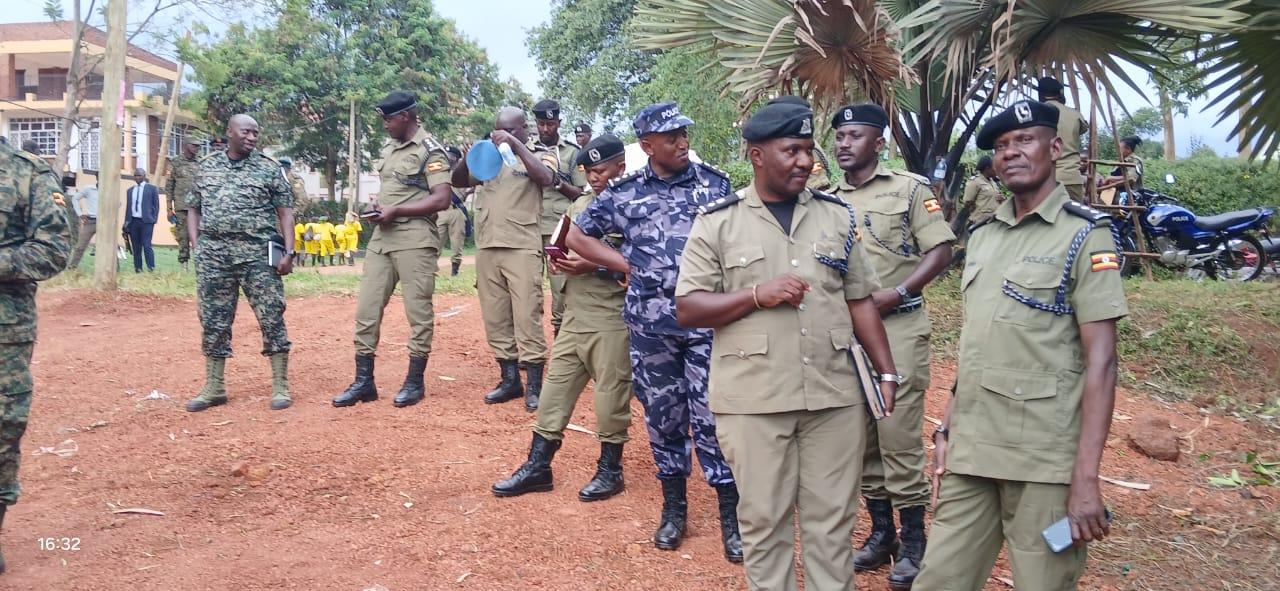
    The high-level security meeting, held at the secluded Uganda’s Civil Service College in Jinja City, confirmed that Kiira Region is on full readiness to secure the presidential inauguration at Kololo Ceremonial Grounds and the subsequent swearing in of Members of Parliament and local government leaders across Busoga.

    SSP Nsaba chaired the Region JOC sitting, co-chaired by the recently-posted Jinja City RCC Salim Komakech and Busoga Sub Region Cantonment Commander Brig Gen Emmanuel Kanyesigye.

    According to SP James Mubi, the regional police loudspeaker, the meeting brought together regional and divisional heads of departments, DPCs, all OCs of main and sub stations and posts, plus sister security forces.

    “No Room for Imposters or Chaos” 

    Brig Gen Kanyesigye issued a stern warning to “individuals who masquerade as army officers in uniforms with fake IDs and documents.” Such imposters, he said, “must face the law without fear or favor to avoid destabilizing Busoga.”

    According to SP James Mubi, the Region JOC has laid out a sweeping security plan covering all phases of the transition.

    “Key measures include full protection of all VVIPs and VIPs, crowd control and access control at all venues, route security for convoys, and standby emergency response teams including fire rescue and medical services,” Mubi said.

    He added that security forces will conduct 24-hour CCTV surveillance and intelligence sweeps across the region. “The plan also includes interagency security coordination, public sensitization drives, evidence-based monitoring and evaluation, and counter terrorism operations.

    All hotels and guesthouses have been directed to profile guests ahead of the ceremonies as a preventive measure,” Mubi noted.

    Nsaba directed that “intelligence led operations, motorcycle squad patrols, and community policing must continue so as to maintain public safety and security.” He stressed that safety drills by all security forces in the region are already underway.

    Trans Africa Highway Under Watch.

    Jinja City RCC Salim Komakech assured the public that the Trans Africa Highway from Kampala to Malaba border will remain open during the swearing in period and the upcoming Uganda Martyrs Day of 3 June.

    However, the highway will be under “full time surveillance of the Integrated Highway Patrol vehicles to constantly monitor and prevent accidents and highway robberies.”

    Komakech who replaced Richard Gulume Balyainho (now in Bugiri), also appealed to the Jinja City Town Clerk Godfrey B. Kisekka to ensure all venues for the swearing in of local leaders are “in full coordination with the city or district security committees for proper and harmonious purposes.”

    He called upon all elected local government leaders to “unite and promote transformational leadership and governance.”

    Decency, Order, and Readiness.

    The Kiira Region JOC emphasized that human rights will be observed, even as security remains tight. According to SP James Mubi, profiling of guests in hotels is purely preventive. “It is about terrorism and crime prevention, not harassment of innocent citizens,” he said.

    With President Museveni set to be sworn in for the 2026 to 2031 term on Tuesday, 12 May, a public holiday, the region’s message was clear: Busoga will be secure, ceremonies will be orderly, and any attempt to interfere will be met with “zero tolerance.”

    “The spirituality of this exercise is decency and orderliness,” Nsaba said. “Just as Paul protected the church from confusion, we shall protect this nation from disruption. That is how we guarantee peace for the people of Busoga and Uganda.” 

    Why Do Leaders Swear In?

    According to SP James Mubi, these ceremonies are not just pomp and protocol. “A swearing in is the legal and moral bridge between an election and authority,” Mubi said. “Without it, there is no mandate, no office, no command.”

    It establishes legitimacy. The Constitution requires every elected leader, from President to LCIII Chairperson, to take an oath of allegiance and an oath of office before exercising powers.

    The oath transforms a candidate into a state officer. Until that moment, they are still private citizens. The ceremony tells the nation: power has changed hands lawfully, not by force.

    It binds the leader to the people and the law. The oath is a public covenant and the President swears to “preserve, protect and defend the Constitution” and to “promote the welfare of the people of Uganda.”

    MPs swear to “be faithful and bear true allegiance.” Local leaders swear to serve without fear or favor. It is a reminder that they hold power in trust, not by right.

    It guarantees continuity and order. Paul’s warning to Corinth was against confusion. A swearing in is the state’s answer to confusion. It puts dates, witnesses, and oaths around power so that no vacuum emerges. “Decency and order” are why SSP Nsaba invoked scripture. An orderly transfer deters opportunists and tells citizens, and the world, that Uganda is governed by law.

    It invites accountability. Because the oath is public, recorded, and often televised, the leader can be held to their own words. Citizens, courts, and history can measure performance against the promise made at Kololo, at Parliament, or at the district /City headquarters. Breaking the oath becomes perjury before the nation.

    “These ceremonies are the country’s immune system against anarchy,” Mubi said. “They tell the soldier, the police officer, the civil servant, and the citizen exactly who has authority, from what date, and under what law. Without that clarity, you get the chaos Paul warned about in Corinth.”

    On Tuesday 12 May, when Gen Museveni raises his right hand at Kololo, he will not be gaining power, he will be accepting responsibility, and Busoga, under zero tolerance security, intends to witness that moment in decency and in order.