
Jinja City Mayor Alhaji Nagaya Abdulhafidh has formally written to the Uganda National Farmers Federation seeking temporary allocation of approximately 3.5 acres at Jinja Show Grounds to accommodate Ambercourt Market traders who must relocate to pave way for the expansion and improvement of Kimaka Aerodrome.
Before the debate begins, before criticism gathers momentum, and before politics colours the discussion, it is important to dwell first on what the letter actually says, because it is within its content that the urgency, the reasoning and the spirit of the request become unmistakably clear, and it is only by starting there that the rest of the story can be fairly understood.
What The Letter Says.
In a letter dated November 23, 2026, addressed to the President of the Uganda National Farmers Federation in Kampala, Mayor Nagaya explains that Jinja City Council is faced with the challenge of relocating Ambercourt Market vendors following the ongoing expansion and improvement of Kimaka Aerodrome by the Civil Aviation Authority.
He explains that the relocation has become urgent following a directive by the Uganda Civil Aviation Authority requiring the city to identify an alternative location for the affected traders, while adding that Ambercourt Market, which sits adjacent to the aerodrome, has been identified among the areas that must be vacated to provide space for the planned construction works.
He further notes, with evident concern, that the 90-day grace period granted to facilitate the relocation has already expired, leaving the city under pressure to secure an alternative site so that the aerodrome expansion works can proceed without further delay.
In his own words, the Mayor wrote that Jinja City Council is currently faced with the challenge of relocating Ambercourt Market vendors following the ongoing expansion and improvement of Kimaka Aerodrome by the Civil Aviation Authority.
That single sentence carries the whole weight of the letter, because it is not a political statement but an administrative cry for help, coming from a city that has been told to move its traders, that has watched the time given to move them run out, and that must now act without having land on which to act.
The Land He Is Asking For.
Flowing naturally from that challenge, the Mayor then points to where he believes the solution lies, and he does so with precision, with restraint, and with a clear sense of what is possible.
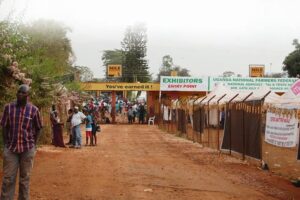
The proposed alternative location is a portion of land within the Uganda National Farmers Federation grounds, commonly known as Jinja Show Grounds, situated on Plot 13-19 Bridge Close.
He says a technical assessment undertaken by Jinja City Council identified the land as suitable for temporary relocation because of its accessibility, available space and compatibility with the agricultural activities associated with the market.
The proposed site is estimated to cover approximately 3.5 acres and would accommodate organised trading areas, access routes and essential facilities, including sanitation and lighting.
He does not ask for the whole Show Grounds, neither does he ask for permanent ownership, but only for approximately 3.5 acres, for a temporary purpose, to be used in an organised and dignified way that respects both the traders and the host institution.
Why He Believes Show Grounds Will Work.
The letter does not stop at asking, because it goes on to explain why the Show Grounds is the most sensible choice available to the city, and why other distant options would do more harm than good.
The Mayor says the arrangement would provide an opportunity to preserve the existing commercial character of Ambercourt while strengthening the relationship between agricultural producers, farmers and market traders, which is a relationship that has always defined the market and given it its unique identity.
He argues, in the same breath, that Ambercourt is essentially a farmers’ market whose activities complement the objectives and mandate of the Uganda National Farmers Federation in promoting agricultural development, marketing and trade, and that locating the market within the Show Grounds would therefore create synergies between the Federation’s agricultural promotion activities and Jinja City’s efforts to facilitate agricultural marketing.
Alongside that institutional logic, he points to the strategic position of the site, which has direct access from Bridge Street and is conveniently accessible from Jinja’s Central Business District, the existing Ambercourt Market catchment area and surrounding residential neighbourhoods.
Retaining proximity to the market’s existing customer base, he says, would help affected traders maintain their businesses and minimise the disruption that could arise from relocation to a distant location, while the availability of approximately 3.5 acres of largely undeveloped land would also present an opportunity to organise the market in a more orderly manner, with proper provision for trading spaces and essential services.
The letter, therefore, is not a vague plea, but a reasoned proposal grounded in a technical assessment, in location logic and in institutional compatibility, and it reads like a document prepared by people who understand both the market and the city.
What He Says About The Traders.
At the heart of the letter is the question of livelihoods, and it is here that the Mayor’s concern becomes most human, most immediate, and most difficult to ignore.
He acknowledges that Ambercourt supports hundreds of traders, a significant proportion of whom are women and youth, with many households depending directly on the market for their income.
The Mayor says providing an alternative trading location would ensure continuity of business operations, protect household incomes and prevent traders from being pushed into unplanned roadside vending, which would harm both the traders and the order of the city.
He describes the proposed arrangement as mutually beneficial, arguing that accommodating Ambercourt temporarily within the Show Grounds would strengthen the commercial utilisation of the Federation’s facilities while providing an opportunity for interaction between farmers, agricultural producers and market traders.
He further links the relocation to the wider economic importance of the Kimaka Aerodrome expansion, saying the project has the potential to enhance connectivity, trade, tourism and investment in Jinja City and the surrounding region.
In other words, the Mayor is not opposing the aerodrome, but supporting it, while insisting that the traders who must give way for it should not be sacrificed in the process, and that development should be measured not only by what is built, but also by who is protected while it is being built.
What He Says About The Terms.
The letter is also careful on the question of duration and control, because it anticipates the fears that often surround land matters in Uganda, where temporary arrangements have sometimes become permanent disputes.
The proposed arrangement is expressly temporary, with the Mayor indicating that the specific terms, duration and conditions of occupation could be mutually agreed upon between the Federation and Jinja City Council.
He says the city is prepared to work closely with the Federation to ensure proper planning, orderly management and provision of the necessary temporary market facilities.
This is not a demand, but an invitation to negotiate, to agree, and to enter a partnership built on mutual respect, with clear responsibilities for both sides and with safeguards that protect the Federation’s interests as much as the traders’ livelihoods.
Who He Copied And Why It Matters.
The letter was copied to the Minister of Local Government, the ministry’s Permanent Secretary, the Resident City Commissioner for Jinja, area Members of Parliament, the City Clerk, the Southern Division Mayor and the Chairman of Jinja City Land Board.
That wide circulation underscores the urgency attached to the matter, while also showing that the Mayor is not acting in secrecy, but placing the matter on the official record before all the relevant authorities, so that no one can later claim they were not informed, and so that the decision can be owned collectively rather than blamed on one office.
Finally, the Mayor appeals to the Federation to consider the request favourably and expeditiously, warning that the expired 90-day grace period has made it necessary to commence the relocation process without further delay.
That is the full content of the letter, a request for 3.5 acres, a request for temporary use, a request to protect traders, and a request to allow development to proceed, and only after understanding that content can we fairly ask the deeper questions that the letter raises.
The Aerodrome Expansion Behind The Letter.
To understand why the letter had to be written at all, one must understand the scale and ambition of the Kimaka Aerodrome expansion, because this is not a small local project, but a national aviation investment with regional consequences.
Kimaka Aerodrome, also known as Jinja Aerodrome, sits on historic land that dates back to the early 1950s, when it was established by the colonial administration, and for decades it remained largely dormant, used mainly as a training ground for the Uganda People’s Defence Forces, while commercial aviation attention remained focused on Entebbe.
That long period of dormancy began to change when government, through the Uganda Civil Aviation Authority, embarked on a deliberate programme to revive upcountry aerodromes across the country, with Jinja identified as one of the most promising because of its tourism potential, its industrial base, and its strategic position on the northern shores of Lake Victoria.
In January 2025, President Yoweri Museveni commissioned construction works for the upgrade of the runway and taxiway at Jinja Aerodrome in Kimaka, marking a significant milestone in Uganda’s aviation sector, and signalling that Jinja was no longer to be treated as a peripheral airfield, but as a gateway.
Since then, works have progressed steadily, including the tarmacking of the runway, expansion of the aircraft apron, and construction of the perimeter fence and entrance gate, among other improvements, and those who have visited the site speak of a facility that is visibly transforming from a forgotten strip into a modern aerodrome.
Yet the work is far from complete, because the Uganda Civil Aviation Authority has told Parliament that an additional Shs120 billion is required to complete the rehabilitation and expansion, citing funding shortfalls and delays in securing land required for the project.
According to the Authority, the outstanding works include construction of a fully equipped air traffic control tower, installation of firefighting equipment and extension of the runway to 2.4 kilometres to meet the required aviation standards, without which the aerodrome cannot be licensed to handle increased traffic safely.
The Authority has further explained that the expansion depends on securing additional land, including approximately 10 hectares reportedly pledged by President Museveni from land occupied by the Uganda People’s Defence Forces at Gaddafi Barracks, as well as the relocation of Ambercourt Market, which occupies about three acres near the facility.
Members of Parliament on the Physical Infrastructure and Works Committee, led by Vice Chairperson William Taylor Tiyo, inspected the ongoing rehabilitation works in November and tasked Jinja City authorities and military leadership to explain the delay in releasing the land, warning that outstanding issues could derail timely completion.
UCAA officials, led by Director of Airports and Aviation Security Sam Wonekha, told the committee that securing additional land and relocating the market were critical to completing the expansion programme, because the market’s proximity to the aerodrome poses a potential aviation safety risk, with market waste attracting birds that pose a serious hazard to aircraft.
Bird strikes, as aviation experts explain, are not a minor inconvenience, but a serious safety concern that can damage engines, shatter windscreens, and in extreme cases cause accidents, which is why international aviation regulations require clear buffer zones around runways and strict control of activities that attract birds, animals and other wildlife near aerodromes.
The Authority has also pointed out that the market’s presence contravenes the Civil Aviation (Aerodromes) Regulations, 2022, and could jeopardise licensing of the aerodrome if not addressed, which means the relocation is not merely a matter of convenience, but a legal and safety necessity.
At the same time, government has indicated that once completed, Kimaka will be gazetted as an official entry and exit point for international flights, with the aim of allowing tourists to fly directly into Jinja instead of landing in Entebbe and travelling by road, a shift that would save time, attract high-value tourists, and position Jinja as a regional aviation hub for tourism, business and investment.
When viewed in that light, the mayor’s letter becomes even more significant, because he is not writing in opposition to this national vision, but writing to ensure that the vision does not collapse under the weight of its own social cost, and that the aerodrome can be completed without destroying the market that has fed Jinja for generations.
A Political Landlord Asking For His People.
In Uganda’s local government tradition, the mayor is generally referred to as the political landlord of the city, a title that carries responsibility as much as honor, because he is the custodian of the people’s interests, the voice of the traders, the defender of the markets, and the first person to be called when the city’s livelihoods are threatened.
That is the role Nagaya is playing in this matter, and it is important to be clear about what he is not asking for.
He is not asking for land to build a personal house, neither is he asking for land to start a private business, nor is he asking for land to enrich himself, his family or his friends, but he is asking for land for hundreds of traders who wake up before dawn to feed Jinja, for women who sell matooke to pay school fees, for youth who load produce to earn a living, and for farmers who depend on Ambercourt to sell what they grow.
If a political landlord cannot ask for 3.5 acres for his people, then one is left wondering for whom he can ask, and must a landlord really beg from his own tenants when the need is so plain and the purpose so public.
The Show Grounds, though under the custody of the Uganda National Farmers Federation, is public land in its purpose, established to serve farmers, traders and the public, with its annual agricultural show standing as a public celebration of farming, and its grounds used for public exhibitions, public education and public commerce.
To ask that a small portion of such land be used temporarily to save a public market is not an extravagant demand, but a reasonable request from a leader to an institution that exists to serve the same public, and it is a request that should be weighed not by who wrote it, but by who will benefit from it.
A Market Is A Public Good.
At the heart of this debate is a principle that students of philosophy understand very well, namely egalitarianism, which teaches that public goods must serve all people equally, not just the powerful, not just the connected, and not just the few who can afford private alternatives.
Egalitarianism further teaches that a society is judged not by how it treats its richest citizens, but by how it protects its most vulnerable, and it is through that lens that the Ambercourt question must be viewed, because the traders at stake are not wealthy developers, but ordinary citizens whose daily survival depends on a stall, a sack of cassava, and a loyal customer.
A market is a public good in the truest sense of the word, because it does not belong to one tribe, one party or one class, but belongs to the farmer who brings his cassava, the mother who buys vegetables for her family, the hotel that buys matooke for its guests, the school that buys beans for its pupils, and the tourist who stops to taste Jinja’s fresh fruits.
When a market is protected, everyone benefits, and when a market is destroyed without an alternative, everyone suffers, although the poor suffer first and suffer most, because they have no savings to fall back on, no alternative business to run to, and no influential voice to plead their case.
That is why the principle of egalitarianism speaks so clearly in this case, because if Jinja is to grow as a fair and just city, it cannot allow development to push its poorest traders to the margins while the benefits of that development flow only to the already privileged, and it cannot celebrate a new runway while the women who feed the city are left without a place to trade.
Why Ambercourt Matters For A Tourism City.
Jinja is no longer just an old industrial town on the Nile, because it has grown into Uganda’s adventure capital, home to the Source of the Nile, white-water rafting, bungee jumping, boat cruises, lakeside resorts, and a fast-growing calendar of festivals, conferences and cultural events.
Tourism, however, does not survive on scenery alone, because it survives on food, and every hotel that hosts a tourist, every restaurant that serves a visitor, every lodge that prepares breakfast for a rafting group, and every roadside food vendor who feeds a boda rider or a day-tripper depends, directly or indirectly, on a reliable, affordable and organized food supply chain, with Ambercourt standing at the heart of that chain.
Every morning, long before the city wakes, trucks arrive from across Busoga, Bugisu, Teso, Buganda and beyond, loaded with matooke, cassava, sweet potatoes, yams, cabbages, tomatoes, onions, fruits and vegetables, and by sunrise, buyers from Jinja, Kampala, Busia, Iganga, Kamuli and Mayuge are already negotiating prices, while by midday, much of that produce has found its way into homes, schools, restaurants, hotels and small food businesses across the region.
Ambercourt’s history deepens its significance, because the market was established around July 2002 through a partnership between the then Jinja Municipal Council and the military, initially created to support the livelihoods of spouses of soldiers attached to Gaddafi Garrison along Kimaka Road, and it has since grown beyond that modest beginning into a major distribution centre that generates significant local revenue and sustains thousands of indirect jobs, from transporters and loaders to food vendors and packaging suppliers.
If Ambercourt is disrupted without a proper alternative, the effects will ripple far beyond the traders themselves, because food prices will rise, supply will become irregular, small food businesses will struggle, hotels will pay more for produce, and the very tourism experience Jinja is selling will become more expensive and less reliable.
A growing tourism city cannot afford a broken food market, because it needs a food market that is organized, accessible, hygienic and close to where people live, eat and trade, and the mayor’s proposal is therefore not just about finding space for traders, but about protecting the food system that supports Jinja’s households, its hospitality industry and its reputation as a welcoming tourism destination.
In that sense, protecting Ambercourt is not an act of charity, but an act of economic wisdom, because a city that feeds its visitors well, feeds its residents affordably, and feeds its hotels reliably, is a city that will keep growing.
Development That Carries People Along.
The Mayor’s letter is not an objection to development, but a call for development that carries people along, for egalitarian development, where the benefits of growth are shared and the burdens are not placed only on the poor.
A modern aerodrome will bring more tourists, more investors, more conferences and more business to Jinja, and it will make the city easier to reach, easier to market and easier to grow, and those benefits are real and should be celebrated.
However, that growth will only be meaningful if the people who have kept Jinja fed are not left behind in the process, because a modern airport and a broken food market cannot coexist in a city that wants to be known for hospitality, and a runway that leads to empty hotels and expensive food will not deliver the prosperity it promises.
The challenge, therefore, is not to choose between the aerodrome and the market, but to find a way for both to thrive, and the Show Grounds proposal offers precisely that path, by giving the aerodrome the space it needs to meet safety and licensing standards, while giving the traders a temporary home from which they can continue to serve the city.
What Happens Next.
The proposed allocation now places the Uganda National Farmers Federation at the centre of efforts to secure an alternative location for the affected traders, as Jinja City seeks to balance the demands of strategic infrastructure development with the need to protect livelihoods and sustain agricultural commerce.
The outcome will be significant for the future of Ambercourt Market and the hundreds of traders who depend on it for their daily economic survival, and it will also be significant for Jinja’s food security, its tourism economy and its ability to grow without leaving its most hardworking people behind.
Parliament’s Physical Infrastructure Committee has already pledged to convene stakeholders, including UCAA, Jinja City Council and the Ministry of Defense, to resolve the land impasse, and the Federation’s response will determine whether that process moves forward smoothly or stalls under fresh controversy.
Jinja is growing, its airport is growing, its tourism is growing, and its population is growing, and the question before the Federation, and before the city, is whether its food market will grow with it, or be scattered in the name of growth.
The mayor’s letter offers an answer, a temporary home at the Show Grounds, close to customers, close to farmers, and close to the city’s future, and in asking for it, the political landlord of Jinja is not asking for himself, but asking for his people, which surely is not asking too much.