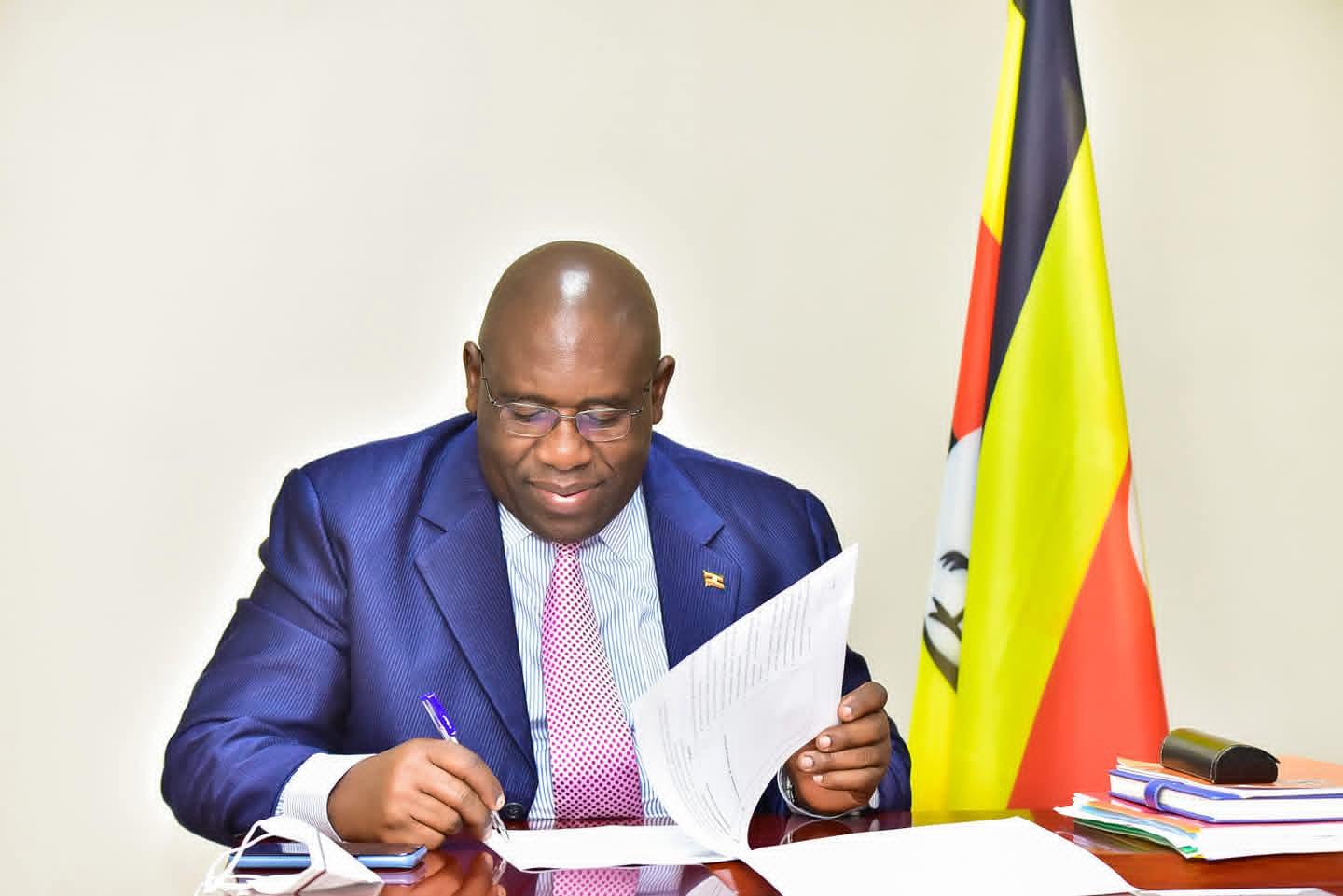
Tag: Hon Asuman Kiyingi

  • Beyond the Parchment Shield: The Kiyingi Bombshell Lecture That Has Set Tongues Wagging.

    Beyond the Parchment Shield: The Kiyingi Bombshell Lecture That Has Set Tongues Wagging.

    The Exposure Uganda (TEU) Preamble.

    There is a moment in Henrik Ibsen’s The Enemy of the People when Dr. Thomas Stockman discovers that the Baths – the very source of his town’s pride and wealth – are poisoned. He believes the town will thank him for telling the truth. Instead, the town declares the truth itself to be the enemy. Ibsen’s lesson is Uganda’s lesson today.

    What follows is not for those looking for the soft substance of jokes, gossip and quick likes. This is not fast food for the timeline. It is a text for the voracious reader – that rare, keen and patient citizen who still believes that a nation is not saved by slogans, but by ideas wrestled with to the end.

    And of course, in every Ibsen town there will always be those hurried chaps whose entire political philosophy can be summed up in one line: if you think, you must be an enemy. To them, if you quote Article 208 you are against the army, if you quote Article 29 you are against the State, and if you simply whisper “show me the law” you have clearly been funded from abroad.

    Like the good citizens in Ibsen’s town, they are absolutely convinced that the majority is never wrong, forgetting that the majority once swore the Baths were pure while the water was poisoning everyone. If that is your school of thought – that every serious write-up is treason and every questioning lawyer is a saboteur – then please, save your bundles and your blood pressure. This long lecture will only spoil your day. Go back to your dancing videos and leave serious work to serious citizens.

    But if you are among the few who still believe, as Stockmann finally did, that “the strongest man in the world is he who stands most alone” for the truth, then welcome. This is your text. For as Montesquieu warned, there is no greater tyranny than that which is perpetrated under the shield of law and in the name of justice. Law without restraint is not law at all; it is merely power dressed in legal robes.

    Today, Uganda does not suffer from lack of laws. We suffer from what Ibsen’s town suffered from – a poison in the Baths that everyone pretends not to see. We have a beautiful Constitution, elaborate institutions, and eloquent judgments, but a parchment shield is useless if the hands meant to hold it are trembling, or have been taught to salute instead of shield.

    Hon. Asuman Kiyingi does not ask you to agree with him. Like Stockmann, he simply asks you to look at the water and admit that it is polluted. He asks you to do something far harder than clapping – to read with patience, to think with attention, and to answer for yourself: when they come for your liberty, who will hold the shield?

    The Exposure Uganda (TEU), a revolutionary digital platform committed to truth beyond fear and facts beyond favour, therefore presents the 2nd Annual Sam Kalega Njuba Memorial Lecture delivered at the Uganda Law Society on 24 September 2026, by Hon. Asuman Kiyingi, in its entirety, verbatim.

    Read it slowly and completely. For as Ibsen reminds us, the real enemy of the people is never the man who tells the truth – it is the lie that everyone agrees to live with.

    Beyond The Parchment Shield–Constitutional Due Process, Administrative Integrity, and the Jurisprudence of Liberty.

    By Hon. Asuman Kiyingi
     2nd Annual Sam Kalega Njuba Memorial Lecture
     Uganda Law Society
     24 September 2026.

    My Lords, the Chief Guest, Justice Esther Kisaakye; the President of the Uganda Law Society; Members of the Family of the late Hon. Sam Njuba; Members of the legal profession; distinguished guests; ladies and gentlemen:

    There is a story about Sam Kalega Njuba that, for me, captures the spirit of this lecture better than any formal description of his career.

    A senior member of our profession, who was familiar with those events, has recalled that, during a deeply troubled period of our constitutional history, Sam Njuba—then President of the Uganda Law Society—was detained at Makindye Military Police following his outspoken opposition to human rights violations.

    When those who knew of his detention sought his release, the matter was taken up with Paul Muwanga, then Chairman of the Military Commission. According to that recollection, Muwanga’s response was: “Oyo twamaze dda okumuyunga”—that Njuba had already been falsely accused.

    Whether one remembers that episode as a historical anecdote or as a warning from our national past, its constitutional significance is difficult to miss.

    A lawyer, and the head of the country’s Bar, was detained because he had spoken out against violations of human rights. The machinery of coercive power had been brought to bear upon a man whose professional vocation was to insist that power itself must remain subject to law.

    And that brings us to the central question I want to pose today:

    What protects the citizen when the State becomes the threat?

    What protects the lawyer when defending the law becomes dangerous?

    What protects the judge, the magistrate, the tribunal member, the human rights commissioner, the journalist, the politician—or the ordinary citizen—when the institutions created to restrain power begin to feel the pressure of power themselves?

    These are not merely questions about the Uganda of the past. They are questions about the Uganda of today.

    It is therefore fitting that we gather today in the name of Sam Kalega Njuba. This occasion is personal for me in more ways than one.

    I knew Norah Njuba at Makerere College School. Her sister Stella was a year ahead of us. Norah and I later entered Makerere University together, and I had the privilege of supporting her campaign for Guild President. She would go on to become Makerere University’s first female Guild President.

    So, long before I came to know Sam Njuba himself, I knew the Njuba family through his daughter.

    I came to know Hon Sam Njuba personally after I entered Parliament in 2006, when we served together on the Parliamentary Committee on Rules, Privileges and Discipline, which I had the privilege of chairing.

    I knew him as a legal icon, a freedom fighter and a man of extraordinary intellectual depth. But what impressed me most was his quiet authority. He was deeply knowledgeable without being overbearing; principled without being theatrical; and, despite the extraordinary circumstances through which he lived, remarkably unassuming.

    That is why I find the title of his memoir, The Betrayal, so evocative.

    It is not simply a political memoir. It is a record of what happens when constitutional ideals encounter the ambitions, betrayals and compromises of those who exercise power.

    Its preface contains a thought that, for me, captures something essential about Sam Njuba’s legacy:

    “Integrity and credibility are values one establishes without profit, popularity or recognition”. That is the Sam Njuba I am privileged to remember tonight.

    And that is why I have chosen to speak about the parchment shield.

    A Constitution can be beautifully written. It can contain elaborate protections for liberty, equality, due process and institutional independence. It can establish courts, tribunals, commissions and elaborate procedures.

    But a parchment shield is of little use if those entrusted with holding it are afraid to stand behind it.

    When Does Political Persecution Begin?

    Let me begin with a proposition. Not every prosecution of a politician is political persecution. Politicians, like everyone else, are subject to the law.

    The constitutional danger begins when the coercive machinery of the State is used in ways that deny the ordinary protections of law—unlawful detention, torture, disappearance, arbitrary restrictions on liberty, selective enforcement, or the manipulation of institutions to produce a predetermined outcome.

    And when those things occur, the question for lawyers is not whether the victim belongs to our political camp.

    The question is:

    What does the Constitution permit?

    Consider the cases that have confronted our courts and our conscience.

    Kakwenza Rukirabashaija brought proceedings in which the High Court found violations arising from his detention and treatment, including torture, and awarded damages.

    Muwanga Kivumbi was granted bail and was subsequently re-arrested. For nineteen days he remained unaccounted for before resurfacing and being brought before court on fresh charges.

    Whatever the merits of those charges, the constitutional question remains: Who had lawful authority to take him away, and where was he being held?

    Alex Mufumbiro spent more than sixty days on remand. The question raised by his proceedings was whether a constitutional guarantee of mandatory bail can be displaced by broad appeals to public interest.

    And then there is the experience of former Kampala Lord Mayor Erias Lukwago.

    He was arrested in the very course of attempting to serve court process. A lawyer and public official, engaged in a legal procedure, was forcibly prevented from performing that function.

    That incident deserves more than passing political commentary.

    When a lawyer cannot safely serve court papers because coercive power intervenes, the problem is no longer simply the treatment of one individual. The legal process itself has become vulnerable.

    The same concern arises in cases involving alleged torture and unlawful detention, including that of Faruku Muhamed. The deeper question is not merely whether a particular institution was independent enough at a particular moment. It is whether the State can inflict grave violations of liberty and bodily integrity and then avoid meaningful accountability.

    That is the larger constitutional danger.

    Because if the State can torture without accountability, detain without explanation, or disappear a citizen without consequence, the parchment shield has ceased to protect the citizen.

    When The Institutions Themselves Come Under Pressure.

    The danger becomes even more serious when institutions created to restrain power begin to experience pressure themselves.

    We have witnessed difficult questions concerning judicial independence.

    In the case of Col Dr Kizza Besigye and Hajji Obed Lutale, the court had to balance the applicants’ claims to liberty against the seriousness of the treason allegations and the State’s asserted investigative interests.

    I do not cite that decision to question the personal integrity of the judge. I cite it because that is precisely where constitutional adjudication matters most.

    The Constitution is not tested when everyone agrees. It is tested when the liberty of a politically inconvenient person collides with the interests of the State.

    The reported transfer of Magistrate Sheila Gloria Atim shortly after she granted bail to Miria Matembe likewise raised public concern about judicial independence.

    There may be legitimate administrative explanations for any judicial transfer. But constitutional institutions must consider not only legality, but also the confidence that their conduct inspires.

    And today we confront an extraordinary constitutional symbolism. Our Chief Guest, former Supreme Court Justice Esther Kisaakye, is addressing this memorial lecture from outside Uganda.

    The President of the Uganda Law Society, Isaac Ssemakadde, is also addressing us from outside the country. One is a former Justice of Uganda’s highest court.

    The other is the elected head of Uganda’s Bar. Whatever one’s view of the individual controversies surrounding either of them, surely, we must pause at what this means for a constitutional democracy.

    A former Supreme Court Justice and the President of the Bar are participating in a lecture on constitutionalism from exile. That is not a footnote to our discussion.

    It is part of the constitutional story we are discussing today. And it reminds us of a painful truth: Silence does not necessarily buy protection from the abuse of power.

    The Law Must Also Protect Those Who Enforce It.

    I speak here with some personal experience. The Leadership Code Tribunal was established under Article 235A of the Constitution to exercise adjudicatory powers over breaches of the Leadership Code.

    I was one of the Tribunal members who challenged, in Constitutional Petition No. 16 of 2022, the constitutional character of the institution and the status of its members.

    The Constitutional Court ultimately held that the Tribunal was not a Court of Judicature under Article 129 and that its members were not judicial officers of the Courts of Judicature. That judgment is the law, and I accept it as such.

    But I continue respectfully to disagree with part of its reasoning, particularly concerning the constitutional meaning of a judicial officer and the protection required for persons entrusted with adjudicatory functions.

    My purpose today is not to reopen that litigation. It is to draw a larger lesson.

    Institutional independence must have consequences in practice.

    If an adjudicator must decide a difficult case involving powerful interests, that adjudicator must be able to do so without fearing that the decision itself will determine his or her professional survival.

    The same principle applies to judges, magistrates, prosecutors, investigators and other public officers.

    A constitutional right to independence that carries no institutional protection is, in practical terms, a parchment right.

    When The Gun Begins To Speak The Language Of Politics.

    Perhaps nowhere is this constitutional question more urgent today than in the relationship between military power and politics.

    Article 208 of the Constitution requires the UPDF to be national, patriotic, professional, disciplined and non-partisan, and subordinate to civilian authority.

    The Political Parties and Organizations Act also places restrictions on the political activities of serving members of the UPDF.

    Those provisions embody a simple constitutional principle:

    The gun must remain subordinate to the Constitution and to civilian political authority.

    Yet we have witnessed the emergence of political mobilization involving serving military officers and political organizations.

    The Patriotic League of Uganda, for example, describes itself as a civic organization and pressure group, but has also operated openly in political mobilization and political debate. Its founder and chairman is a serving military officer.

    The constitutional question therefore cannot be avoided by terminology.

    If the activities of an organization amount to participation in partisan political activity, the law must be applied according to the substance of those activities rather than merely the label attached to the organization.

    And the law cannot mean one thing for a civilian and another for a General. The question is not whether we agree with the politics involved.

    The question is:

    Where does the Constitution draw the line between military service and partisan political activity—and who is responsible for enforcing that line?

    That question deserves an answer grounded in law, not personality.

    The lesson of the Kabaziguruka litigation is also instructive.

    The Supreme Court reaffirmed in 2025 that military courts could not exercise blanket jurisdiction over civilians, after which Parliament amended the UPDF Act.

    That was an important constitutional correction. But constitutionalism does not end when Parliament amends a statute.

    We must also ask what happens to citizens who were subjected to unconstitutional processes before the law was corrected. A constitutional judgment is not merely a legal document.

    It must change the lived reality of the citizen. The Cost of Asking: “Show Me The Law”

    There is a phrase that has particular resonance in Uganda’s history:

    “Show me the law”.

    It is the question that every public officer exercising coercive power should be prepared to answer. Where is the law authorizing the arrest?

    Where is the warrant? Where is the lawful basis for the detention? Where is the authority for the search?

    Where is the constitutional authority for military intervention? Where is the legal authority for interfering with an independent institution?

    And where is the law that permits a public officer to punish another public official for exercising a constitutional right and where is the law that permits an individual, simply because of office or military rank, to determine for himself what is legal and what is not?

    That last question is no longer theoretical. We have heard a serving General say:

    “I will define what is legal and what is not.”

    That proposition should trouble every constitutional lawyer. Not because of the personality of the speaker, but because of what the proposition represents.

    Under constitutional government, no individual defines legality by personal decree.

    The Constitution defines the limits of power. Parliament makes law within the Constitution. Courts interpret and enforce the law. Public officers exercise powers conferred upon them by law.

    The military operates under constitutional and statutory authority. No General, Minister, police officer, magistrate, judge, politician or lawyer is above that order.

    Otherwise, we cease to have government by law and begin to have government by discretion. And government by unchecked discretion is the beginning of arbitrary rule.

    The Constitution Is Everyone’s Shield.

    The temptation in Uganda is to think that constitutional violations are somebody else’s problem. Today it is an opposition politician.

    Tomorrow it may be a journalist. Then a lawyer. Then a magistrate. Then a judge.

    Then a public servant. Then an ordinary citizen who happens to stand in the way of someone powerful.

    But constitutional rights are not political party property. The right against torture does not belong to the opposition. The right to liberty does not belong to lawyers.

    Judicial independence does not belong to judges. Due process does not belong to politicians. Constitutional supremacy does not belong to Parliament.

    They belong to all of us.

    That is why the defense of constitutionalism cannot be left to lawyers alone.

    The citizen must defend it. The journalist must defend it. The academic must defend it. The religious leader must defend it. The traditional and cultural leader must defend it. The business community must defend it. Parliament must defend it. The Judiciary must defend it. And the legal profession must defend it—especially when defending it is inconvenient. Because the Constitution is not a shield that lawyers carry on behalf of everyone else.

    It is the shield every Ugandan must be prepared to hold.

    And this is where I return to Sam Kalega Njuba.

    His generation understood, often at enormous personal cost, that constitutionalism is not an ornament. It is a discipline imposed upon power.

    Sam experienced detention. He went into exile. He participated in a liberation struggle. He became Minister for Constitutional Affairs. He helped shape constitutional government. He returned to Parliament decades later as an opposition politician.

    Through all those transformations, what survived was his reputation for integrity.

    That is why his legacy matters now. Not because Uganda has no Constitution—we have one. Not because Uganda has no laws—we have many. Not because Uganda has no courts—we have courts.

    The question is whether those institutions can continue to restrain power when power is determined not to be restrained.

    That is the real test of constitutionalism.

    And so, when the police officer arrests without lawful authority:

    Show me the law. When soldiers take a citizen away:

    Show me the law. When a public official interferes with an independent institution:

    Show me the law. When an adjudicator is punished for deciding according to law:

    Show me the law. When a public officer invokes rank instead of legal authority:

    Show me the law. And when anyone—however powerful, however popular, however highly decorated—claims the personal authority to decide what is legal and what is not:

    Show me the Constitution. Because that is the difference between constitutional government and arbitrary government. That is the difference between power and lawful authority. And that is the jurisprudence of liberty.

    Sam Njuba spent much of his life reminding Uganda, by his words and by the example of his life, that integrity is not established by office, popularity or power.

    It is established by what one does when power is available—and by the courage to say no when power exceeds the law. May his memory continue to challenge us. May his integrity continue to embarrass our compromises.

    And may the Uganda he believed in remain a country in which every exercise of public power can still be met with the simplest and most important question in constitutional government:

    Show Me The Law.

    Thank you.


  • Kiyingi: The Constitution Cannot Be Décor when Abduction Replaces Warrant, the Republic Is at Risk.

    Kiyingi: The Constitution Cannot Be Décor when Abduction Replaces Warrant, the Republic Is at Risk.

    The Exposure Uganda (TEU) Preamble:

    When The Law Stops Speaking and Power Starts Posting.

    Every republic rest on a simple idea: power must explain itself in the language of law. Courts issue warrants. Parliament debates. Constitutions bind. That is the grammar of constitutional government.

    What Senior Advocate Asuman Kiyingi calls “Sovereign Lawlessness” is the moment that grammar collapses. When a military officer can enter a lawyer’s home without judicial authority, detain him in an unknown place, and then post photographs of the man blindfolded for the public to see, the Constitution ceases to be the rulebook. It becomes decoration.

    In Kiyingi’s context, “republic” does not just mean a country that is not a monarchy. He is using it in the constitutional and philosophical sense. A republic, for Kiyingi, is a political order where power belong to the people and is exercised through law, not through a person.

    Asuman Kiyingi writes not from anger alone but as a lawyer, a republican, and a student of history. Through the lawyer’s lens he sees breaches of due process and fair hearing, the basic promise that no one is above the law. Abduction without warrant, detention without record, threats aimed at Parliament, the judiciary and Buganda Kingdom. For him these are not political complaints. They are constitutional violations.

    Through the republican philosopher’s lens, he recalls James Madison’s warning about parchment barriers, the truth that constitutions fail when institutions lack courage.

    He recalls John Locke’s warning that when rulers govern by fear instead of law, sovereignty returns to the people. He also takes up Carl Schmitt’s dangerous question about who decides when the law is suspended. Kiyingi’s answer is clear. In a republic, nobody. The law decides.

    Through the historian’s lens he places Uganda beside Chad, Togo and Zaire not to copy their fate but to recognize a pattern. When family succession, military authority and personalized power converge, institutions are hollowed out one by one.

    What Kiyingi notes as different this time is style. Earlier regimes used legal procedure as camouflage. This one uses public humiliation as strategy.

    Kiyingi does not close with despair, he closes with Article 3. The Constitution itself anticipated moments when institutions would falter and it placed ultimate sovereignty not in the barracks, not in State House, not in Parliament, but in the people. His call is for citizens to raise the cost of lawlessness without breaking the law. Insist on procedure. Document abuses. Use regional courts. Stand together as institutions.

    Read Kiyingi’s piece and ask yourself which lens he is asking you to look through right now. Is it the lawyer’s lens that checks every action against the Constitution? Is it the republican’s lens that asks whether power can still explain itself. Or is it the historian’s lens that warns about patterns we have seen before. That is the choice he puts before every Ugandan reader.


    Sovereign Lawlessness: How to Salvage What Remains of the Uganda Republic.

    By Asuman Kiyingi

    A profound and suffocating state of fear has been systematically engineered across Uganda. For the average citizen, the traditional markers of constitutional governance appear increasingly overshadowed by the reality of an alternative power center operating beyond the restraints of civilian law.

    The country has been plunged into mounting public anxiety over a relentless series of high-handed actions that project the Chief of Defense Forces (CDF), General Muhoozi Kainerugaba, as all-powerful, unaccountable, and effectively beyond the reach of the institutions established by the Constitution.

    The most chilling manifestation of this unchecked authority unfolded in the pre-dawn darkness of mid-June 2026, when armed security operatives reportedly scaled residential fences in Wakaliga, Kampala. They did not arrive with judicial warrants. They arrived in unmarked “drone” minibuses and forcibly entered the residence of former Kampala Lord Mayor and senior advocate, Ssalongo Erias Lukwago. He was abducted by armed operatives and held incommunicado for days. When Lukwago eventually appeared before a court, visibly weakened and stripped of the ordinary protections of due process, he was charged with misprision of treason—an offence relating to the alleged failure to report a treasonous plot. By then, the institutional mask had completely fallen.

    The abduction and detention in an unknown ungazetted place were not merely acknowledged; they were publicly celebrated. Through statements posted on his verified X account, General Muhoozi Kainerugaba openly claimed responsibility for Lukwago’s capture and detention.

    The posts included photographs showing Lukwago blindfolded while in custody. In a series of posts, the General claimed that Lukwago had “urinated thrice,” required diapers, and would spend the night subjected to “kiboko” (caning). These statements, published by the country’s highest-ranking military officer, generated widespread alarm about the treatment of a senior advocate and opposition leader while in military custody.

    The same verified X account subsequently carried threats directed at political opponents and traditional institutions. In one widely circulated post, the General declared that after targeting opposition figures, he would pursue the Katikkiro of Buganda and the Kabaka if their television and radio stations did not cease broadcasting about the individual he captured and subsequently handed over to the police.

    When the head of a state’s military apparatus can summarily detain a senior officer of the court, torture him and boast about it publicly as a personal “capture,” and subsequently use dehumanizing slurs to threaten the Katikkiro and the Kabaka of Buganda, a dangerous constitutional threshold has been crossed. This is no longer merely political repression.

    It represents the consolidation of what may properly be described as Sovereign Lawlessness—a condition in which a dominant actor signals to the entire country that he is answerable to nobody except the ultimate source of personal power, standing effectively above Parliament, Cabinet, the courts, traditional institutions, and the citizenry.

    In constitutional theory and political science, this concept describes a dangerous mutation of state authority. It combines Carl Schmitt’s notion of the sovereign as the actor who decides on the exception with James Madison’s warning regarding “parchment barriers”—the structural reality that constitutional texts become ineffective when institutions lack the capacity or will to enforce them. Sovereign Lawlessness emerges when state power becomes detached from legal justification and accountability. Law ceases to function as a neutral framework governing society and instead becomes an instrument deployed selectively against opponents while granting effective immunity to those exercising power.

    Authority is no longer validated by constitutional office, legal process, or democratic delegation, but by the capacity to coerce and the willingness to exercise coercion publicly.

    This development is not disconnected from Uganda’s political history. Rather, it reflects a long-standing pattern in which independent centres of influence are systematically neutralised before they can mature into meaningful alternatives to executive authority.

    The fate of Col Dr. Kizza Besigye, the political isolation of Amama Mbabazi, the dismantling of General Kale Kayihura’s security networks, and the curtailment of Rebecca Kadaga’s independent parliamentary influence all illustrate variations of the same principle.

    Most recently, the political difficulties confronting Anita Among arguably follow a similar historical trajectory. The principle is quintessentially Machiavellian: a ruler must never permit the emergence of an independent centre of political gravity capable of rivaling the throne.

    Yet under General Muhoozi, this logic appears to have undergone a significant mutation. The earlier model relied upon legal processes, bureaucratic manoeuvres, and institutional management to preserve a veneer of constitutional order.

    The emerging model increasingly dispenses with subtlety. It does not merely manipulate institutions; it publicly humiliates them. Threatening the Buganda Kingdom, its Katikkiro, and its media platforms for reporting on a matter of public concern represents an attempt to subordinate one of Uganda’s most enduring centres of cultural and historical legitimacy to raw military authority.

    Uganda’s trajectory is not unique. Across Africa, republics have often been weakened when institutions were subordinated to family succession projects. In the Chadian model, following the death of President Idriss Déby in 2021, the constitutional succession framework was set aside as military authorities dissolved key structures to install his son, Mahamat Déby. The Togolese precedent offers an example of institutional capture; following the death of President Gnassingbé Eyadéma in 2005, the military facilitated the installation of his son, Faure Gnassingbé, using legislative institutions to regularise an extra-constitutional transfer of power.

    In the Mobutuist model of Zaire, meaningful coercive power was progressively concentrated within elite units personally loyal to Mobutu Sese Seko, draining practical authority from formal state offices. While Uganda’s circumstances remain distinct, repeated public declarations by General Muhoozi expressing his desire to succeed his father as President have naturally generated public debate regarding the future relationship between military authority, dynastic succession, and constitutional governance.

    The anxiety now gripping many Ugandans stems from a disturbing shift: ordinary civic activity increasingly risks being framed as subversion. Activities ordinarily protected under Chapter Four of the Constitution—political discussion, media engagement, public criticism, and civic mobilization—are increasingly treated as security concerns.

    Opposition figures, such as Leader of the Opposition Joel Ssenyonyi and vocal legislators like Ssemujju Nganda, are subjected to routine, public threats of containment. General Muhoozi has publicly stated that he intends to name a Leader of the Opposition of his choice to replace Ssenyonyi. Journalists and media organisations are vilified, with independent outlets like NTV and the Daily Monitor openly labeled by the CDF as circus clowns, alongside the ominous declaration that those days are over because leadership has been handed to his generation. Previously, when summoned to appear before a Parliamentary Committee, General Muhoozi refused to attend, derisively dismissing the Committee members.

    Most alarmingly, the logic of intimidation has begun extending even to senior figures within the state itself. When Major General (Rtd) Kahinda Otafiire publicly raised concerns about what he termed “rogue security elements” within the Police Crime Intelligence Directorate allegedly involved in unlawful killings, the response was not an institutional inquiry.

    Instead, he became the subject of public threats from military figures, with the CDF warning that the minister had provoked lions enough and was dangerously close to being arrested. Such incidents reinforce the terrifying perception that constitutional office no longer guarantees protection from arbitrary, personalized power.

    When institutions fail, constitutional responsibility does not disappear. The Constitution of Uganda locates sovereignty in the people. Article 1(1) explicitly provides that all power belongs to the people, while Article 3 imposes a mandatory injunction and a supreme constitutional right upon every citizen to defend the Constitution against efforts to subvert the established constitutional order. This does not require violence; indeed, constitutional fidelity demands precisely the opposite. It requires lawful, organised, and principled resistance to illegality.

    Under the lawful authority of Article 3, a terrified population can utilize specific, asymmetric mechanisms to raise the political cost of lawlessness. First, public servants remain custodians of legality through bureaucratic constitutionalism.

    To protect the state apparatus from absolute capture, civil servants and professional officers can insist upon strict procedural compliance, demand formal written instructions, document irregular directives, and maintain meticulous administrative records to slow and expose unconstitutional exercises of power.

    Second, where domestic remedies prove inadequate due to institutional capture, citizens and civil society organisations must systematically bypass local bottlenecks through regional and international litigation. Invoking supranational regional mechanisms, such as the East African Court of Justice (EACJ), places the regime under international legal scrutiny. Articles 6(d) and 7(2) of the EAC Treaty legally bind member states to the principles of good governance, democracy, the rule of law, and social justice, while Article 30(1) allows any resident of a Partner State to challenge the legality of state actions. Because EACJ judges sit entirely outside the reach of local military deployment, regional litigation dramatically increases the diplomatic and economic costs of unconstitutional conduct.

    Third, the digital age allows citizens to turn threats into legal exhibits through meticulous documentation and evidence preservation. The principal actors of this current overreach are leaving an undeniable, primary trail of their own lawlessness. Every public threat, admission of unlawful conduct, and documented abuse should be permanently archived. Today’s reckless social media post becomes tomorrow’s legal exhibit when international bodies look to enforce targeted transnational financial and travel sanctions under frameworks like the Global Magnitsky Human Rights Accountability Act—a path previously seen when General Kale Kayihura was sanctioned in 2019 for his alleged role in corruption and serious human rights abuses.

    Finally, because divide-and-rule methods rely on the isolation of individual targets, the most effective response is building institutional solidarity. When traditional cultural institutions like the Buganda Kingdom, religious bodies, professional associations like the Uganda Law Society, civil society organizations, and independent media explicitly align, they form an immense social block. Constitutional governance survives when institutions collectively refuse to stand alone, or to validate personalized tyranny by whatever name it is called.

    Sovereign Lawlessness is ultimately unstable. A political order that simultaneously intimidates the judiciary, weakens Parliament, threatens traditional institutions, attacks the media, and marginalizes constitutional safeguards gradually erodes its own foundations.

    The Constitution anticipated moments of institutional failure and therefore placed ultimate sovereignty not in the military, not in political parties, and not in individuals, but in the people themselves. The challenge facing Uganda today is not simply whether its institutions can survive. It is whether its citizens, acting lawfully and collectively under the authority of Article 3, can preserve the constitutional republic before personalized military power supplants it entirely.

    The writer is a Senior Advocate and former Minister.


  • The Epistemic Foundations of Governance: A Case Against the Performance State.

    By Asuman Kiyingi.

    Writing as a constitutionalist, Senior Advocate and former Minister Hon Asuman Kiyingi argues that a nation’s survival depends on truth, not performance, and dissects how lying to ourselves collapses law, science, and governance.

    He posits that truth functions as structural infrastructure for republics. Using law, scripture and the exacting demands of physics, Hon Kiyingi argues that abandoning what he terms ‘veracity’ renders constitutionalism, innovation and governance inoperable.

    At The Exposure Uganda (TEU), We Expose, You Decide, we share Hon Asuman Kiyingi’s piece verbatim.

    Enjoy the read:

     At Kyankwanzi, President Yoweri Museveni lamented that while the West conquered the cosmos, Africa was busy dancing. It was a stinging remark, designed to provoke. But it missed the deeper, structural point: America did not reach the moon because it stopped dancing; it reached the moon because it stopped lying to its engineers.

    A nation that lies to itself cannot diagnose its own condition. And a nation that cannot diagnose itself is a patient already marked for the morgue.

    What confronts us, therefore, is not merely a political or economic malaise. It is something more fundamental—an epistemic collapse, a breakdown in our relationship with truth itself. Professor Wangoola-Wangoola Ndawula, in Elders’ Fire of Wisdom (pp. 8–9), captures this with piercing clarity: “the dearth of the ability to speak truth: truth to self; truth to spouse; truth to family; truth to community; truth to friends; and truth to power.” That dearth is not abstract. It is the quiet engine of national decline.

    A Constitution is not a magic spell. It does not enforce itself. It is a social contract sustained by fidelity—fidelity to facts, to law, to evidence. Once truth is abandoned, the Constitution ceases to function as a shield and is reduced to a performance document: recited with reverence in public, but quietly dismembered in practice.

    A Nation That Lies To Itself Cannot Be Constitutional.

    Because constitutionalism rests on truth in ways we often refuse to admit. You cannot design policy for a population you refuse to count honestly. You cannot have elected leaders whose votes you count in the dark. You cannot administer justice on a foundation of perjured evidence. You cannot cultivate a thinking innovative society where questioning is treated as subversion.

    You cannot hold power accountable where transparency is replaced by managed narratives. Remove truth, and the entire constitutional architecture collapses—silently, but decisively.

    And so, we see the consequences unfold, not as isolated failures, but as a pattern.

    In our universities, intellectual inquiry is steadily reduced to ideological safety and political convenience. The fear of offending replaces the courage to interrogate. Students are trained not to test and challenge ideas, but to repeat acceptable ones. A nation that lies to itself cannot produce knowledge; it can only reproduce consensus.

    In the press, the suffocation is more visible. Try publishing anything critical of government or certain figures and see how editors turn you away. Yet a free press is the nervous system of a republic—it carries signals, detects danger, and enables response. When it is choked by economic pressure, regulatory intimidation, or self-censorship, the state becomes a blind giant. It reacts, but cannot see. It moves, but without direction.

    A nation that lies to itself cannot inform its citizens; it can only manage their perceptions.

    Within the state itself, the danger becomes existential. When intelligence briefs are crafted to soothe rather than to inform, or to wrongly implicate citizens in wrongdoing, governance becomes a hallucination. Decisions are made not on reality, but on curated illusions. Policies fail not because they are poorly executed, but because they were never grounded in truth to begin with. A nation that lies to itself cannot govern; it can only perform governance.

    This is why truth is not a moral accessory. It is structural. It is constitutional. It is civilizational.

    Both Christianity and Islam articulate this with striking clarity. In the Gospel of John 8:32, the Christian injunction is direct: “You shall know the truth, and the truth shall set you free.” This is not a metaphor for private spirituality alone; it is a statement about the conditions of liberation. Freedom—whether of a person or a nation—depends on an honest encounter with reality.

    Falsehood enslaves judgment, distorts decision-making, and traps societies in cycles of illusion.

    The Qur’an reinforces the same principle in Surah Al-Asr (103:3), where humanity is described as being in loss except those who believe, act righteously, and “encourage one another to truth and to patience.” Truth here is not incidental; it is foundational. It is a collective obligation, a shared discipline without which moral and social order collapses. The message is unequivocal: abandon truth, and ruin is not a risk—it is a certainty.

    A nation that lies to itself rejects both moral law and constitutional order. And in doing so, it forecloses its own future.

    The moon, so casually invoked in the Kyankwanzi remark, offers a brutal lesson. It is not reached by aspiration alone. It is reached by precision. In the physics of space travel, there is no room for narrative management. A decimal misplaced is not a public relations problem—it is an explosion. A faulty assumption is not politically inconvenient—it is fatal. There is no patronage in physics. A rocket does not respond to loyalty; it responds to truth.

    A nation built on manufactured data, patronage-driven advancement, and suppressed inquiry is fundamentally incompatible with that level of precision. Performance can build a stage. It can choreograph appearances. But it cannot build a rocket.

    A nation that lies to itself has no independent institutions—only compliant ones. It has no scientific inquiry—only imitation. It has no reliable statistics—only manufactured numbers. It has no meritocracy—only patronage. It has no governance—only theater.

    And theater, however elaborate, cannot escape gravity.

    If we are serious about progress, then truth must be elevated from a private virtue to a constitutional standard. Data must cease to be a public relations tool and become a sacred trust. Institutions must be anchored not in convenience, but in veracity. Leaders must demand truth, even when it is uncomfortable. Citizens must insist on it, even when it is inconvenient.

    Because in the end, the question is not whether we desire to reach the moon.

    It is whether we are willing to submit to the discipline of truth required to get there. Until then, we remain exactly where we are—dancing in the dark, paka chini.

    The writer is a Senior Advocate and a former Minister and can be reached on 0772613094.

  • A Message for Kyankwanzi: Hon Asuman Kiyingi Calls for Prof Latigo-Style Humility, Says Credit Must Be Shared Not Hoarded.

    In an era where public credit is hoarded and blame outsourced, where institutions often shrink behind personalities, moments of true statesmanship are rare, and worth revisiting.

    Senior Advocate and former Minister Hon Asuman Kiyingi reflects on one such moment: Prof. Morris Ogenga-Latigo’s quiet refusal of personal glory in Parliament on December 12, 2007.

    As the NRM caucus convenes in Kyankwanzi this week, Hon Kiyingi holds up what he calls, “The Latigo Standard”, a reminder that republics are built not on the strength of individuals, but on humility, collective responsibility, and institutions that outlive their occupants.

    We at The Exposure Uganda (TEU)reproduce his write-up verbatim below. Enjoy the read:

    By Asuman Kiyingi

    A moment of humility in Parliament offers a timely lesson on leadership, accountability, and the danger of personalizing the state.

    On December 12, 2007, Uganda witnessed a rare act of leadership. The best-performing Member of Parliament refused the title.

    That Member was Hon Prof. Morris Ogenga-Latigo.

    As the NRM caucus meets in Kyankwanzi this week, the question is not only what is discussed, but what is learned. Beyond ideology and strategy, there is a deeper need to reflect on the values that sustain a republic—humility, integrity, and respect for institutions. These are not taught in manuals; they are learned from example. Prof. Latigo offered one such example.

    I served in the 8th and 9th Parliaments representing Bugabula County South. In the 8th Parliament, Prof. Latigo represented Agago County and served as Leader of Opposition (LoP). I have not encountered a more balanced, clear-headed, and intellectually grounded Leader of Opposition. You could defeat him with numbers, but rarely with logic.

    On that December morning, New Vision newspaper published a performance ranking for members of parliament placing him at the top. In today’s politics, such a headline would be amplified and weaponized. But when he rose to speak, he dismantled it.

    “I am a scientist,” he said, “and I know something about statistics.”

    He argued that the ranking was methodologically flawed, given the unique role of the Leader of Opposition. Then he made a statement that should define public leadership: any credit attributed to him belonged to the Opposition collectively and to Parliament as an institution.

    That was the Latigo Standard.

    It stands in sharp contrast to a political culture that increasingly thrives on the opposite instinct—the monopolization of credit and the outsourcing of failure. In this emerging logic, success has a single visionary, one author, while failure is anonymous, external, or conveniently delegated to “incompetent ministers”, “corrupt civil servants” and the “useless opposition”. The effect of this is not merely rhetorical; it is institutional.

    When credit is centralized and monopolized, institutions shrink.

    Citizens begin to relate to the state not as a system of rules and responsibilities, but as a source of personal benevolence. Public programmes are no longer seen as obligations of the Republic, but as gifts from someone above. In such an environment, accountability weakens, and institutions recede.

    The consequences are visible in Parliament itself. Members struggle to claim credit for development programmes and infrastructure raised during their tenure and are increasingly drawn into roles that are not legislative—funding funerals, paying school fees, meeting emergency welfare needs. This is not generosity but a symptom. It reflects a deeper erosion of institutional trust, where citizens no longer expect the system to function without personal intervention.

    Alongside this is a growing suspicion of political opposition. Where dissent is framed as sabotage, and oversight is treated as hostility. Yet a functioning republic depends on this tension. The opposition is not an inconvenience to be destroyed; it is a constitutional necessity.

    Prof. Latigo understood this balance. He led without inflating himself. He strengthened institutions without diminishing others. By refusing an undeserved accolade, he protected not just his integrity, but the credibility of the office he held.

    That is what makes his example enduring—and relevant to Kyankwanzi today.

    As leaders gather there, the question is whether the Latigo Standard has any place in the political culture being shaped. Is leadership presented as collective responsibility, or as personal entitlement? Are institutions strengthened, or quietly subordinated?

    A republic—res publica—is a public matter. It cannot survive on the strength of individuals alone. It depends on leaders who understand that credit must be shared, responsibility must be owned, and institutions must function and outlive those who occupy them.

    The Latigo Standard reminds us of a simple truth: leadership is not about claiming distinction, but about being measured and exercising restraint.

    Until that standard is reclaimed, we risk entrenching a politics where institutions weaken, responsibility is diffused, and public service is mistaken for personal prominence.

    Uganda does not lack leaders. What it needs are more Profs. who can say, when praised beyond measure: this is not mine alone.


    The writer is a Senior Advocate and former Minister.