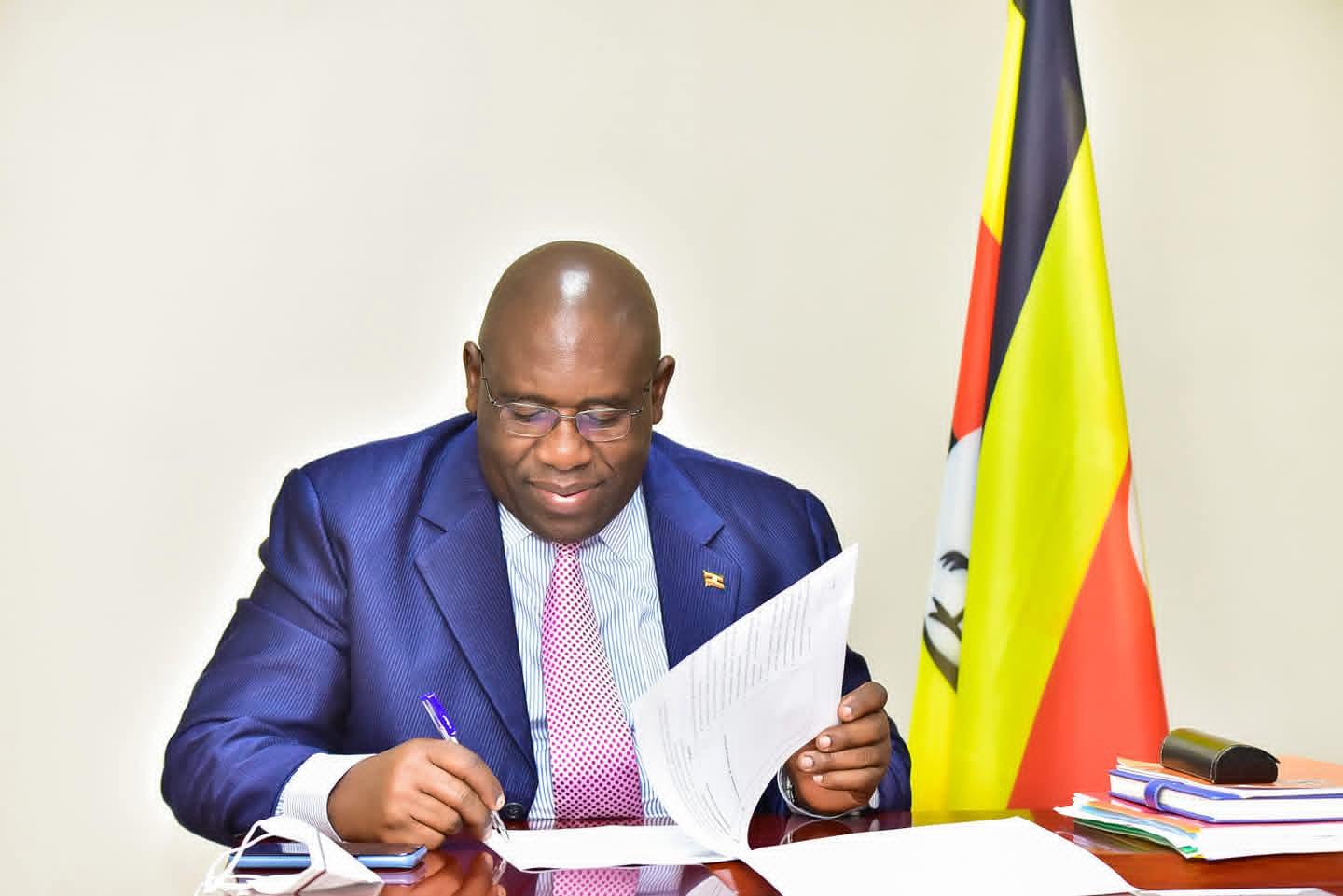
By Asuman Kiyingi
Senior Advocate, Former Member of Parliament, Former State Minister for Foreign Affairs.
TEU Preamble.
I write this with the deepest respect for the office of the President of the Republic of Uganda, H.E. Yoweri Kaguta Museveni, and for the legacy he has built over decades as a Pan-Africanist, a liberation fighter, and a statesman who has made humanity and the dignity of the African people his best diction.
It is President Museveni who taught this generation that Uganda’s foreign policy must never be for sale, that Pan-Africanism is not a slogan but a catchphrase we must live by, and that no African country should ever again be used as a mercenary for someone else’s geopolitical project.
Under his leadership, Uganda has stood with the oppressed, from the liberation struggles of Southern Africa to the peacekeeping missions in Somalia where our sons have bled so that others may live in peace.
It is precisely because of that proud record that I feel compelled to speak now.
Patriotism, I have learned in Cabinet and in Parliament, is not measured by how quickly we say “yes” to every request made of us. Patriotism is also measured by the courage to say “pause” — to ask the hard questions before we commit the blood of our sons and daughters to a cause whose terms we do not yet understand.
What is being proposed now, the deployment of the Uganda People’s Defence Forces(UPDF) into Gaza under a new international arrangement, is not a routine peacekeeping mission. It is a decision that will place Ugandan soldiers in the middle of one of the most complex, painful, and politically explosive conflicts of our time. And it is a decision that Parliament was asked to make without seeing the contract, without seeing the rules, without seeing the exit plan.
I know President Museveni’s heart is for peace and for humanity. I know his instinct is to stand with the vulnerable. But as someone who once held the brief for Uganda’s foreign affairs, and as someone who once sat on the benches of Parliament, I believe we owe him, we owe our soldiers, and we owe the Constitution a more sober debate.
The questions I raise in the article below are not meant to undermine our President. They are meant to protect the Pan-African principles he has championed, to protect the neutrality Uganda must keep as Chair of the Non-Aligned Movement (NAM), and to protect our UPDF from being drawn into an open-ended commitment without a clear political destination.
I therefore invite you, fellow Ugandan, to read the argument that follows in full, not to divide us, but to strengthen us.
Our soldiers deserve clarity. Our Constitution deserves respect. And the Pan-African vision of President Museveni deserves to be guarded jealously.
Read on:
Uganda’s decision to commit the Uganda People’s Defense Forces (UPDF) to a proposed international force in Gaza—and Parliament’s hurried approval of that deployment—represents a grave miscalculation in foreign policy and a troubling failure of parliamentary oversight.

No reasonable Ugandan should object to helping protect civilians, facilitate humanitarian access, or contribute to genuine international efforts to end conflict. Uganda has a proud record in international peace-support operations.
But sending Ugandan soldiers into Gaza is not simply another peacekeeping assignment. It is a deployment into one of the world’s most politically charged and militarily volatile theatres, under a mission whose precise mandate, command structure, rules of engagement, funding arrangements and legal protections were not disclosed to Parliament prior to approval.
Reporting on the parliamentary debate reveals the extraordinary haste with which the decision was taken. The Minister of Defense Hon Kiryowa Kiwanuka informed MPs that President Yoweri Museveni had, through emissaries, received a request from President Donald Trump for Uganda’s participation. Yet troop numbers and deployment dates had not been determined, and the Minister indicated that the Status of Forces Agreement (SOFA) would be concluded after Parliament approved the deployment.
That sequence should concern every citizen: Parliament was asked to sign the contract first and learn its terms later.
A Constitutional Duty Abandoned.
The deployment of armed forces outside Uganda is not an ordinary executive transaction. Article 210 of the Constitution assigns Parliament the explicit duty to regulate troop deployments outside our borders, backed by the statutory framework of the UPDF Act.
During the debate, Opposition MPs complained that they had been blindsided and that the motion was not subjected to the Defense and Internal Affairs Committee. Deputy Speaker Rt Hon Thomas Tayebwa ruled that the motion did not require committee referral and proceeded to dispose of it.
Even if procedurally defensible, constitutional responsibility is larger than procedural minimums. Where Ugandan soldiers are to be placed in a combat zone thousands of kilometers away, Parliament must know what they are being sent to do, under whose command, under what law, with what rules of engagement, at whose cost and under what conditions they can be withdrawn.
Worse still are signals from the Executive framing the UPDF’s objective as “dismantling terrorist cells”. This language betrays a hawkish misreading of the conflict. Reducing a decades-long struggle over national liberation, occupation and self-determination purely to a counter-terrorism operation risks reproducing the logic of colonial enforcement.
The framework established under UN Security Council Resolution 2803 requires the permanent decommissioning of weapons from “non-state armed groups”. This creates a profound asymmetry: Israeli forces remain the military forces of a recognized state, while Palestinian armed groups are treated within the International Stabilization Force (ISF) mandate as non-state armed groups whose weapons must be permanently decommissioned.
If UPDF troops enter Gaza to forcibly disarm these groups without their consent, they will not simply be keeping peace. They could find themselves acting as combatants in an asymmetric counter-insurgency.
Who Commands the “Board of Peace”?
There is a fundamental distinction that was obscured from Parliament: the International Stabilization Force is UN-authorized, but it is not a conventional UN-commanded peacekeeping force.
Resolution 2803 places the ISF under a unified command acceptable to the “Board of Peace”—a US-sponsored transitional body created around Donald Trump’s Gaza plan and chaired by Trump himself, with Secretary of State Marco Rubio and Jared Kushner among its senior figures.
The UN Security Council authorized this arrangement but did not transform the Board into a UN institution. The subsequent implementation architecture has made the distinction even clearer: the ISF is operating under United States unified command through Major General Jasper Jeffers, in consultation with Egypt and Israel.
The political architecture should give Uganda pause. Israel is represented on the Board, but the State of Palestine is not. Palestinians are to have a peripheral role in the technocratic administration of Gaza, but they are not part of the sovereign political authority supervising the international security architecture.
Constructing a Palestinian political future through an externally designed security structure in which Palestinians do not exercise primary political authority is reproducing the logic of colonial tutelage. Security imposed from outside cannot substitute for the political agency of the people whose territory is being governed.
For Uganda—and especially for Uganda as Chair of the Non-Aligned Movement (NAM)—joining the military arm of a US-designed transitional architecture without a clear Palestinian political mandate or conventional UN command represents a tragic recapitulation to imperialist preferences. It is a fundamental betrayal of the Pan-African anti-colonial doctrine that President Museveni himself has made his catchphrase.
Africa’s historic liberation movements, including South Africa’s ANC and Algeria’s FLN, have consistently maintained a principled distance from externally imposed guardianship plans. They understand that security cannot be built by subordinating an occupied people’s right to self-determination.
Uganda risks transforming the UPDF into an auxiliary police force for a foreign imperial project.
The Danger of Mission Drift and Permanent Deployment.
By failing to define a clear political destination, Uganda risks entangling its military in an open-ended quagmire. As strategic analysts have pointed out, there is a fundamental difference between state-collapse problems and sovereignty problems.
In Somalia, where the UPDF has been deployed since 2007, the challenge was state collapse—using military force to help build institutions. Gaza, by contrast, is fundamentally a sovereignty problem. Military force cannot resolve contested claims to identity, statehood and self-determination.
The history of international intervention offers sobering warnings.

The Kosovo model: Military intervention can end open warfare while leaving the core question of state sovereignty frozen and unresolved indefinitely.
The Southern Lebanon model: Peacekeepers can spend decades containing surface instability without ever resolving the strategic conflict beneath it.
Gaza risks becoming Kosovo without agreement on sovereignty, and Southern Lebanon without agreement on security.
The danger for the UPDF is not merely immediate tactical failure, but mission drift: troops arrive, mandates are repeatedly renewed, deadlines slip, and a “temporary” deployment acquires a permanent logic.
Having maintained a military presence in Somalia for nearly two decades, Uganda should know that entering a conflict without a clear political exit strategy can lead to indefinite commitment.
Neutrality and NAM Commitments Compromised.
Uganda’s credibility as an impartial actor has also been severely eroded.
While President Museveni has historically advocated diplomacy and a two-State solution, recent military posture projects an increasingly unambiguous bias. CDF Gen. Muhoozi Kainerugaba publicly offered military assistance to Israel during its recent confrontation with Iran.
Then, days before Parliament approved the Gaza deployment, the military unveiled a monument at Entebbe honoring Lt. Col. Yonatan Netanyahu, commander of the 1976 Israeli raid on Ugandan soil.
Commemorating an operation that violated Ugandan sovereignty, immediately before Parliament authorized Uganda’s participation in the Gaza force, creates a profound credibility problem for Uganda’s claim to neutrality in the eyes of Palestinians.
This posture is difficult to reconcile with Uganda’s duties as NAM Chair for 2024–2027. The Kampala Declaration reaffirmed support for ending the Israeli occupation and securing an independent, sovereign Palestinian State based on pre-1967 borders with East Jerusalem as its capital.
Sending troops to enforce stabilization without a binding political pathway to Palestinian statehood risks turning Uganda into an instrument of conflict management rather than liberation.
Furthermore, the framework envisages a newly trained Palestinian police force working with the ISF. But policing Gaza cannot substitute for Palestinian statehood. An externally supervised security administration risks becoming an instrument for managing the conflict rather than building the institutions of a sovereign state.
Without political reunification between Gaza and the West Bank and a credible pathway to Palestinian sovereignty, security arrangements risk merely managing the occupation rather than ending it.
The Unavoidable ICC Contradiction.
The legal risks are equally acute.
Uganda is a State Party to the Rome Statute of the International Criminal Court (ICC), which issued arrest warrants in November 2024 for Israeli Prime Minister Benjamin Netanyahu and former Defence Minister Yoav Gallant in connection with the situation in Palestine.
Uganda is now proposing to send its armed forces into the very conflict theatre that remains before the ICC, while the principal Israeli leadership implicated in the Court’s proceedings faces arrest warrants.
The contradiction is sharpened by US sanctions imposed in June 2025 against four ICC judges, including Ugandan Judge Lady Justice Solomy Balungi Bossa, in response to the Court’s actions concerning Israel.
Participating in a security architecture designed by an administration that has actively penalized a Ugandan jurist serving on the ICC bench creates an uncomfortable legal and diplomatic contradiction for Uganda.
This does not mean that Uganda cannot participate in any international effort involving Israel or Palestine. It means that any participation must be consistent with Uganda’s international legal obligations and its longstanding commitment to an independent international justice system.
Conclusion: Demand Accountability Before Deployment.
A Status of Forces Agreement and Rules of Engagement cannot be negotiated as afterthoughts. They determine legal immunities, criminal jurisdiction, rules on lethal force, responsibility for casualties, medical evacuation and the circumstances under which Ugandan soldiers may use force.
Ugandans are entitled to know whether their soldiers will use force only in self-defense or whether they may be ordered to forcibly disarm Palestinian armed groups.
Uganda already carries substantial military commitments in Somalia, the Democratic Republic of Congo and South Sudan. International flattery or diplomatic goodwill is not a sufficient reason to risk Ugandan lives.
Parliament must reopen this question, demand the missing legal instruments, scrutinize the SOFA and Rules of Engagement, and insist that any military contribution be explicitly tied to an undeniable roadmap towards a sovereign, independent Palestinian State alongside Israel.
Our soldiers deserve to know what they are being sent to do, under whose command, under what law, at whose expense and to what political end.
Security in Palestine must ultimately serve freedom and self-determination—not merely a better-policed occupation.