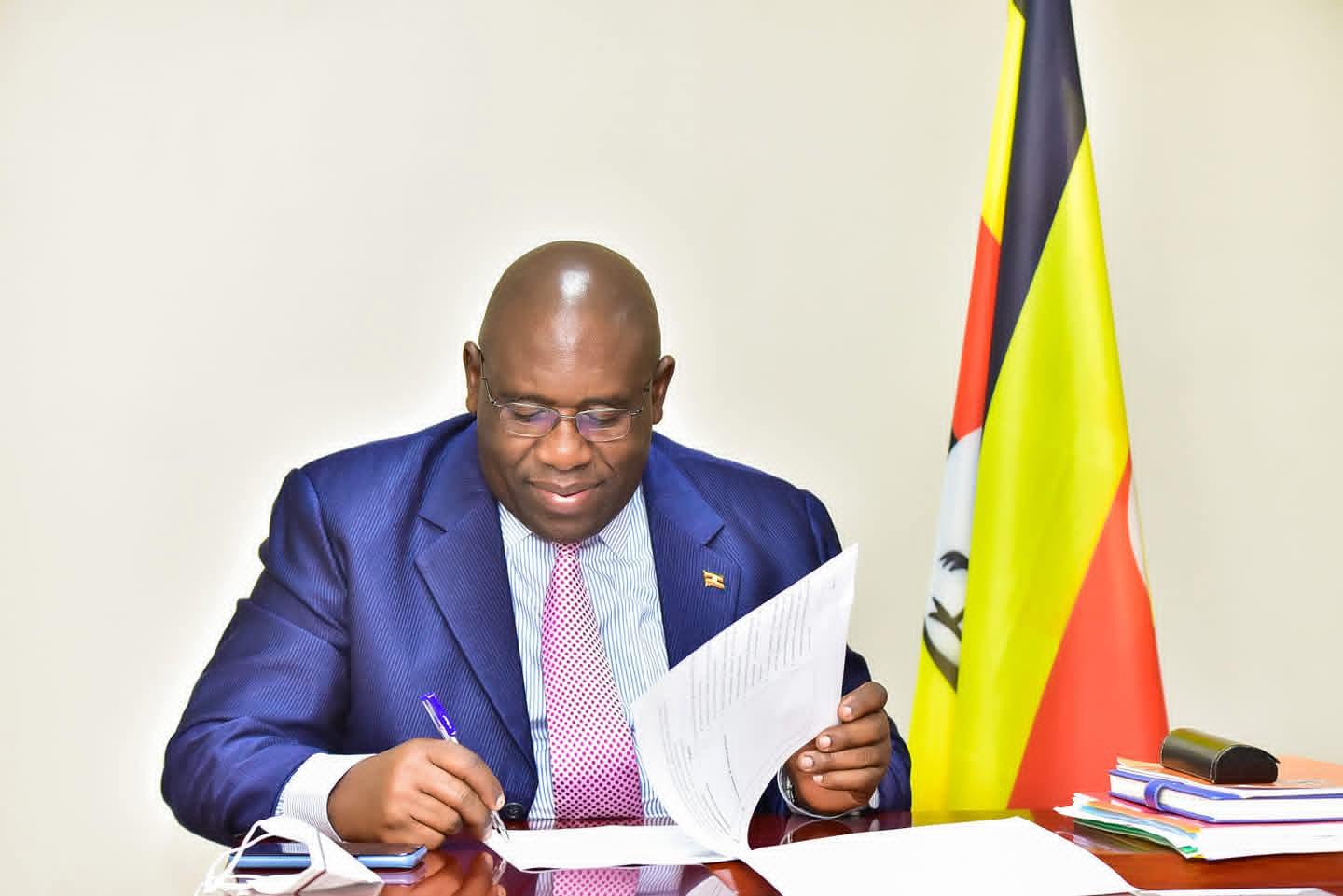
Tag: Asuman Kiyingi

  • Rwakakamba Vs Kiyingi, When Two Protagonists Spit Fire: Pressure Group or Presidential Ambition Machine? The Debate Uganda Cannot Avoid.

    Rwakakamba Vs Kiyingi, When Two Protagonists Spit Fire: Pressure Group or Presidential Ambition Machine? The Debate Uganda Cannot Avoid.

    From The Exposure Uganda (TEU) Newsroom.

    At The Exposure Uganda (TEU), we have been following with keen interest the issues surrounding the ongoing endorsements, the debate around the Patriotic League of Uganda (PLU), and the constitutional questions that continue to arise from them.

    This is a debate that has not stayed in one place. It has moved from opinion pages to WhatsApp groups, to radio talk shows, to newsrooms, to Parliament corridors, to homes across the country. Some Ugandans discuss it openly. Others discuss it quietly. Others choose not to discuss it at all. That in itself tells us how sensitive, and how important, this conversation has become.

    At the center of the latest round of this debate are two voices.

    On one side is Morrison Rwakakamba, who wrote in The Independent on 3 November 2026 defending the UPDF Chief of Defense Forces (CDF) General Muhoozi Kainerugaba, fondly referred to as “Gen MK” and the Patriotic League of Uganda (PLU).
    Rwakakamba who is the CEO of Prescot 15 Investment Advisory and immediate former chairman URA, argues that PLU is a lawful pressure group, that Gen Muhoozi enjoys constitutional freedoms of association and expression, and that the legal gaps in Uganda’s electoral and party laws require political dialogue rather than judicial intervention.

    On the other side is Hon Asuman Kiyingi, senior advocate, former Member of Parliament (Bugabula South in Kamuli district), former Cabinet Minister and former Deputy Chairperson of the Leadership Code Tribunal.

    His argument is that the classification of PLU as a pressure group does not answer the military question, that Article 208(2) requires the UPDF to remain non-partisan and subordinate to civilian authority, and that Uganda needs an authoritative judicial interpretation alongside genuine national dialogue.

    TEU, a revolutionary digital news platform does not take a side in this exchange. Our role is to ensure that Ugandans have access to the full arguments, in full, so that each reader can judge for themselves.

    What follows below is Hon Kiyingi’s rejoinder to Rwakakamba, reproduced verbatim, in his own words, without editing or summarizing.

    We invite you to read it in full, and to follow this debate with us as it continues to unfold.

    READ ON VERBATIM:

    Rwakakamba’s Civilian-Clothes Constitution: Why Military Law Cannot Be Suspended For Muhoozi.

    Constitutional freedoms do not exempt serving military commanders from non-partisanship. Morrison Rwakakamba’s defense of General Muhoozi Kainerugaba confuses civic association with military immunity, presidential awareness with constitutional compliance, and political dialogue with the enforcement of existing law.

    By Asuman Kiyingi

    Morrison Rwakakamba’s response to my article, published in The Independent on 3 November 2026 under the title “Kiyingi’s sweeping claim against Muhoozi seeks to mask gaps in the law and electoral institutions”, advances an extraordinary constitutional proposition: that Uganda’s serving Chief of Defense Forces (CDF) may direct nationwide presidential succession mobilization without violating military neutrality, provided the vehicle is described as a civic pressure group operating outside military establishments and command.

    His defense rests on three propositions: that the Patriotic League of Uganda (PLU) enjoys statutory exemption as a pressure group; that General Muhoozi Kainerugaba exercises constitutional freedoms independently of his military command; and that supposed legal ambiguities require political dialogue rather than judicial intervention.

    None answers two fundamental questions. Is General Muhoozi a serving member of the Uganda Peoples’ Defense Forces (UPDF)? If so, can he lawfully direct partisan presidential mobilization while remaining bound by Article 208(2) and military legislation?

    Rwakakamba, who has publicly identified himself as a patriotic cadre, is entitled to defend PLU. But political affiliation cannot substitute for constitutional reasoning. His accusation that my arguments are sweeping is misplaced when his defense separates legal provisions that must be interpreted together.

    The controversy is not whether soldiers possess constitutional rights or pressure groups may lawfully exist. It concerns whether those freedoms authorize conduct incompatible with military obligations.

    A Pressure-Group Exemption Is Not Military Immunity.

    Rwakakamba relies heavily on section 1(2) of the Political Parties and Organizations Act, Cap. 178, which excludes pressure groups and civic organizations from the statutory definition of political organizations.

    Section 1(1) defines political organizations by their objectives, while section 1(3) recognizes pressure groups seeking to influence public opinion and government action.

    Political advocacy alone therefore cannot disqualify PLU from being a pressure group. Its objectives, structures and activities require examination, particularly its mobilization for a named presidential successor.

    But Rwakakamba overlooks a fundamental distinction.

    Even assuming PLU is a lawful pressure group, its classification does not automatically authorize a serving military commander to direct its partisan activities.

    Section 16 restricts participation by Defense Forces members in political parties and organizations. Its application to PLU raises questions concerning the organization’s legal character.

    Independently, Article 208(2) requires the UPDF to remain non-partisan, national, patriotic, regular and professional, and subordinate to civilian authority.

    That constitutional obligation cannot be displaced by an organizational exemption under ordinary legislation.

    A familiar interpretive principle captures the danger: Quando Aliquid Prohibetur Ex Directo, Prohibetur Et Per Obliquum, a Latin for ‘what the law prohibits directly cannot be accomplished indirectly’.

    (Editor’s Note: For example, if the law says you cannot enter a house through the front door, you cannot climb in through the window and say you did not use the front door. In a nutshell if the law says a serving General cannot run a presidential campaign, he cannot run it through a pressure group and say he did not run as a general).

    Rwakakamba disagrees and says this maxim does not create a new prohibition. He says you cannot use a Latin saying to invent a crime where the statute does not forbid it.

    Kiyingi replies in his rejoinder:

    The maxim does not invent prohibitions. It prevents established restrictions from being defeated through artificial changes of form.

    If particular partisan activities are prohibited to a serving commander, conducting them through a civic pressure group does not automatically make them lawful.

    The law must examine substance, not merely labels. The maxim does not invent prohibitions. It prevents established restrictions from being defeated through artificial changes of form.

    If particular partisan activities are prohibited to a serving commander, conducting them through a civic pressure group does not automatically make them lawful.

    The law must examine substance, not merely labels.

    Constitutional Rights & Military Obligations.

    Rwakakamba invokes Articles 29 and 38, protecting expression, association and political participation.

    These rights are fundamental but operate within the Constitution as a whole.

    Article 43 permits lawful limitations justified by the rights of others and the public interest, provided they are acceptable and demonstrably justifiable in a free and democratic society.

    Article 208(2) establishes military non-partisanship, while Article 210 authorizes Parliament to regulate military organization and discipline.

    The objective is not to extinguish soldiers’ citizenship but to prevent the coercive institutions of the state from becoming instruments of partisan competition.

    An ordinary soldier expressing a political opinion is not equivalent to the CDF directing a nationwide movement promoting his presidential succession.

    Rwakakamba’s suggestion that Muhoozi acts exclusively in his private capacity whenever he wears civilian clothes is untenable.

    Military obligations arise from continuing military status, not the uniform worn.

    The UPDF Act, Cap. 330, provides the statutory framework for military service and discipline. Section 97 addresses relevant restrictions concerning political office and military service.

    The distinction between formal presidential nomination and preceding political mobilization is important.

    Rwakakamba argues that Muhoozi has not presented himself for nomination. But presidential campaigns do not begin when nomination papers reach the Electoral Commission.

    Political structures, endorsement campaigns and mobilization networks are established much earlier.

    If military neutrality became enforceable only upon formal nomination, a serving commander could organize an entire presidential campaign while retaining military command, retiring shortly before nomination.

    That interpretation would severely weaken Article 208(2).

    The question is whether Muhoozi’s present activities comply with military law, not whether he is already a nominated candidate.

    What The Courts Actually Decided.

    The Supreme Court’s decision in Attorney General v Major General David Tinyefuza, Constitutional Appeal No. 1 of 1997, is instructive.

    The Court considered whether Tinyefuza had ceased being a soldier following his appointment as Presidential Adviser and attempted resignation.

    It rejected the proposition that military status could terminate independently of applicable legal procedures.

    Military membership and accompanying obligations are determined by law, not an officer’s preferred description of his position.

    Although Tinyefuza did not determine whether a serving CDF could chair a presidential pressure group, it undermines the suggestion that military obligations disappear whenever an officer claims to act privately.

    The Tumukunde litigation addressed military status, constitutional rights, parliamentary representation and military discipline.

    More directly, in Kasozi and Others v Attorney General, the Constitutional Court rejected partisan political activity “within the army”.

    Rwakakamba construes that formulation as though the prohibition ends at the barracks gate.

    That is an artificial geographical interpretation of an institutional constitutional obligation.

    Military non-partisanship concerns the character and conduct of the institution and its members, not merely where activities occur.

    Neither Tumukunde nor Kasozi establishes unrestricted partisan freedoms for serving commanders outside military installations.

    Nor does Article 78, providing for UPDF representation in Parliament, authorize serving officers to direct presidential succession campaigns.

    Constitutionally authorized parliamentary representation cannot become unlimited partisan political liberty.

    Museveni’s Letter: The Smoking Gun Rwakakamba Misreads.

    (Editor’s Notes for context: Why Kiyingi Calls M7’s Letter A Smoking Gun.

    Kiyingi is not saying Museveni confessed to a crime, rather he is saying Museveni’s letter of 11th October,2026 to the NRM CEC is the smoking gun because:

    It acknowledges PLU is mobilizing for MK’s presidency in 2031, it invites the CEC to discuss MK’s suitability and it also proves that the organized succession mobilization around the serving CDF had reached the Commander-in -Chief himself.

    In Kiyingi’s words: “It establishes presidential awareness and organized political direction not by itself, criminal liability”. So, the smoking gun is not proof of guilt, it is proof of awareness and organization.

    Rwakakamba says Kiyingi misread the letter, Kiyingi says Rwakakamba misses the point-because the letter itself is the proof that this was not just supporters acting alone.)

    Rwakakamba accuses me of mischaracterizing President Museveni’s letter of 11 October 2026 to the NRM Central Executive Committee.

    Yet the letter acknowledges PLU’s mobilization for Muhoozi’s presidency in 2031–2036 and invites consideration of his suitability.

    Its significance is not that the President confessed to a criminal offence.

    It establishes that organized succession mobilization surrounding Uganda’s serving CDF had reached the Commander-in-Chief and become a matter for deliberation within the ruling party’s highest leadership.

    Subsequent developments reinforce its importance.

    On 29 October, Muhoozi directed PLU members to concentrate on presidential endorsements rather than discussing his father’s CEC paper. On 31 October, PLU Secretary General Twalla Fadil issued instructions attributed to Muhoozi concerning digital endorsements, regional and district structures and registration of political cadres.

    These developments challenge Rwakakamba’s suggestion that PLU mobilization consists merely of unsolicited enthusiasm by independent supporters.

    The smoking gun establishes presidential awareness and organized political direction—not, by itself, criminal liability.

    Why has the Commander-in-Chief not confronted the implications for military neutrality?

    Presidential awareness, political accommodation or institutional silence cannot confer legality upon unconstitutional conduct.

    When Private Politics Intrudes Into Public Power.

    Rwakakamba’s private-capacity defense becomes less convincing when tested against Muhoozi’s interventions in civilian governance.

    Consider his public declaration that PLU would approve new Resident District Commissioners.

    Article 203 vests RDC appointments in the President. A civic association may recommend candidates. But what constitutional authority permits PLU, under the serving CDF, to claim an approval role in presidential appointments?

    Consider also the reported ultimatum to Hon Justine Nameere, State Minister for Local Government.

    Following statements allegedly attributed to her and considered derogatory to the CDF, Muhoozi reportedly demanded an apology and threatened her with dismissal.

    Article 113 establishes the framework for appointing ministers, while the Constitution regulates termination of ministerial appointments. The CDF possesses no independent constitutional authority to dismiss a minister.

    These incidents cannot be explained away as private civic advocacy.

    They raise serious questions about military influence over civilian executive authority.

    A pressure group may lobby government. It cannot acquire constitutional powers over public appointments or ministerial tenure.

    This is precisely why civilian supremacy matters.

    The ULS, Constitutional Litigation & Foreign Examples.

    Rwakakamba attacks the Uganda Law Society’s Executive Order RNB No. 13 of 2026, arguing that the Society has assumed prosecutorial powers.

    Calling a legal opinion an Executive Order does not make it binding.

    The ULS cannot prosecute by proclamation or exercise the Director of Public Prosecutions’ constitutional powers.

    But its statutory mandate permits it to identify constitutional concerns, advise government and call upon competent authorities to act.

    Recommending investigation or prosecution is not itself prosecution.

    Article 137 separately provides for resolving questions requiring constitutional interpretation.

    A properly constituted petition concerning Article 208(2) does not usurp the DPP’s powers.

    Neither does the dismissal of Male Mabirizi’s private criminal complaint establish that Muhoozi’s PLU activities comply with the Constitution.

    Criminal liability and constitutional compliance involve different legal questions.

    Rwakakamba’s objection to judicial intervention mistakes constitutional adjudication for political persecution.

    His comparative examples fare no better.

    United States Department of Defense Directive 1344.10 distinguishes permissible personal political expression from restricted partisan campaign activity by serving military personnel.

    Kenya’s Constitution, under Article 239(3), similarly restricts partisan conduct by national security organs and their members when exercising official functions.

    These examples distinguish citizenship from partisan military involvement.

    Egypt’s military-led development, which Rwakakamba praises, cannot determine Uganda’s constitutional obligations.

    Economic performance does not override Article 208(2).

    Welcome Dialogue, But Not Militarized Succession.

    Rwakakamba invokes the Consociational Democracy Agreement (CDA) associated with General Salim Saleh and Professor Ogenga Otunnu as an alternative to constitutional litigation.

    I welcome serious national reconciliation initiatives.

    Having recently obtained a substantial document containing the CDA’s proposed dialogue framework, which I am yet to examine fully, I recognize that it deserves informed engagement.

    However, important questions remain. How does the CDA relate to the National Consultative Forum and the Inter-Party Organization for Dialogue (IPOD)?

    How will civil society, religious and cultural institutions, academia, professional associations, women, youth, organized labour, business and communities beyond established political elites participate?

    Who will determine representation, control the agenda and guarantee independence?

    The CDA should become part of transparent, inclusive national dialogue culminating in a genuinely representative National Conference.

    Such a conference must confront constitutional reform, civilian supremacy, electoral credibility, judicial independence, accountability, federalism, decentralization and peaceful political transition.

    Above all, dialogue must not become a political cover for legitimizing a predetermined militarized Muhoozi succession.

    National reconciliation cannot be purchased by sacrificing constitutional principles.

    Political negotiations and constitutional accountability are complementary, not competing obligations.

    The Choice Between Military Command And Partisan Ambition.

    The controversy is not hostility towards Muhoozi or opposition to his future presidential ambitions.

    The Constitution does not disqualify a citizen merely because he is the President’s son or has served in the military.

    But political ambition must operate within the law. Muhoozi cannot claim the advantages of military command while treating its constitutional obligations as optional during partisan mobilization.

    Rwakakamba’s defense asks Ugandans to accept that a serving CDF may direct a presidential succession movement privately while its institutional implications remain legally irrelevant.

    That proposition is constitutionally unsustainable.

    PLU’s classification as a pressure group does not settle the military question. Presidential awareness does not confer constitutional immunity. Nor can dialogue substitute for judicial determination of existing legal obligations.

    Uganda requires authoritative judicial resolution alongside genuine national dialogue capable of producing a broader political settlement.

    Our constitutional history warns against confusing military authority with political entitlement.

    Military law does not end at the barracks gate. The Constitution does not change when the Chief of Defense Forces changes his clothes. And what the law prohibits directly cannot be legitimized indirectly through a political pressure group.

    The writer is a senior advocate, former Member of Parliament, former Cabinet Minister and former Deputy Chairperson of the Leadership Code Tribunal.


  • M7’s Former Minister Exposes PLU: How Endorsements Across 146 Districts Violate Article 208(2) As He Peeps Inside PLU’s Presidential Machine.

    M7’s Former Minister Exposes PLU: How Endorsements Across 146 Districts Violate Article 208(2) As He Peeps Inside PLU’s Presidential Machine.

    Preamble: The Guardians and The Family.

    From Plato (c. 428-348 BC) in The Republic (c. 375 BC) warning that the guardians of the city must never become merchants of power, to Baron de Montesquieu (1689-1755) in De l’Esprit des Lois (1748) insisting on the separation of executive, legislative and military power, to General Carl von Clausewitz (1780-1831) in Vom Kriege / On War (1832) establishing that war is politics by other means but must remain subordinate to civilian politics – republics have faced one existential question: Quis custodiet ipsos custodes? Who guards the guardians when the guardians decide to guard a family?

    Rome did not fall on 10 January 49 BC when Gaius Julius Caesar (100-44 BC) crossed the Rubicon River with the XIII Legion. It fell when the Roman Senate convinced itself that a serving general could remain a serving general while campaigning to become Caesar.

    England did not lose its Parliament when Oliver Cromwell (1599-1658) abolished the Rump Parliament on 20 April 1653. He destroyed it by sitting in Parliament with his Army outside, fusing barracks and bench.

    In post-colonial Africa, from Kwame Nkrumah (1909-1972) and his Convention People’s Party (CPP) in Ghana after independence in 1957, to Mobutu Sese Seko (1930-1997) and his Mouvement Populaire de la Revolution (MPR) in Zaire after 1965, the most durable authoritarianism was never the classic coup d’état. It was the slow, legalistic fusion of barracks, party, and bloodline until the state could no longer tell where the army ended and the family began.

    It is in this long philosophical, political, historical and military tradition – from Plato to Montesquieu to Clausewitz, from Caesar to Cromwell to Mobutu – that the current Ugandan constitutional moment of October 2026 must be read.

    What follows is not an interpretation. It is the verbatim text of Counsel Asuman Kiyingi‘s analysis – Of Museveni’s Smoking Gun & Rwakakamba’s Bankrupt Defense Of Militarism and Dynasty (2026) – presented in full, without edit, for the reader to judge on law, on history, and on principle.

    Read it verbatim:

    Recent developments demonstrate why these safeguards matter beyond the courtroom. On 31 October, Muhoozi declared:

    “PLU will approve all new RDCs in the country.”

    Yet Article 203 vests RDC appointments in the President. Political organizations may recommend candidates, but recommendations differ fundamentally from claiming approval authority over presidential appointees.

    Does PLU merely intend to advise the President, or must prospective RDCs secure its approval? If the latter, where does that authority originate?

    The implications become more troubling against the background of intimidation and factional tensions surrounding the succession campaign.

    General Kahinda Otafiire faced threats following his parliamentary criticism of the CDF’s conduct. Minister for the Presidency Milly Babirye Babalanda publicly complained about hostility towards herself and officials perceived as loyal to Museveni.

    Hadijah Namyalo, coordinator of political mobilisation for the NRM National Chairman, had her security detail withdrawn amid confrontation with PLU figures.

    On 30 October, Museveni reportedly directed its restoration and ordered an investigation, indicating that he had neither authorized nor known about the withdrawal.

    Who ordered it? Were security arrangements influenced by competing political loyalties?

    Responsibility remains to be established, but these developments raise serious concerns about competing centres of political authority.

    President Museveni occupies four overlapping positions: Head of State, Commander-in-Chief, NRM Chairman and Muhoozi’s father. These relationships heighten rather than diminish his constitutional responsibilities.

    In his 11 October letter, Museveni wrote:

    “As the Father of Muhoozi, a resistance fighter and the one who encouraged him to join the Army, I know him to excel on most of these considerations.”

    A father’s assessment of his son is natural. But presenting that assessment to the ruling party’s leadership while his son commands the national army creates unmistakable constitutional tension.

    The Constitution does not prohibit a President’s son from seeking the presidency. Neither does it permit familial succession ambitions to override military neutrality, equal political competition or civilian supremacy.

    When the President’s son commands the army while directing a nationwide presidential campaign, the danger extends beyond favouritism to the potential conversion of republican institutions into instruments of dynastic succession.

    Museveni argues that procedures without substance are barren. But military non-partisanship is no empty procedural requirement. It safeguards against converting armed power into partisan advantage.

    If Muhoozi wishes to pursue the presidency, he should relinquish military command before engaging in partisan competition. If he remains CDF, the Commander-in-Chief must enforce military neutrality.

    The Constitution recognizes no familial exception to military neutrality.

    Rwakakamba also criticizes the ULS for demanding disciplinary and prosecutorial action.

    Yet section 3 of the Uganda Law Society Act establishes its responsibilities concerning justice and the rule of law, while Article 3(4) recognizes citizens’ duty to defend the constitutional order.

    Issuing a legal opinion is not exercising judicial authority. The ULS may identify apparent violations and demand investigation; competent institutions must independently determine legal consequences through due process.

    The controversy demands expeditious judicial resolution.

    Under Article 137, the Constitutional Court should determine PLU’s legal character and the compatibility of Muhoozi’s chairmanship and political direction with Article 208(2). Applicable retirement obligations and PLU’s claimed influence over RDC appointments also require appropriate legal scrutiny.

    Museveni’s letter, Muhoozi’s directives and PLU’s formal notice provide important evidentiary material.

    The Attorney General, Electoral Commission and military authorities must discharge their respective duties. Above all, the judiciary must resolve this controversy independently and without intimidation.

    Rwakakamba is correct that soldiers retain constitutional rights and lawful pressure groups may undertake civic advocacy.

    But those propositions do not answer the ULS’s central objection.

    Ugandans may support Muhoozi’s presidential ambitions. The question is whether the serving commander of their national army may personally direct the political machinery promoting those ambitions.

    Museveni’s letter supplies the smoking gun. Muhoozi’s directives reinforce its significance. The experiences of Otafiire, Babalanda and Namyalo expose the wider dangers of militarized succession.

    The UPDF belongs to the Republic of Uganda, not to a family, faction or succession project.

    President Museveni must choose between enforcing military neutrality and acquiescing in its erosion.

    Ultimately, the question is whether Uganda’s constitutional institutions still possess the independence and courage to prevent military power from becoming the guarantor of dynastic succession.

    The writer is a senior advocate, former Member of Parliament and former Minister.


  • Four Decades Of President Yoweri Museveni: A Nation At The Crossroads Of Succession.

    Four Decades Of President Yoweri Museveni: A Nation At The Crossroads Of Succession.

    Preamble To The Exposure Uganda (TEU)
    TEU In-Flight Briefing No. TEU-20260902.

    Welcome aboard TEU Supersonic. We are flying at the cruising altitude of constitutional reason, where every citizen can read the compass and see the runway ahead.

    Uganda is entering that delicate phase that every long-governed state must one day confront, which is how to transfer power from one generation to the next without injuring the Republic itself.

    The current debate was triggered by a claim that after four decades, President Yoweri Museveni intends to give way to his son, Gen. Muhoozi Kainerugaba. It is also public record that supporters of Gen. Muhoozi, widely referred to as MK, have declared that he will be on the ballot in 2031, and he has neither rebuked nor dismissed those declarations. That leaves his ambition firmly in the public domain.

    Two legitimate constitutional narratives have emerged, and both deserve a fair hearing.

    The first narrative emphasizes rights and continuity. It argues that MK, like any other citizen under Articles 1 and 59 of the Constitution, enjoys the full right to stand, to be voted for, to support any person of his choice, and to aspire for the highest office. Supporters see in him continuity, institutional memory, generational renewal and the legitimate claim of a citizen who has served in uniform. To them, aspiration itself cannot be criminalized.

    The second narrative emphasizes process and impartiality. It argues that the question is not whether MK may stand, for he clearly may, but how a serving Commander of Defense Forces (CDF) exercises that right while still holding command of the national army. This school cites Article 208 which requires the UPDF to be national, non-partisan, professional and subordinate to civilian authority, and the Political Parties and Organizations Act which restricts partisan political activity by serving officers. To them, the concern is whether the political field will remain open and equal for all other aspirants.

    TEU does not carry a brief for or against any person, family, party or faction. Our fidelity is to a stable and flourishing Uganda where power passes only through the Constitution.

    This is where classical statecraft helps us think more clearly.

    Sun Tzu in The Art of War offers two relevant maxims. In Chapter One he teaches that “All warfare is based on deception,” meaning the battle is often won when the outcome is made to appear inevitable before it is fought.

    In Chapter Three he adds that “The supreme art of war is to subdue the enemy without fighting.” Applied to democratic succession, the lesson is cautionary for all sides. No outcome should be made to feel inevitable before citizens have voted, and no political actor should win by shaping the environment rather than by persuading the electorate.

    Niccolò Machiavelli helps us from a different angle. The Florentine scholar did not teach immorality but realism about power. In The Prince, Chapter 19, he warns that a Prince must above all avoid being despised and hated, for stability depends on legitimacy. In Chapter 25, he reminds us that fortune controls half our actions but free will must control the other half.

    And in his Discourses On The First Ten Books of Titus Livy (Nicolo’s other major political book), he argues that no state endures unless it establishes laws and institutions for succession that outlive the founder. In other words, the greatest service a long-serving leader can render is not to choose a successor, but to build institutions strong enough to produce a successor constitutionally.

    Read together, Sun Tzu warns against predetermination, while Machiavelli warns against institutional vacuum. Both point Uganda to the same place: an open, lawful, competitive process.

    That process must guarantee that every qualified Ugandan enjoys the freedom to organize, to assemble, to campaign and to be judged by the people, that security institutions remain within their constitutional mandate, that the Electoral Commission applies the rules equally to all, and that the Judiciary remains the impartial compass when constitutional questions arise.

    It is in that spirit that we have invited Hon. Asuman Kiyingi, Senior Advocate and former Minister who has served both in Cabinet and at the Bar, and political arena as Bugabula North MP in Kamuli to offer his constitutional reflection.

    We present his piece verbatim, without addition or subtraction, so you may interrogate it, agree with it, disagree with it, and reach your own reasoned conclusion.

    Because as our motto says, We Expose, You Decide.

    Read Hon. Asuman Kiyingi Verbatim:

    Four Decades of Museveni: When Succession Becomes A Constitutional Crisis. Uganda must ensure that power passes through the Constitution, not around it.

    By Asuman Kiyingi

    Uganda has suddenly been confronted with a remarkable claim: that after four decades in power, President Yoweri Museveni is preparing to “give up power” and that Gen Muhoozi Kainerugaba will take over.

    The assertion, attributed to PLU Member of Parliament Hon David Kabanda (Kasambya County), would be extraordinary enough even if it concerned an ordinary political transition.

    It becomes considerably more consequential because Muhoozi is the serving Commander of the Defense Forces and has himself publicly confirmed his intention to contest for the presidency in 2031.

    Whether the President intends to leave office in favor of his son, whether Kabanda was announcing an agreed political plan, or whether the statement represents political messaging or speculation, is a question President Museveni can easily settle.

    He should.

    Because if Uganda’s next President is already being identified before the people have had an opportunity to choose—and before other aspirants have even had an opportunity to compete—the country is confronted with something much more serious than ordinary succession politics.

    It is confronted with a constitutional question. Who chooses Uganda’s next President?

    President Museveni may decide when to leave office. He may express a preference about who should succeed him. Gen Muhoozi may aspire to become President. Other NRM or PLU members may aspire to the same office. Opposition politicians may do likewise.

    But none of them can constitutionally appoint Uganda’s next President.

    Article 1 of the Constitution provides that all power belongs to the people, who exercise their sovereignty either directly or through their democratically elected representatives.

    That principle is not decorative.

    It means that the presidency is not the personal property of its incumbent. Neither is it the property of a political party, a family, a military institution or a political faction.

    The next President must derive authority from the constitutional electoral process.

    This is why the reported claim that the President will “give up power” in favour of Muhoozi deserves serious interrogation. Whatever the political meaning of “giving up power”, the constitutional transfer of presidential authority cannot simply be accomplished by personal designation. The Constitution establishes procedures governing presidential tenure, resignation, vacancy, elections and succession.

    Political preference cannot substitute for constitutional process.

    What about the other NRM and PLU aspirants?

    There is a question that President Museveni should answer directly:

    What happens to the other members of the NRM and PLU who aspire to become President of Uganda?

    Why should one aspirant appear to enjoy an early endorsement while others have not even been given the opportunity to present themselves?

    If Gen Muhoozi wishes to become the NRM flag bearer, why not allow him to compete openly against every other NRM presidential aspirant?

    Let those who wish to contest declare their ambitions. Let them articulate their programmes. Let them debate one another.

    Let the party’s members determine its flag bearer through transparent, credible and competitive internal processes.

    If Muhoozi enjoys the overwhelming support that his supporters claim, there should be no reason to fear such a contest.

    Indeed, an open contest would strengthen his claim to leadership.

    If President Museveni genuinely believes that Muhoozi is the best person to lead Uganda, why should he fear allowing him to compete for the NRM flag against other aspirants? And if Muhoozi truly commands the overwhelming support claimed for him, why should that support not be demonstrated through an open and credible contest?

    The same principle should apply to PLU or any other political formation.

    After forty years, the ruling political movement has an opportunity to demonstrate that it is an institution capable of producing leadership through competition rather than succession by designation.

    Allowing anyone who wishes to lead the NRM to compete for its presidential flag, subject to the law and the party’s rules, would strengthen rather than diminish the President’s historical legacy.

    But can everyone actually compete?

    This is where the question of succession becomes inseparable from the condition of Uganda’s civic and political space.

    It is not enough to tell Ugandans that they will eventually be allowed to choose their President if the political environment in which that choice is supposed to occur has already been severely constrained.

    A genuinely competitive election requires more than ballot papers, polling stations and competing names.

    It requires the freedom to organize, assemble, campaign, speak, criticize government, mobilize supporters and participate in political life without intimidation or arbitrary interference.

    Uganda’s experience in recent years raises serious questions on this score.

    Reports of abductions and prolonged detention of political opponents, the continued prosecution and incarceration of opposition figures, and the displacement of political actors into exile have contributed to a political environment in which opposition forces face serious constraints on their ability to organize and compete.

    These developments cannot simply be dismissed as isolated law-and-order incidents.

    Their cumulative effect on the electoral environment matters.

    The constitutional promise of popular sovereignty becomes hollow if citizens are presented with a choice only after some potential choices have been systematically weakened or eliminated.

    This is the danger Uganda must confront before 2031.

    For if the political field is sufficiently narrowed, an election can retain all the outward characteristics of constitutional legitimacy while failing the more fundamental test of whether voters were genuinely offered a free and meaningful choice.

    The question therefore cannot simply be whether Muhoozi can win an election.

    The prior question is whether everyone who wishes to challenge him will be allowed to compete on reasonably equal terms.

    That responsibility rests principally with the State.

    The Government must protect, rather than constrict, the civic space in which political competition takes place. Security agencies must operate within the law. Opposition politicians must be free to organize and campaign.

    The Electoral Commission must be capable of enforcing electoral rules impartially. The courts must remain independent. Political parties must be allowed to compete without intimidation or administrative manipulation.

    Otherwise, Uganda risks creating the appearance of constitutional succession while reproducing the substance of predetermined succession.

    But what if the contest itself has lost meaning? Let me put the question personally, but hypothetically.

    Suppose I wished to contest for the presidency in 2031. What exactly would I be contesting?

    Would I be entering a genuinely open constitutional contest in which the law, the institutions and the political environment give every candidate a reasonable opportunity to persuade the electorate?

    Or would I be participating in an electoral process whose fundamental conditions had already been compromised by restrictions on civic space, unequal access to political organization, detention of political opponents, the use of State institutions in partisan politics and the unresolved involvement of the military in political mobilization?

    If the latter is the reality, then a more fundamental question arises:

    What is the constitutional value of merely participating in an election whose essential conditions of democratic competition have already been compromised?

    This is not an argument against elections.

    It is an argument for elections that deserve to be called elections in the constitutional sense.

    A ballot paper alone does not make an election free and fair. The constitutional right to choose necessarily includes the conditions that make meaningful choice possible.

    If political competitors cannot organize freely, assemble freely, speak freely, campaign freely or remain free to participate in political life, then the existence of competing names on a ballot cannot, by itself, cure the underlying democratic deficit.

    And if the eventual winner enjoys advantages unavailable to other contestants because of incumbency, State resources, security structures or political mobilization by serving public officials, the question cannot simply be whether votes were counted.

    The deeper question is whether the people were genuinely free to choose.

    The civil-military contradiction. This is also why the involvement of the military in the succession question is so consequential.

    Article 208 of the Constitution establishes the UPDF as a national, non-partisan, patriotic, professional and disciplined force subordinate to civilian authority.

    Parliament has reinforced this constitutional principle through the Political Parties and Organizations Act, which places significant restrictions on members of the UPDF and other specified public officers participating in partisan political activity.

    These provisions exist for a reason.

    The military possesses instruments of coercive power that ordinary political actors do not possess. Its political neutrality is therefore not simply a matter of institutional etiquette. It is a constitutional safeguard for political equality.

    A presidential aspirant who simultaneously commands the national armed forces occupies a fundamentally different position from an ordinary presidential aspirant.

    This does not mean that every political statement by a serving military officer automatically establishes a constitutional violation. Uganda’s constitutional jurisprudence itself reflects complexities concerning the relationship between military service and political office.

    But the combination of active presidential ambition, partisan political mobilization and command of the national armed forces presents a constitutional contradiction of exceptional seriousness.

    It requires authoritative determination rather than political rationalization.

    The question is therefore not whether Muhoozi has a right to aspire to the presidency.

    He does, subject to the Constitution and the law.

    The question is whether he can simultaneously exercise the constitutional responsibilities of a serving CDF and participate in partisan political activity in a manner consistent with those same constitutional and statutory requirements.

    That is a question for the institutions of the Republic—not for political convenience.

    From formal election to genuine popular choice

    There is a profound distinction between being elected and being freely chosen.

    An election can be procedurally conducted while the political environment preceding it is profoundly unequal.

    A country can have polling stations, ballot papers, counting centers and declared results and yet fail to provide citizens with the meaningful political choice contemplated by the Constitution.

    That is why the integrity of the 2031 election cannot be left until 2031.

    The conditions must be established well before polling day.

    The Electoral Commission should clarify the legal status and activities of political formations involved in political mobilization and ensure that electoral rules apply equally to all.

    Parliament should interrogate the intersection between military service, partisan politics and presidential succession.

    The Government should guarantee civic and political freedoms rather than merely proclaim them.

    Security agencies should remain within their constitutional mandate.

    Political parties should open their internal processes to genuine competition.

    And citizens, civil society and political actors should not wait until an election has been conducted to ask whether the conditions for a free election existed.

    What must be done now.

    President Museveni can remove much of the uncertainty surrounding succession.

    He can publicly clarify whether the extraordinary claim that he intends to “give up power” in favour of Gen Muhoozi has any basis.

    He can affirm that no successor has been predetermined.

    He can insist that every NRM presidential aspirant enjoys an equal opportunity to compete for the party’s flag.

    The NRM itself can demonstrate its democratic maturity by establishing transparent rules through which competing presidential aspirants can present themselves and seek the mandate of the party.

    The Electoral Commission can clarify the legal status and activities of political formations involved in presidential mobilization, particularly where serving public officers are involved.

    Government can restore the civic conditions necessary for genuine electoral competition—including freedom from arbitrary detention, abduction, intimidation and unjustified restrictions on lawful political organization.

    And the constitutional questions surrounding military command and partisan political activity can be subjected to authoritative institutional determination rather than political convenience.

    These measures would not weaken President Museveni.

    They would strengthen his legacy.

    After forty years, his greatest contribution to Uganda’s constitutional development may not be choosing who comes after him.

    It may be demonstrating that he does not have the constitutional power to choose.

    The Judiciary must be the constitutional compass

    Ultimately, however, Uganda cannot depend upon individual goodwill.

    Constitutions exist precisely because political power cannot safely be left to the goodwill of those who exercise it.

    The Judiciary therefore has a particularly important role.

    Article 137 provides the constitutional jurisdiction for determining questions concerning the interpretation of the Constitution, including challenges alleging that an Act of Parliament or an act or omission by a person or authority is inconsistent with the Constitution.

    Where the relationship between military command, partisan political activity, presidential succession, civic freedoms and electoral competition raises genuine constitutional questions, the courts should be prepared to pronounce upon them.

    They should not wait until a succession arrangement has become politically entrenched or until another disputed electoral process has already produced a constitutional crisis.

    But judicial independence is indispensable.

    The courts must neither become instruments for legitimizing political arrangements simply because those arrangements are powerful nor instruments for frustrating legitimate political aspirations.

    Their responsibility is more demanding:

    to apply the Constitution impartially to everyone.

    That requires courage.

    It requires institutional independence.

    And above all, it requires fidelity to the Constitution.

    The real test of four decades

    The ultimate issue is not whether Muhoozi should or should not become President.

    If Muhoozi wins a genuinely free, fair and competitive election, Uganda must accept that result—even those who oppose him.

    If another NRM candidate defeats him in a genuinely competitive party contest, that result should be respected.

    If an opposition candidate wins a genuinely free national election, that result must equally be respected.

    The constitutional issue is not who wins.

    It is whether the people are genuinely free to decide who wins.

    That is why the reported succession claims, the condition of civic space, the treatment of political opponents, the role of the military and the independence of the Judiciary cannot be examined separately.

    Together they determine whether Uganda’s next presidential transition will be a constitutional succession—or merely an electoral ritual conferring legitimacy on a political outcome shaped by an unequal political environment.

    After four decades, Uganda’s historical test is no longer simply whether an incumbent can remain in power.

    It is whether Uganda can demonstrate that political power is bigger than any individual who exercises it.

    An incumbent may choose retirement or express a political preference.

    Muhoozi may aspire to the presidency.

    Other NRM and PLU members may aspire to it.

    Opposition politicians may aspire to it.

    Indeed, every Ugandan who satisfies the constitutional qualifications should be entitled to aspire to the presidency.

    But no individual can choose Uganda’s next President.

    Only the people can do that through the Constitution.

    And if the meaning or limits of that Constitution are contested, the courts must be there to say what the Constitution permits and what it forbids.

    They must do so without fear.

    Without favour.

    And with absolute fidelity to the Constitution.

    President Museveni owes Uganda an answer—not because he is constitutionally required to nominate a successor, but precisely because he is not.

    Uganda must now confront a deceptively simple question:

    When power eventually passes, will it pass through the Constitution—or around it?

    The writer is a senior advocate and former Minister.


  • Uganda’s Gaza Test, the Weight of the Uniform in a Fractured World: Hon Asuman Kiyingi on Why Impartiality, Not Firepower Will Decide the Success of Any Mission in Gaza.

    Uganda’s Gaza Test, the Weight of the Uniform in a Fractured World: Hon Asuman Kiyingi on Why Impartiality, Not Firepower Will Decide the Success of Any Mission in Gaza.

    Preamble: The Weight of The Uniform In A Fractured World.

    War and peace have always turned on one question: who do the guardians serve?

    In 431 BC, an ancient Greek general and historian Thucydides (460 BC-400 BC) warned that in moments of great power struggle, “it was the strong who did what they could and the weak who suffered what they must.” Yet even the strong, he noted, lost when they lost the belief of those they claimed to protect. Credibility, not firepower, was the true currency of empire.

    Napoleon Bonaparte (1769-1821), whom the world remembers for redrawing the map of Europe between 1799 and 1815, understood this better than most generals.

    He rose from a young artillery officer to Emperor of France not just by winning battles, but by building institutions. Yet his most enduring lesson for soldiers came in one sentence: “The moral is to the physical as three is to one.”

    In other words, morale, perception and legitimacy matter three times more than guns and numbers. Napoleon conquered half of Europe, but he lost it in Russia in 1812 because the people he marched into no longer believed his cause was theirs.

    That is why modern peacekeeping rests on three pillars forged in blood: impartiality, consent, and minimum use of force. From United Nations Emergency Force (UNEF) in Sinai in 1956 to AMISOM in Mogadishu, the doctrine has been clear — a peacekeeper must be seen to have no flag but peace.

    The moment a blue helmet is perceived as the armed wing of one side’s politics or theology, it ceases to keep peace and becomes a target.

    History is littered with the cost of ignoring that. In Lebanon in 1983, a multinational force lost neutrality and lost 241 marines in a single day.

    In Bosni and Herzegovina, UN “safe areas” collapsed not because troops lacked courage, but because the world doubted their mandate. And in Africa, Uganda itself knows this truth: the UPDF earned respect in Somalia not merely by fighting Al-Shabaab, but by staying, in the eyes of Somalis- as a buffer, not a belligerent.

    Today, the Middle East presents the hardest test of all. Gaza is not a border dispute. It is a wound where law, religion, memory and power intersect. Any force sent there will walk into a story 75 years old, where every stone has a narrative and every uniform is read for its allegiance before its purpose.

    It is in that context that reports of a proposed Ugandan deployment as part of an International Stabilization Force in Gaza must be weighed — not just militarily, but politically and morally. For Uganda, this is not about the capacity of its soldiers.

    The UPDF has proven itself from Mogadishu to Bunia. The question is about Uganda’s soul as a diplomatic actor: Can a nation be both a committed friend and a credible referee?

    These are the dilemmas that have occupied statesmen from South Africa’s Nelson Mandela to Texas’s Dwight D. Eisenhower. “You cannot shake hands with a clenched fist,” Mandela said.

    And Eisenhower, the four-star-general-turned-president, cautioned: “In the councils of government, we must guard against the acquisition of unwarranted influence… by the military-industrial complex.” Missions abroad must serve national interest and national values, not just the logistics of deployment.

    It is with that burden of history and philosophy in mind that we turn to the voice of experience.

    Read verbatim what former State Minister for Foreign Affairs, Member of Parliament and Senior Advocate, Hon. Asuman Kiyingi, is saying on Uganda’s proposed Gaza mandate:

    Uganda’s Gaza Mandate: Why the Proposed Deployment Risks Uganda’s Credibility.

    By Asuman Kiyingi

    Reports that Uganda has agreed in principle to deploy the Uganda People’s Defense Forces (UPDF) as part of a proposed International Stabilization Force (ISF) in Gaza should concern every Ugandan who values the country’s diplomatic credibility. Ordinarily, such an invitation—reportedly following discussions initiated by the United States—would be presented as recognition of Uganda’s reputation as a dependable contributor to international peace support operations. For decades, the UPDF has distinguished itself through demanding stabilization missions in Somalia, South Sudan, the Central African Republic and the Democratic Republic of Congo.

    Yet the proposed Middle Eastern deployment raises profound institutional and geopolitical questions that cannot be ignored. Can Uganda credibly present itself as a neutral peacekeeping actor when its own Chief of Defence Forces has repeatedly and publicly declared unwavering political, religious and military support for one side in the conflict? More fundamentally, does participation risk drawing Uganda into a political framework that many believe falls short of the requirements of international law and a just settlement of the Israeli-Palestinian conflict?

    In peace support operations, perception matters almost as much as reality. A force entrusted with maintaining security during a political transition must command the confidence of all parties. It must not only be impartial but also be seen to be impartial.

    Unfortunately, the public pronouncements of Uganda’s Chief of Defence Forces, General Muhoozi Kainerugaba, have seriously undermined that perception. During the escalation of tensions involving Israel and Iran earlier this year, General Muhoozi declared on X: “Uganda stands with Israel because we are Christians. Jesus Christ is our God.” In another post he described Israel as “the land of our Lord Jesus Christ” and quoted Deuteronomy 33:29: “Blessed are you, Israel! Who is like you, a people saved by the Lord?” He subsequently spoke of Uganda’s readiness to commit substantial numbers of troops to defend Israel if called upon.

    Whether one agrees with these sentiments is beside the point. Military commanders occupy offices that transcend personal theological or political convictions. Their public statements carry the sovereign weight of the state. Once the head of a national army openly identifies with one belligerent in an ongoing conflict, the credibility of any future peacekeeping deployment into that theatre is inevitably called into question.

    This perception has been reinforced by symbolism. Earlier this year, General Muhoozi announced plans to erect a monument at Entebbe International Airport in honour of Lieutenant Colonel Yonatan (“Yoni”) Netanyahu, the Israeli commander killed during the 1976 Entebbe raid. Whatever one’s view of that operation, it remains a deeply contested episode in Uganda’s history. Uganda’s sovereignty was violated, Ugandan soldiers lost their lives, and significant military assets were destroyed. For Uganda’s serving Chief of Defence Forces to commemorate the commander of the attacking force inevitably communicates a political message. To many Palestinians, Arab governments and members of the Organisation of Islamic Cooperation (OIC), it becomes considerably more difficult to regard Uganda as an impartial security guarantor.

    Even if these statements had never been made, important questions would still remain about the political architecture of the proposed Gaza mission. While the United Nations Security Council has authorised an international security mechanism, debate continues over wider proposals for Gaza’s post-conflict governance. Several proposals supported by the United States envisage an internationally supervised transitional administration backed by a multinational stabilization force.

    Many states, however, argue that security cannot be divorced from political justice. The Arab League and the OIC have consistently maintained that any international presence in Gaza must form part of an irreversible political process leading to an independent Palestinian state based on the 1967 borders. They oppose arrangements that separate Gaza from the West Bank, postpone Palestinian sovereignty indefinitely or convert temporary security measures into permanent political structures.

    This concern is not confined to governments. Hazrat Mirza Masroor Ahmad, the worldwide Head of the Ahmadiyya Muslim Community, has consistently emphasized that lasting peace requires restraint by the major powers and an unwavering commitment to justice. In an official statement issued in response to the escalation of the Israeli-Palestinian conflict in October 2023, he urged:

    “We urge the United States and other influential nations to abstain from any actions or statements that may further inflame the volatile situation. Instead, alongside the relevant international organizations, they should make every possible effort to urgently de-escalate the conflict and secure peace as soon as possible.

    Justice and equity are of paramount importance in achieving lasting and sustainable peace. Thus, all the major powers must focus on establishing long-term and sustainable peace based upon the principles of fairness and true justice.”

    His message reflects a broader principle of international law: durable peace rests not merely on security, but on justice accepted as legitimate by all parties.

    Against that background, Uganda must ask whether participation in the proposed force would reinforce or undermine its own diplomatic standing. If a stabilization mission is widely perceived as implementing a political settlement lacking broad regional legitimacy, participating states inevitably become associated with that perception. Uganda therefore risks being viewed, not simply as a neutral peacekeeper, but as an enforcement partner in a controversial geopolitical project.

    The proposed deployment also carries domestic implications. Uganda’s previous external military engagements largely enjoyed public legitimacy because they were presented as advancing regional security within Africa. Gaza is fundamentally different. Public debate following reports of the proposed deployment reveals growing skepticism.

    Some commentators question whether Uganda’s expanding foreign military commitments are increasingly shaped by geopolitical patronage rather than clearly defined national interests. Others fear that Uganda’s armed forces are becoming an exportable security instrument for the strategic priorities of major powers. Whether justified or not, such perceptions deserve serious consideration.

    Within sections of Uganda’s Muslim community, additional concerns have been expressed about what is perceived as a recurring pattern in which Uganda’s external military engagements—from Somalia to operations against the Allied Democratic Forces, and now potentially Gaza—align with broader Western security priorities in conflicts involving Muslim populations. Reports that the proposed deployment followed discussions with the United States are likely to reinforce that perception, irrespective of the government’s intentions.

    Supporters of the mission note that Uganda would not be acting alone but alongside countries including Morocco, Albania, Kosovo and Kazakhstan. Yet this comparison also exposes Uganda’s unique challenge. There is no comparable public record of the serving defense chiefs of those countries making similarly explicit declarations of political and religious allegiance to one side in the conflict. Uganda therefore enters any prospective mission carrying an avoidable burden created not by the professionalism of its soldiers but by the public conduct of its military leadership.

    Uganda has earned international respect through decades of sacrifice in regional peace operations. That reputation should not be placed at risk by entering one of the world’s most politically polarized conflicts under circumstances that compromise the appearance of neutrality. Peacekeeping succeeds only when those whom peacekeepers are sent to protect believe they are guardians of justice rather than instruments of one side’s political objectives.

    The question before Uganda is therefore not whether the UPDF possesses the professionalism to undertake another demanding mission. It unquestionably does. The real question is whether the proposed deployment advances Uganda’s long-term diplomatic interests, preserves its reputation for impartiality, and contributes to a peace founded on justice, international law and the equal dignity of both peoples.

    Until Uganda can demonstrate that its participation would be genuinely impartial and embedded within a credible political process leading to a just and lasting settlement—including the realization of Palestinian self-determination—it should respectfully decline participation in the proposed Gaza mission. Uganda’s greatest contribution to peace is not merely the deployment of troops. It is the preservation of the moral credibility that has long enabled it to contribute meaningfully to peace and stability on the African continent.

    The writer is a senior advocate and former State Minister for Foreign Affairs (Regional Cooperation).


  • Theatre of Formalism: Asuman Kiyingi Says Real Power Has Moved Beyond the 1995 Constitution In Response to Morrison Rwakakamba.

    Theatre of Formalism: Asuman Kiyingi Says Real Power Has Moved Beyond the 1995 Constitution In Response to Morrison Rwakakamba.

    The Exposure Uganda (TEU) Preamble:

    When a constitution continues to breathe but its authority has quietly been relocated, can a nation still claim to be governed by law?

    That is the jurisprudential gauntlet thrown down by Senior Advocate Hon Asuman Kiyingi in a blistering rejoinder to presidential advisor Morrison Rwakakamba, reigniting Uganda’s most consequential debate: whether the Republic is witnessing the slow migration of sovereign power from institutions de jure to centers of influence de facto.

    The debate is about where power lies. De jure-by law the 1995 Constitution gives power to Parliament, Courts and elected leaders. De facto in practice Kiyingi argues that effective decision-making is increasingly moving to informal centers outside those institutions.

    Rwakakamba says the fact that Parliament sits, courts work and elections happen proves that democracy is alive. Kiyingi says that it is like judging a car by its logbook, not by who is driving it.

    At stake is whether Uganda is preserving constitutional form or constitutional substance.

    In his earlier response, Rwakakamba defended the constitutional order by pointing to its visible architecture: Parliament sitting and passing an UGX 84.3 trillion budget, courts adjudicating disputes, elections being held, and public contestation thriving in the media.

    Invoking Articles 98 and 99, he framed recent developments as executive delegation rather than constitutional displacement, and described Uganda’s condition as “hybrid constitutionalism” — a system where democratic forms persist alongside other centers of influence.

    Hon Kiyingi does not dispute the survival of those forms. His charge is far more fundamental. He argues that Uganda now faces the classic pathology of hybrid constitutionalism — where the architecture of democracy stands intact, but the locus of imperium has shifted beyond the reach of legal accountability.

    What follows is not a quarrel over personalities, but a contest over the very ontology of constitutional power in the 1995 constitutional order: Form, or Substance?

    In Philosophy, ontology asks “what is the fundamental nature and source of this thing?” So, ontology of constitutional power is another way of saying where does power fundamentally come from, what is it and who is it supposed to belong to under the 1995 Constitution?”

    The Constitution’s ontology rejects the idea that power resides in one dominant center or in informal networks. It says power resides in institutions acting according to law.

    Why Kiyingi uses the term in this article:

    When he writes a “contest over the very ontology of constitutional power” he means:

    Rwakakamba and I disagree on the most basic question: What is power under our constitution? Is it still legally located in Parliament, Courts and statutory bodies as the 1995 Constitution designed? Or has it, in practice, shifted to informal centers where law and legal accountability do not reach?”

    If the ontology changes, if power no longer flows from the people through institutions by law, then even if the Constitution text remains, the constitutional order has changed.

    Read On Verbatim:

    By Asuman Kiyingi

    I welcome Morrison Rwakakamba’s thoughtful response to my essay, The Theatre of Legitimacy: Why Muhoozi’s “Slow Coup” is the Climax of Uganda’s Gun Rule. Constitutional democracy flourishes when ideas are tested through reasoned argument rather than silenced by coercion. In that respect, his intervention contributes to an important national conversation.


    Yet, after a carefully argued essay, Rwakakamba never answers the constitutional question I posed. Instead, he answers a different one.

    I never argued that Uganda has formally repealed the 1995 Constitution, dissolved Parliament, closed the courts, or abolished elections. Nor did I suggest that President Museveni has ceased to occupy the presidency. Those are the questions Rwakakamba chooses to answer.

    My question is simpler, but constitutionally more fundamental:

    Where does effective public power actually reside, and are the powers created by the Constitution still being exercised by the institutions to which the Constitution entrusts them?

    That is the constitutional question his article never answers.

    Rwakakamba points to Parliament sitting, courts hearing cases, elections taking place, and the passage of an UGX 84.3 trillion national budget. These are undoubtedly constitutional forms. But constitutionalism has never been judged by institutional survival alone.

    Modern constitutional decline rarely begins with tanks surrounding Parliament or the formal suspension of a constitution. More often, constitutional forms survive while effective authority gradually migrates from legally accountable institutions to informal centers of power that increasingly determine public outcomes without assuming corresponding constitutional responsibility.

    The constitutional question is therefore not whether institutions continue to exist, but whether they continue to exercise the authority the Constitution entrusts to them.

    Rwakakamba argues that because these developments remain publicly contested—in Parliament, the courts, and the media—constitutionalism remains alive. Respectfully, political contestation and constitutional accountability are not the same.

    Citizens may protest, lawyers may litigate, and Parliament may debate, but constitutionalism ultimately depends upon whether those exercising public power remain legally answerable to institutions capable of restraining them.

    If effective power can routinely be exercised outside legally authorized institutions without legal consequence, contestation becomes evidence of political freedom, not necessarily of constitutional accountability.

    This brings us to the principle of legality, which Rwakakamba again sidesteps. The Constitution distributes public power deliberately. Institutional boundaries are not matters of administrative convenience; they are constitutional safeguards against arbitrary power.

    Consider the closure of Nation Media Group’s televisions(NTV/Spark TV), radio, and newspaper operations. The constitutional controversy was never simply whether government had grievances against the media house.

    The real question was whether statutory powers entrusted by Parliament to civilian regulatory authorities could lawfully be displaced by military command without any publicly identifiable legal process. That question goes to the very heart of the doctrine of legality.

    The same constitutional concern arises whenever senior military actors publicly threaten lawyers, journalists, or political leaders before ordinary legal institutions have acted. The issue is whether legal accountability is being administered through constitutionally competent institutions acting independently, or whether those institutions increasingly appear to validate decisions already made elsewhere.

    Rwakakamba invokes Articles 98 and 99 to suggest that these developments merely reflect executive delegation rather than constitutional displacement. But executive authority cannot convert powers vested by statute in one institution into powers exercisable by another simply because it appears administratively convenient.

    The doctrine of legality exists precisely to prevent public power from becoming personal discretion. The issue is not whether government remains effective; the issue is whether government continues to act through law.

    Rwakakamba also invokes the language of “hybrid constitutionalism” to explain Uganda’s present condition. Ironically, that description undermines rather than strengthens his argument.

    In comparative constitutional scholarship, hybridity generally describes systems in which democratic institutions formally survive while informal power increasingly determines political outcomes. Elections continue, courts remain open, and constitutions remain in force, yet the decisive allocation of public authority depends upon relationships of political loyalty and coercive influence rather than institutional independence.

    That is not an answer to my argument. It is remarkably close to describing it.

    There is a further irony. During the national debate over the removal of Article 102(b), in a September 2017 interview with The Observer newspaper, Mr. Rwakakamba himself argued that abolishing the presidential age limit would remove “the last firewall that guarantees peaceful transition.” He warned that constitutional institutions capable of managing peaceful succession were still insufficiently developed and spoke of “institutions that are diminishing.”

    Those observations rested upon an important constitutional insight: that constitutional decline need not occur through the formal abolition of institutions but may arise from the weakening of their practical capacity to perform their constitutional functions.

    That insight remains constitutionally sound. It is therefore difficult to understand why the same distinction between constitutional form and constitutional substance is now dismissed as a manufactured narrative.

    Neither John Locke (Second Treatise of Government, 1689) nor Montesquieu (The Spirit of the Laws, 1748) measured constitutionalism by the continued existence of institutions alone. Locke argued that legitimate government rests upon the exercise of public power through settled law rather than arbitrary discretion. Montesquieu maintained that liberty depends upon constitutional powers remaining genuinely separated rather than concentrated in a dominant centre of authority. Both were concerned with constitutional substance rather than constitutional appearance. That remains the unanswered question.

    On one important point, Rwakakamba and I agree: Uganda’s constitutional project deserves vigorous defense. Our disagreement concerns how constitutional decline should be recognized.

    We must defend this project through robust civic engagement and open, reasoned debate—the very antithesis of the arbitrary force, bayonets, bullets, and basements that characterize the abduction and lawless detention of political opponents.

    Constitutions rarely perish through a single dramatic rupture. More often, their institutions continue to function while their practical authority is progressively diminished. The constitutional question is therefore not whether Parliament sits, courts hear cases, or elections are held. It is whether public power continues to be exercised through the institutions the Constitution creates.

    A constitution does not cease to exist when its institutions disappear. It begins to lose its authority when its institutions remain, but their constitutional powers are increasingly exercised elsewhere. That is the constitutional question Morrison Rwakakamba’s article never answers.

    The writer is a senior advocate and former MP/ Minister.


  • Two Altars, One Decision: Justice Before Caesar & Conscience in The Age of Judicial Fidelity. Reading Asuman Kiyingi on Magistrate Atim’s “God Help Me” Preamble.

    Two Altars, One Decision: Justice Before Caesar & Conscience in The Age of Judicial Fidelity. Reading Asuman Kiyingi on Magistrate Atim’s “God Help Me” Preamble.

    TEU Preamble. Reading the Said, the Unsaid and the Weight Between the Words.

    In law, and in life, silence is never empty, it is a language of its own.
    Senior Advocate and former Minister Hon Asuman Kiyingi sat with that silence in Luzira Magistrate’s Court. He watched Grade One Magistrate Her Worship Sheila Gloria Atim face a file that was not just about bail. It was about age, about politics, about history. Before her was former Ethics &Integrity Minister Hon Dr. Miria Matembe, 73, seemingly ailing, and one of the framers of the 1995 Constitution. The state wanted her kept in, the public was watching. The pressure was real. And then the Magistrate spoke. But before she spoke the law, she spoke herself.

    “I am a simple human being entitled to give justice to all people of Uganda. I owe allegiance to Uganda. I am a judicial officer, a Catholic by religion and aged 45 years. God help me in the decision I am about to deliver.”

    To the untrained ear, that was a courtesy. To Asuman Kiyingi, that was a judicial philosophy delivered in 5 sentences.

    First, what he heard philosophically. This was the ancient contest between logos and kratos.

    Logos is Greek for reason, order, and law. Kratos is power, force, and the will of the mighty. Every courtroom is where these two meet. When a judicial officer begins by saying “I am a simple human being,” she is deliberately placing logos above kratos. She is saying: “I will not be intimidated. I will not be flattered. I will reason.”
    Hon Kiyingi saw a woman refusing to let the office wear her. Instead, she was wearing the office with humility. In psychology, this is called “self-distancing.” By naming herself plainly -age, faith, humanity-she removes ego from the room. That is how a judge protects impartiality.

    Second, what he heard legally. “I owe allegiance to Uganda.” That phrase is the Constitution speaking through a person. Article 126 demands that judicial power be exercised in the name of the people and in accordance with the law. Allegiance to Uganda is allegiance to that text, not to personalities.

    For context: Article 126 cited above is the anchor of judicial authority in Uganda. It provides two key things: first the source of power that judicial power is not derived from the president, parliament or any individual.

    “Judicial power is derived from the people and shall be exercised by the courts…in the name of the people and in conformity with law and with the values, norms and aspirations of the people”. This is why a judicial officer owes allegiance to Uganda and to the Constitution, not to personalities.

    Second, the principles of justice-when adjucating both civil and criminal cases, courts must apply five principles: equality, that is justice to all irrespective of social or economic status, speed-justice shall not be delayed, three(compensation)-adequate compensation to victims of wrongs, four (reconciliation) between parties shall be promoted and five is (substance over technicalities)-substantive justice without undue regard to technicalities.

    In essence, Article 126 reminds the judiciary that it serves the people, under the law and according to conscience.

    “Bail,” Kiyingi would later argue in his article, “is not mercy. It is memory.” It is the court remembering Article 23 on personal liberty and Article 28 on presumption of innocence. It is the court remembering Besigye v. Uganda where the High Court said discretion must be exercised judiciously, and Patel v. Uganda where the test for sureties was set.

    What the Magistrate did not say was also law. She did not mention politics. She did not mention which side Dr. Matembe belongs to. In law, omission is a decision. Her silence on those things was her fidelity to Article 28: that a person is innocent until proven guilty.

    Third, what he heard theologically. “I am a Catholic. God help me.” This is coram Deo. A Latin phrase meaning “before the face of God.” It is the idea that every judgment is made in the presence of a higher witness.

    She also invoked Imago Dei. This is a theological term meaning “the image of God.” It is the belief that every human person, whether 25 or 73, whether in power or in prison, carries a dignity that cannot be erased by age, illness, or accusation. By saying “God help me,” the Magistrate was not being religious for show. In the Judeo-Christian tradition, judges were always reminded that they judge for God. Hon Kiyingi read this as an act of accountability. She was telling the courtroom: “I will answer for this.”

    Fourth, what he heard psychologically. In psychology, what people do not say reveals what they are guarding.
    She did not say if she is married. She did not say if she has children. She did not give biographical details that invite sympathy or attack.

    In a country where a goodnight text or a lift to town can become a national debate, that restraint is strategy. It is called “boundary setting.” She was drawing a line: “Judge me on the law, not on my life.”

    Hon Kiyingi also heard courage in the pause. In high-pressure cases, the easiest thing is to adjourn, to delay, to let someone else decide. She chose to decide. That is what psychologists call “moral agency” -acting in line with values even when there is risk. Through Hon Kiyingi’s eyes, this was not an isolated ruling. It was an echo.
    It echoed Justice Samuel Wako Wambuzi, who said judicial independence is for the protection of citizens.

    It echoed Justice John Bosco Katutsi, who refused to let courts become rubber stamps. It answered Justice Martin Stephen Egonda-Ntende’s retirement question: “Team Judiciary, where are our Wambuzis?”
    In Luzira, the answer was 45 years old, in a magistrate’s robe, and speaking to God before speaking to the file.

    The Exposure Uganda (TEU), your very credible and informative platform, therefore invites you to read Senior Advocate Asuman Kiyingi’s full piece.

    Read the words, then listen for the silence between them. That is where the Constitution lives.

    Read verbatim:

    A Beacon of Judicial Courage: Saluting Magistrate Sheila Gloria Atim’s Fidelity to the Constitution

    By Asuman Kiyingi

    In every constitutional democracy, the courtroom is the ultimate frontline where individual liberty confronts the coercive power of the state. It is in politically charged cases, where executive displeasure looms over judicial proceedings, that the true character of a judicial officer is revealed.

    Inside Luzira Magistrate’s Court, Grade One Magistrate Her Worship Sheila Gloria Atim offered Uganda a compelling demonstration of judicial independence, institutional courage and fidelity to the Constitution.

    In granting bail to the ailing 73-year-old former Ethics Minister, Hon Dr. Miria Matembe, Magistrate Atim did far more than exercise judicial discretion. She reaffirmed the constitutional principles of liberty, due process and the presumption of innocence.

    Faced with determined state efforts to keep the veteran anti-corruption and good governance crusader in detention despite her age and frail health, Atim refused to allow political pressure or institutional intimidation to eclipse the law.

    Before delivering her ruling, she declared:

    “I am a simple human being entitled to give justice to all people of Uganda. I owe allegiance to Uganda. I am a judicial officer, a Catholic by religion and aged 45 years. God help me in the decision I am about to deliver.”

    Those remarkable words captured the essence of the judicial oath. By affirming that her allegiance was to Uganda and justice for all, she reminded the nation that a judicial officer’s highest loyalty is neither to the Executive nor to public opinion, but to the Constitution and the law.

    Though serving on the lower bench, Magistrate Atim’s courage belongs to a distinguished lineage of Ugandan jurists who chose constitutional duty over convenience.

    It evokes the legacy of former Chief Justice Samuel Wako Wambuzi, who consistently maintained that judicial independence exists not for the comfort of judges but for the protection of citizens. It recalls the steadfastness of the late Justice John Bosco Katutsi, who famously refused to let his court be used as a rubber stamp for executive overreach, insisting that the temple of justice must remain unsullied by political machinations.

    The bridge between that generation and the present was eloquently drawn by Justice Frederick Egonda-Ntende upon his retirement. Lamenting what he regarded as an increasing judicial reluctance to intervene in plainly deserving cases, he recalled the refusal to allow NUP’s deputy spokesperson Alex Waiswa Mufumbiro to leave prison to bury his wife and asked: “Team Judiciary, where are our Wambuzis? Where are our Kityos?” It was less a lament than a challenge to the Bench.

    In Luzira, Magistrate Her Worship Atim answered that challenge. She demonstrated that constitutional courage is not the preserve of appellate courts; it begins in the magistrates’ courts, where ordinary citizens first encounter justice.

    The significance of her ruling extends far beyond Hon Dr. Matembe. Every Ugandan who appears before a magistrate depends on the assurance that liberty will not depend upon political influence, wealth or official favour.

    Article 23 of the Constitution protects personal liberty, while Article 28 entrenches the presumption of innocence. Bail is therefore not an act of judicial charity but a constitutional safeguard against punishment before conviction.

    That principle has long been reflected in Uganda’s jurisprudence. In Col. (Rtd) Dr. Kizza Besigye v. Uganda (2005), the High Court reaffirmed that although bail is discretionary, the discretion must be exercised judiciously and consistently with constitutional guarantees.

    Likewise, Arvind Patel v. Uganda (2003) established enduring principles regarding the assessment of sureties. By faithfully applying those principles and granting non-cash bail to one of the framers of Uganda’s Constitution, Magistrate Atim demonstrated that the law remains a shield for citizens rather than a weapon of the state.

    Her ruling also comes at a moment when public confidence in the administration of justice faces unprecedented strain. Dr. Kizza Besigye and his co-accused, Hajji Obeid Lutale, have formally complained to their trial judge that they have been denied representation by counsel of their choice, including Erias Lukwago and Martha Karua.

    Questions have also arisen over whether the limited time allowed to prepare their defence adequately safeguards the constitutional right to a fair hearing. Earlier, the reported abduction of Erias Lukwago while preparing to serve court process on the Chief of Defence Forces, following the latter’s public declaration that only the President could summon him, deepened public concern about equality before the law and respect for judicial process.

    Against that backdrop, Magistrate Her Worship Atim’s fidelity to constitutional principle assumes even greater significance.

    As Justice George Kanyeihamba observed, a judge’s greatest weapon is not the coercive force of the police but the moral authority of a well-reasoned decision. Magistrate Atim reminded Uganda that judicial independence is not an abstract constitutional ideal reserved for academic debate. It is a daily choice made by individual judicial officers whenever liberty stands against power.

    Uganda’s Constitution will endure not simply because its provisions were eloquently drafted, but because judges and magistrates continue to honour them when doing so carries personal and institutional risk. In Luzira, Magistrate Sheila Gloria Atim demonstrated that the tradition of Justice Samuel Wako Wambuzi, Justice John Bosco Katutsi, and Justice Martin Stephen Egonda-Ntende has not disappeared.

    At a moment when many Ugandans are asking whether the courts remain the last refuge of the citizen, she offered hope: the Constitution still speaks with authority wherever judicial officers possess the courage to let the law—not power—have the final word.

    The writer is a Senior Advocate and former Minister.

    The Exposure Uganda (TEU) Closing Note.

    The Exposure Uganda (TEU) is not cut from the same cloth as the many pages that have flooded our digital space. We are not part of a culture where any person recovers from illness, buys bundles, and then declares themselves a newsroom. Media is not a hobby. It is a calling, a discipline, and a public trust.

    TEU is a revolutionary digital news platform built on knowledge, sharpened by skill, tested by experience, and sustained by competence.

    We have the training and the temperament to engage any subject- law, governance, theology, economics, culture- with depth, with balance, and without malice.

    We do not exist to serve individuals; we do not exist to fight institutions. Our work is not partisan, and it will never be personal. As philosophers have long reminded us, “The purpose of the press is to expose the powerful to the people, and the people to the powerful.” We take that seriously.

    Theologically, we understand that truth is sacred. Scripture teaches that “You shall know the truth, and the truth shall set you free.” John 8:32. To expose is therefore not to destroy. It is to liberate. It is to place facts before citizens so that they can judge for themselves.

    Our allegiance is not to a party, a personality, or a patron. Our allegiance is to truth. To the Constitution of the Republic of Uganda. And to the people whose stories we carry.

    We do this work with respect for human dignity, with fidelity to facts, and with the professionalism that journalism demands. We verify before we publish. We give context before we conclude. We listen before we speak.

    In an era where noise is mistaken for news, TEU chooses to be light.

    Our Motto: We Expose. You Decide.

    We welcome your views: To comment on this article, share a story idea, tip, or send us confidential information, reach TEU on WhatsApp 0776462509 or Call 0704019359. You can also email us at: exposureuganda000@gmail.com

  • The Creep of Totalitarianism: Hon Kiyingi Publishes Mwenda’s 2007 Letter As Uganda’s Warning for 2026.

    The Creep of Totalitarianism: Hon Kiyingi Publishes Mwenda’s 2007 Letter As Uganda’s Warning for 2026.

    Preamble: A Letter From 2007, A Warning For 2026 

    Beloved Uganda, 

    Some documents age. Others sharpen. 

    The letter you are about to read was written in 2007 by Andrew Mwenda after his Knight Fellowship at Stanford. It was a resignation. It was also a prophecy. 

    Senior Advocate Asuman Kiyingi recovered it, verified it with Wafula Oguttu, Mwenda’s mentor and former Daily Monitor editor, and placed it before us again. Why? Because Uganda in 2026 is living inside the very warnings Mwenda penned 19 years ago.

    Abductions in unmarked vehicles. Detention in unauthorized places. Military trials for civilians. Fear replacing debate. And intellectuals who once resisted power now rationalizing it.

    Mwenda’s line stands like a bell: “Totalitarian control does not come in a gallop, but in a creep.”

    This is not about one man. It is about a standard. A standard of liberty, law, and courage that Uganda’s independent press once carried when Oguttu, Onyango-Obbo, and the original Mwenda chose arrests over surrender.

    Read this piece slowly. Read it without skipping. Read it as if your constitutional space depends on it. Because it does.

    Kiyingi is not attacking a person. He is recovering an argument. The archival Mwenda warned that personalized power, co-opted voices, and normalized impunity will hollow out a nation while leaving its laws standing on paper.

    “As for me, I can never betray the cause of liberty. Liberty is an ideal for which I am willing to live, work to see strengthened and, if need be, die.”

    That is the threshold before us.

    Read the full piece verbatim below. Then ask yourself: Are we counting the creep, or are we feeding it?


    The Creep of Totalitarianism: What Andrew Mwenda’s 2007 Resignation Letter Teaches Us Today 
    By Asuman Kiyingi

    A friend at New Vision recently sent me a copy of it. I read it three times, searching its lines for a familiar cadence. It sounded unmistakably like Andrew Mwenda—the original, bold, unyielding patriot and public philosopher who once stood at the forefront of Uganda’s intellectual resistance.

    To verify its provenance, I checked with Wafula Oguttu, Mwenda’s mentor and former editor at the Daily Monitor. He confirmed to me that the resignation letter was authentic.

    As a student of constitutional law, I regard this archival text as far more than a historical curiosity. It is a diagnostic manual that lays bare the structural pathologies consuming Uganda today.

    Written in 2007 after Mwenda’s Knight Fellowship at Stanford University, the letter now serves as an internally generated mirror held up to the very establishment he currently defends. It deserves renewed attention because Uganda is witnessing an alarming escalation of state-sanctioned abductions, illegal detentions, and the unconstitutional deployment of specialized security agencies against political critics.

    Mwenda’s central warning remains profoundly relevant: “Totalitarian control does not come in a gallop, but in a creep.”

    Constitutional subversion rarely begins with an open assault on democracy. It advances incrementally, as executive power steadily empties constitutional safeguards of their practical force while preserving their formal appearance.

    When civilian critics are seized in unmarked vehicles by plain-clothed operatives, held incommunicado in unauthorized safehouses, tortured, humiliated, or subjected to military tribunals—or confined in “basement” detention facilities—we are witnessing precisely that advanced stage of constitutional decay.

    The greatest tragedy is not merely that these abuses occur with apparent impunity, but that sophisticated intellectual arguments are increasingly deployed by former reformists to rationalize them.

    The earlier Mwenda understood that once the state becomes personalized, the rule of law gradually yields to the rule of political convenience.

    Political theorists have long observed that personalized regimes survive not simply by silencing critics, but by transforming former critics into defenders of the system. In his 2007 resignation, Mwenda condemned corporate media owners for sacrificing editorial independence in pursuit of “sweetheart business deals” with government, invoking Judas Iscariot’s betrayal for thirty pieces of silver.

    Today that transactional logic has shifted from institutions to individuals. The contemporary political economy of regime survival increasingly depends upon the co-option of influential voices within the intelligentsia.

    When those who once defended institutional accountability become the foremost defenders of specialized state machinery that institutionalizes fear, the capture of the civic space approaches completion. The suffocating atmosphere Mwenda once described inside newsrooms has spread into the national consciousness, where many Ugandans now calculate whether exercising constitutional freedoms is worth risking their liberty.

    Revisiting Mwenda’s 2007 position is therefore not an exercise in personal criticism. It is an attempt to recover a constitutional argument whose enduring validity transcends the evolution of its author.

    The archival Mwenda argued that “only a democratic dispensation can guarantee the security of property rights” and warned that “succumbing to blackmail only makes one more vulnerable to more blackmail.” Those observations remain as compelling today as when they were first written.

    No amount of legal gymnastics, executive decrees, “basement” detentions, or military tribunal prosecutions can substitute for genuine constitutional accountability. When a government increasingly relies on abducting citizens and terrorizing critics, it tacitly admits that coercion has displaced persuasion as the principal instrument of political authority. The force of ideas is replaced by the force of the state’s monopoly on violence.

    To defend constitutionalism today requires reclaiming the standards of courage, independence and truth exemplified by pioneers of Uganda’s independent press—Wafula Oguttu, Charles Onyango-Obbo and the original Andrew Mwenda—who endured arrests, prosecutions and intimidation rather than surrender editorial independence.

    We must reject the normalization of state impunity, refuse to look away from the plight of the abducted, and resist the creeping authoritarianism threatening to consume the remaining space for constitutional liberty.

    Ultimately, this episode teaches a timeless lesson about the danger that arises when public intellectuals—and eventually society itself—yield to militarized political intimidation. Once fear replaces principle, the institutional guardrails protecting ordinary citizens from arbitrary power collapse with alarming speed.

    Mwenda concluded his resignation with words that remain a demanding constitutional standard: “As for me, I can never betray the cause of liberty. Liberty is an ideal for which I am willing to live, work to see strengthened and, if need be, die.”

    As Uganda navigates this season of profound institutional anxiety, we should remember that while justice ultimately favors the oppressed, it does not flourish through passive resignation.

    As the Luganda proverb reminds us, Lubaale mbeera nga n’embiro kwotadde—God helps those who also help themselves. If Uganda is to remain anchored in constitutionalism, the rule of law and human dignity, the archival Mwenda spoke truth to power. The contemporary citizen must now find the courage to do the same.

    The writer is a Senior Advocate and former Minister.

  • Ex-Minister Asuman Kiyingi on Parliament, the Law and The Flight Plan.

    Ex-Minister Asuman Kiyingi on Parliament, the Law and The Flight Plan.

    Preamble to The Exposure Uganda (TEU)  

    In-Flight Briefing TEU-20260518

    Welcome aboard TEU Supersonic.

    Relax, this is not a fighter jet and we are not dropping anything except footnotes. TEU Supersonic is a passenger plane, and you are the kind of passenger we like: smart, restless, allergic to half-truths, and thirsty for information that actually makes sense.

    We are flying at cruising altitude of “Let’s Talk About It Properly.” Destination: a clearer view of Parliament, the law, and why both should behave like they belong to you.

    For this trip, please switch your mind to “curious” mode and stow away “I already know everything” mode. It will not fit in the overhead bin.

    Keep your skepticism on. Keep your sense of humor on. If an idea makes you uncomfortable, breathe, read it again, then decide. Our job is not to sell you a destination. It’s to make sure you can see the map, read the compass, and ask why the plane keeps circling the same runway.

    A plane only works if the crew knows the manual and the passengers know where it’s supposed to go. Lately, Parliament has felt less like a deliberative body and more like a lounge where the guest list gets decided before you arrive. That’s not how it’s supposed to work.

    Here’s the simple philosophy: a republic is a shared aircraft. The Constitution is the manual. The people are both passengers and part-owners. When the manual gets ignored, everyone feels the turbulence.

    So, we have invited Hon. Asuman Kiyingi to the cockpit for today’s leg. He is not here to shout. He is here to read the manual out loud, explain why Article 82 and Article 208(2) matter, and show what happens when Parliament and the law stop being spectators in their own story.

    Think of this as your in-flight briefing no jargon without translation, no outrage without context. Just a clear, sharp look at where we are, why it matters, and what a functioning flight plan looks like.

    Fasten your seatbelts, open your mind, and keep your questions ready. Hon. Asuman Kiyingi will be with you shortly.

    TEU Supersonic: We Expose, You Decide.  

    Transporting the knowledge-thirsty, one honest conversation at a time.

    Beyond Anita Among: What Must Be Done to Reclaim Parliamentary Independence and the Rule of Law in Uganda

    By Asuman Kiyingi

    The high-stakes political crisis unfolding as the 12th Parliament takes shape—marked by citizen petitions under the Leadership Code Act, high-profile asset investigations, cash seizures, and the sudden withdrawal of political endorsements for the outgoing Speaker, Anita Annet Among, and her deputy, Thomas Tayebwa—has left the Ugandan public locked in a state of shock and anxiety. From the ostentatious displays of multi-billion-shilling luxury vehicles amidst widespread economic distress to the current dramatic security operations on Anita Among’s residences in Nakasero and Kigo, the balance of power is shifting rapidly.

    Yet, as the state security apparatus and ruling party factions scramble to manage this fallout, the most damning indictment is not directed solely at the beleaguered outgoing leadership of the August House. It should be shared with the formal Opposition, whose silence and strategic paralysis have reduced them to passive spectators of their country’s destiny.

    The Costs of Safe Cynicism: The Opposition’s Abdication of Duty

    Faced with this seismic rift within the National Resistance Movement (NRM) coalition, the main opposition parties have offered neither a unified institutional statement nor hinted at a consensus candidate for the Speakership. Instead, the opposition’s response has been outsourced to individual outbursts of safe cynicism and sharp wit. While theatrical advice urging the embattled Speaker to “use her resources and fight on,” or mocking the executive’s hypocrisy, makes for engaging political satire, it is a poor substitute for a robust counter-narrative and strategy.

    By retreating into silence, the opposition has effectively conceded that the Speakership of the 12th Parliament is an “internal NRM affair.” This passive stance permits President Yoweri Museveni and the leadership of the Patriotic League of Uganda (PLU) to project themselves as anti-corruption crusaders.

    Yet this posture is a profound historical distortion. The current enforcement is deeply duplicitous; it is a half-hearted commitment to anti-corruption operating strictly on the calculus of a “use-and-dump” strategy.

    The historical timeline exposes this acute duplicity:

    1. The Trigger: Digital Exposure and Institutional Shielding

    The current crisis traces its most recent origins directly to February and March 2024, when Agora Discourse—whose leading public figures included investigative journalist Agather Atuhaire, lawyer Godwin Toko, and Dr. Jimmy Spire Ssentongo—launched the #UgandaParliamentExhibition on X. The exhibition unmasked Speaker Anita Among’s massive per diem allocations, multi-billion-shilling “Corporate Social Responsibility” (CSR) funds routed through private staff accounts, nepotism, and the controversial 500-million-shilling “Service Award.”

    Following these explosive revelations, public interest lawyers formally petitioned the Inspectorate of Government (IGG) to investigate. Rather than launching an immediate probe, the IGG deployed an administrative delaying tactic, advising that the office could not act because the Auditor General was handling a routine financial audit of Parliament. Frustrated, activist lawyers bypassed the IGG and directly petitioned the Leadership Code Tribunal (LCT). The LCT flatly rejected the petition on jurisdictional grounds, clarifying that under the statutory command of the Leadership Code Act, it cannot receive direct complaints from citizens; it can only adjudicate cases exclusively investigated and referred to it by the IGG.

    1. The Street Mobilization and State Repression

    While the formal avenues of accountability were blocked by this bureaucratic game of legal “ping-pong,” public anger boiled over. Inspired by youth movements across the region, a decentralized coalition organized the #March2Parliament anti-corruption demonstrations between July 22 and July 25, 2024.

    Instead of listening to the citizens, the executive stood firmly behind Anita Among, shielding her from scrutiny. President Museveni issued televised warnings that protesters were “playing with fire.” Security forces responded with iron-fisted repression. Over 104 individuals were arrested. High-profile figures at the National Unity Platform (NUP) headquarters, including Deputy President Dr. Lina Zedriga Waru and Members of Parliament Francis Zaake, Charles Tebandeke, and Hassan Kirumira, were targeted. On the streets, prominent youth leaders like former Makerere University Guild President Salim Papa Were and activist Praise Aloikin were dragged into police vans.

    The state deployed a tactical legal shortcut to break the movement’s momentum: approximately 100 peaceful citizens were hurried through magistrates’ courts, charged with the colonial-era misdemeanor of “Common Nuisance” under the Penal Code Act, and systematically denied bail—remanding them to facilities such as Luzira Prison and Kitalya Prison for weeks.

    To allow the executive to now rewrite history, activating the IGG and deploying security agencies in highly publicized searches and operations only when it becomes politically convenient to neutralize Among as a front-runner for the 12th Parliament, is a catastrophic failure of opposition leadership. It validates a system where accountability is never structural, but merely a weapon of selective enforcement used to discard loyalists who have outgrown their political utility.

    The Constitutional Overreach: The Shadow of Military Dictation

    Compounding this institutional vacuum is the deeply troubling, unconstitutional behavior of external political and military actors seeking to dictate the leadership of Parliament, a co-equal branch of government. The aggressive posturing by the Chief of Defence Forces (CDF) and the leadership of the PLU represents a serious encroachment on the constitutional order.

    This overreach was plainly on display during a thanksgiving party held in Kyungu, Mukono District, for outgoing Defence Minister hon Jacob Oboth-Oboth. At the event, PLU Secretary General and Kasambya County MP Hon David Kabanda went as far as to explicitly proclaim Oboth-Oboth the “next Speaker of Parliament.” Kabanda openly stated that he was executing direct instructions from the Chairman of the PLU, CDF Gen. Muhoozi Kainerugaba, and that the choice had been formally endorsed by President Museveni.

    To have the leadership of Parliament decreed at a private celebratory function by a military command structure is not only a violation of basic democratic tenets but a direct affront to Uganda’s Constitution:

    Article 208(2) of the Constitution explicitly mandates that the Uganda People’s Defence Forces (UPDF) must be non-partisan, national in character, and subordinate to civilian authority. When the choice of the next Speaker is openly dictated by the CDF through a political pressure group, the constitutional wall separating the military from civilian politics collapses.

    Article 82 provides that the election of the Speaker is the exclusive, sovereign prerogative of elected Members of Parliament. This mandate is executed through a secret ballot free from external coercion, as required under Rule 5 of the Rules of Procedure of the Parliament of Uganda.

    When military and factional entities treat the Speakership as a fait accompli to be settled via executive fiat or military decrees before the House even convenes, they reduce Parliament to a mere department of State House. The opposition’s failure to forcefully denounce and voice a constitutional objection to this overreach is an abdication of its duty to defend democratic governance.

    A Strategic Path Forward: Exploiting Fractures and Building a National Consensus

    The opposition must immediately abandon its current positioning as an audience to NRM theater and recognize that public anger across Uganda has created a rare opening for genuine structural change. Even from a position of numerical minority in the House, a sophisticated, proactive strategy can fundamentally alter the dynamics of the 12th Parliament.

    1.Court Courageous NRM Independents and Reformers

    The heavy-handed tactics used to neutralize the incumbent Speaker, combined with the overt military dictation of her successor witnessed in Mukono, have sent shockwaves through the backbenches of the ruling party. Many NRM and independent legislators are quietly terrified, realizing that the executive and military apparatus can completely bypass party organs and parliamentary rules to impose leaders.

    The opposition need not field a purely partisan candidate destined for certain defeat. Instead, they can actively court, endorse, and build a coalition around a courageous, independent-minded NRM candidate or a respected legal institutionalist willing to contest as an independent in the Speaker race. By exploiting internal anxieties through the constitutional and procedural guarantee of a secret ballot in the election of the Speaker, the opposition can galvanize a cross-party alliance of legislators eager to reclaim parliamentary independence from military and executive dictation.

    2.Make Universal Prosecution the Clarion Call.

    The opposition must shift the national narrative from the vulnerabilities of an individual to a systemic demand for uniform rule of law. The clarion call must be unambiguous: the full, transparent prosecution of all implicated culprits.

    The recovery of massive, unmapped cash reserves from a leader’s residence triggers immediate public outrage. While establishing strict criminal convictions for illicit enrichment under Section 31 of the Anti-Corruption Act or money laundering under the Anti-Money Laundering Act (AMLA) requires proving the underlying offense and navigating shifting evidentiary burdens, the state has shown it can move swiftly when motivated.

    The opposition must demand that this standard be universally applied. If the state is genuinely fighting corruption, lifestyle audits, asset tracing, wealth declarations, residential searches, and forensic audits currently deployed against the outgoing Speaker must be extended to all. Demanding equal enforcement exposes the selective nature of the current crackdown and prevents the regime from using anti-corruption rhetoric as a tool for selective political containment and fixing the Speaker race.

    1. Champion Legislative Decoupling

    The current crisis provides the ultimate justification for a comprehensive Parliamentary Reform Bill. The opposition must lead the charge to strip the Office of the Speaker of the immense, unilateral financial patronage and budgetary discretion that has turned the position into a toxic prize and an executive target. By tabling structural reforms to insulate oversight committees such as COSASE and PAC, and demanding total transparency in parliamentary expenditure, the opposition can channel public outrage into lasting institutional safeguards.

    Conclusion

    Ugandans are weary of a political landscape where accountability is only delivered as a byproduct of elite betrayal and “use-and-dump” calculations. The national anger generated by the exposure of systemic rot in the 11th Parliament must not be squandered or allowed to be co-opted by those who tolerated, built, or maintained the patronage network in the first place.

    The current crisis presents an opportunity that transcends the woes of any individual politician. If the opposition can rise above its paralyzing cynicism, stand firmly behind the constitutional independence of the legislature, and construct a broad anti-corruption consensus with courageous independent reformers, a new path becomes possible. The battle for the 12th Parliament must not be about which faction of the ruling establishment has the upper hand; it must be about dismantling the parchment barriers that protect the corrupt and beginning the arduous work of building a truly accountable, corruption-free Uganda.

    The writer is a Senior Advocate and former Minister.


  • The Tweeting General Vs The State: Former Museveni Minister Kiyingi Exposes Uganda’s Parallel Voices.

    TEU Context.

    Who speaks for Uganda when the army tweets one thing and diplomacy says another?

    Uganda’s CDF, who is also the First Son, Gen Muhoozi Kainerugaba is not only an interesting person but holds a very sensitive and strategic position in the country’s military.

    He is being seen by people using different lenses or perspectives depending on which side of the platform one is. From cheekily threatening to capture neighboring Kenya in a matter of days, to wanting to marry Beyoncé, to threats like beheading Col Dr Kizza Besigye and NUP leader and two-time presidential candidate Robert Kyagulanyi Ssentamu popularly known as Bobi Wine, whom he calls Kabobi, to now referring to Turkey, a country seen as one of Uganda’s trading partners, as ‘pigs’, among others.

    He has been named the “Tweeting General” with a million plus followers on his X handle, formerly Twitter.

    Even President Yoweri Museveni, who is his father and Commander-in-Chief, notices that MK is not an angel but quickly adds that people should not close their eyes to Muhoozi’s great contributions to Uganda’s defense and security.

    While some argue that MK is just a stubborn chap who is referred to as Genzi General by his uncle Gen Salim Saleh, others look at him as a stubborn man who enjoys seeing others get irritated the way onion does to the eyes yet in itself the onion does no harm.

    But some think MK is just reckless while others think he uses humour to answer back or hit back at some of his equally stubborn targets.

    Former Minister Hon Asuman Kiyingi picks an angle in a hard-hitting rhetorical approach.

    We are The Exposure Uganda; we do not fear to tackle any topic. When we do it, we are not only professional, fair and objective, we are not for anybody nor against anybody. We simply do our work. Hence our slogan: We Expose, You Decide.

    We reproduce Hon. Kiyingi’s piece verbatim for TEU readers.

    Read it, weigh it, and judge for yourself: Is this the “apology state” or a new doctrine of power?

    TEU Audience, Enjoy the Read Verbatim:

    From “Turkey Pigs” to Sovereignty Farce: Who Is in Charge of the Ugandan State?

    By Asuman Kiyingi.

    Uganda today faces a question that can no longer be avoided: Who is actually in charge of the state?

    To the outside world, we project coherence—a reliable trade partner, a pillar of regional security, and a predictable diplomatic actor. Yet, domestic reality tells a different story: a state speaking in competing voices, perpetually correcting itself after the fact, and struggling to maintain a single, authoritative line.

    The widely reported “Turkey pigs” remarks by Muhoozi Kainerugaba are merely the latest episode in a pattern that has become impossible to ignore. They follow earlier, provocative statements directed at Kenya—remarks that necessitated a formal diplomatic apology from President Yoweri Museveni. They also mirror commentary suggesting Ugandan involvement in conflicts far beyond our borders, at times misaligned with established official positions on Middle Eastern tensions.

    Taken together, these are not isolated incidents. They point to a deeper structural failure: the emergence of parallel, uncoordinated centers of authority.

    When the State Speaks in Two Voices.  

    A functioning state is defined by the clarity of its command. Foreign policy must be conducted through established civilian channels; military authority must remain firmly within a structured chain of command, subordinate to civilian authority; public communication must reflect settled policy, not personal impulse. When those lines are blurred, institutional coherence collapses.

    We have now slipped into a recurring cycle of provocation, clarification, and apology. This has effectively created a dual-track diplomacy: an official posture on one hand, and an unsynchronized, militarized narrative on the other. This can not be strategic signaling. It is an institutional contradiction. Such conduct raises serious questions under the Constitution, the UPDF Act, and the Leadership Code Act—all of which require public officers to uphold discipline and the dignity of their offices. A state that tolerates parallel messaging in high-stakes diplomacy risks eroding the very sovereignty it claims to defend.

    The Sovereignty Bill: A Mirror of the Same Disorder. 

    If the diplomatic sphere reveals the problem, the legislative process confirms it. The handling of the Protection of Sovereignty Bill, 2026, serves as a classic case study in governance by improvisation.

    A bill with glaring defects, criticized for its extreme overbreadth and constitutional risk moved through Cabinet, the NRM caucus, and formal parliamentary processes with virtually no substantive scrutiny. It was defended as sound law by the Attorney General and the NRM’s Director of Legal Affairs. Then, only after public backlash, came a decisive intervention.

    President Museveni issued a formal communication indicating that the draft did not reflect Cabinet’s intent. He subsequently met with joint parliamentary committees, agreeing to significant exemptions—including for institutions regulated by the central bank, religious organizations, and foreign direct investment.

    Earlier, the Governor Bank of Uganda Michael Atingi-Ego, who had appeared before Parliament, warned of the dire economic consequences of the bill regarding financial flows and investor confidence.

    The resulting exemptions indicated in a hurried amended bill are revealing. They remove precisely those sectors where the bill’s impact would have been most catastrophic. But exemptions do not cure overreach; they expose it. A law that must carve out its most critical sectors to remain functional is not a finely calibrated instrument—it is fundamentally flawed legislation. Furthermore, instead of the bill’s withdrawal, these changes are being fast-tracked without renewed, meaningful public participation. This is more of legislative damage control than constitutional lawmaking.

    The Cost of Governing by Afterthought.

    What is emerging is a pattern of “action first, correction later”—the hallmarks of an “apology state.” Statements are made, then walked back. Laws are drafted, then hastily revised.

    Positions are taken, then adjusted as the political winds shift.

    The cost of this drift is tangible and immediate. In the arena of international relations, this behavior is catastrophically expensive. It breeds a perception that official state channels—the Foreign Ministry, the diplomatic corps, and official press releases—are merely “diplomatic niceties” devoid of substance. Conversely, the erratic, bellicose social media posts of General Muhoozi may increasingly be viewed by foreign capitals as the “real” voice of the Ugandan state.

    This dangerous duality projects Uganda as a duplicitous and dishonest actor. When the world stops believing that a country’s official word holds weight, it loses the currency of trust, which is the bedrock of foreign investment, aid, and security partnerships. Domestically, it leaves citizens—and even the bureaucracy—in a state of perpetual confusion, unsure of which directives represent the correct policy position and law of the land.

    Conclusion: One State, One Authority.

    If this drift is to be arrested, we must restore institutional clarity. Foreign policy must speak through a single, accountable channel. Legislative processes must be disciplined at their inception, rather than repaired at their conclusion.

    Ultimately, we must confront a fundamental paradox: A state cannot credibly claim to be legislating for sovereignty “against” the external world when it lacks the internal discipline to exercise sovereignty over its own military officers and actors, regardless of their rank or influence. True sovereignty is not merely a defensive posture against outsiders; it is the capacity to ensure that all domestic power centers remain strictly subordinate to the rule of law. When individual impulse replaces the law and institutional process, the rule of law is effectively suspended.

    Uganda cannot function indefinitely as a state of parallel voices. The question of who is in charge is no longer merely rhetorical; it is a matter of national stability. Sovereignty is not a concept to be decreed in legislation; it is a reality to be demonstrated through coherent, disciplined institutions that speak with one voice.

    The writer is a Senior Advocate and former Minister.


  • Ex-Museveni Minister ‘Butchers’ Sovereignty Bill 2026, Challenges MPs to Reject Civic Asphyxiation.

    By Asuman Kiyingi.

    TEU BRIEF: They are telling you it is about “protection.” They are calling it “sovereignty.”  It is neither.

    What sits before Parliament is a confession written in legal ink: the State is afraid of its own people. Afraid of the diaspora nurse in Boston wiring UGX 500,000 for her mother’s drugs. Afraid of the youth NGO that dares to audit a district budget or questions Parliament’s reckless spending. Afraid of the economist who can subtract 35% debt service from 100% revenue and tell you why your hospital has no gloves or paracetamol.

    The Protection of Sovereignty Bill, 2026 does not guard the border. It builds a fence around your mind, your wallet, and your mouth. It turns every Ugandan abroad into a “foreigner.”

    It caps your right to receive help at UGX 400 million, unless the Minister likes your face. It calls truth “economic sabotage” and prices it at UGX 2 billion or 20 years.

    Gen. Muhoozi Kainerugaba once called the NRM “the most reactionary organization” in Uganda. He was right. This Bill is the proof. It is POMA for your bank account. It is sedition law with a calculator. It is legislative xenophobia against your own sister or cousin in kyeyo.

    The cost of this “protection”?

    UGX 3–5 trillion in capital flight.

    UGX 500B–1T in tax lost.

    20,000–30,000 jobs killed — mostly yours.

    UGX 450B–1T in remittances choked — the school fees, the dialysis, the funeral.

    The crime? Being Ugandan and connected.

    Article 1 of the Constitution says sovereignty belongs to the people. This Bill says it belongs to the Minister of Internal Affairs. Both cannot be true.

    Read Asuman Kiyingi’s forensic dissection clause by clause. Read how “agent of a foreigner” now means your cousin in Dubai.

    Learn how “economic sabotage” now means telling the truth about corruption. Read how the Emperor passed a law to outlaw anyone shouting that he has no clothes.

    Then ask your MP: Which side of history are you dressing for?

    Because the Emperor is naked.  The Bill is the thread.  And silence is consent.

    At The Exposure Uganda (TEU), We Do Not Flatter. We File. We Expose, You Decide”

    Welcome to the TEU record. Enjoy the read. Then decide what you do with it:

    He may have been misquoted. Or perhaps he has since reconsidered. But in a moment of rare candor, the UPDF CDF Gen. Muhoozi Kainerugaba was widely reported to have described the ruling National Resistance Movement (NRM) as “the most reactionary organization” in Uganda today.

    A forensic reading of the Protection of Sovereignty Bill, 2026 suggests that this was no slip of the tongue, but an unintended Saul to Paul moment. The emperor is naked. This Bill represents neither governance nor security; it is the codification of fear—specifically, the state’s fear of a citizenry that organizes, questions, and connects beyond the traditional perimeter of state control.

    The Architecture of Encirclement.

    The Bill’s internal logic reveals a strategy of civic asphyxiation. Clause by clause, it recasts ordinary civic activity as inherently suspect.

    Under Clause 1, an “agent of a foreigner” is defined with such elastic breath that it captures any person whose activities are “directly or indirectly supervised, directed, controlled, financed, or subsidized by a foreigner”. Most chilling is Clause 1(b), which expands the term “foreigner” to encompass Ugandan citizens residing outside Uganda.

    This is not regulation; it is encirclement. Having long utilized the Public Order Management Act (POMA) to throttle physical assembly, the state now seeks to seize the financial and intellectual lifeblood of civic engagement. The objective is clear: to ensure no independent center of mobilization can attain the capacity to challenge the status quo.

    This legislative maneuver arrives alongside a radical political agenda: proposals to extend presidential terms from five to seven years and to shift the election of the President to Parliament. In this light, the Bill is a preemptive “silencer” fitted to the body politic.

    The Price of “Protection”: Economic Sabotage by Law.

    While the Bill invokes “sovereignty,” it ignores the empirical reality of our global interconnectedness. Data from the Citizens Coalition Against Sovereignty Bill reveals that this “protection” comes at a staggering cost:

    Capital Flight: A projected reduction in foreign inflows by UGX 3–5 trillion annually, effectively stalling GDP growth by up to 1 percentage point.

    Fiscal Erosion: An estimated tax revenue loss of UGX 500 billion to 1 trillion as consumption and employment take a hit.

    Job Losses: The potential destruction of 20,000–30,000 jobs, primarily among skilled youth and professionals.

    Under Clause 22(1), the Bill imposes a logistical blockade by prohibiting any person from receiving more than twenty thousand currency points—exactly UGX 400 million—from a foreigner within twelve months without written approval from the Minister.

    Article 21 and the Fracturing of Citizenship.

    Uganda’s 1995 Constitution is unambiguous. Article 21 guarantees equality before the law and prohibits discrimination. By placing the diaspora within the regulatory crosshairs of “foreigners” under Clause 1(b), the Bill introduces a distinction that is constitutionally offensive.

    This is a fundamental redefinition of belonging that threatens the Diaspora’s role as a vital economic lifeline. Remittances contribute approximately UGX 4.5–5.3 trillion annually. By stigmatizing these funds, the Bill risks a UGX 450 billion to 1 trillion drop in remittances. To legislate distance where none exists is to engage in legislative xenophobia against our own kin, threatening the healthcare and education of millions of households.

    The Monopoly of Influence.

    The Bill ignores state-level external global capital overbearing influence, focusing its weight exclusively on domestic actors who engage with the world outside of NRM-approved channels.

    As Robert Klitgaard famously noted, systems defined by Monopoly (M) and Discretion (D) without Accountability (A) inevitably drift toward corruption ($C=M+D-A$).

    Here, the commodity being monopolized is feared political influence. Under Clause 17, the Minister holds the sole power to grant certificates of registration, while Clause 18 allows for refusal if the Minister is “satisfied” the applicant is not a “fit and proper person”—a standard devoid of objective criteria. This “regulatory uncertainty” forces financial institutions to “de-risk,” raising compliance costs by 5–10% and choking the private sector.

    The Resurrection of Sedition.

    Perhaps the most insidious element is the attempt to regulate speech through the euphemism of “economic sabotage.” In Clause 13, the Bill criminalizes any person who publishes information that “weakens or damages the economic system or viability of the country”.

    Uganda’s constitutional jurisprudence—from Onyango-Obbo v. Attorney General to Andrew Mwenda v. Attorney General—appeared to have buried the ghost of colonial sedition. Yet, the logic has returned. By swapping political language for technocratic terminology, the state extends its reach while narrowing the citizen’s defense. The penalty is a staggering fine of up to one hundred thousand currency points (UGX 2 billion) or imprisonment for up to twenty years. The colonial state feared the politically conscious subject; the NRM administration fears the economically literate one who might flag the fiscal cost of patronage, grand corruption and abuse of office.

    The Honest Witness.

    In the classic tale, the emperor’s power endured only as long as the court remained silent. The test before Uganda’s Parliament is whether it will act as a mute chorus for the executive or as an honest witness to the people.

    The Protection of Sovereignty Bill, 2026 is a declaration of no confidence in the Ugandan people. Sovereignty does not reside in the halls of the Ministry of Internal Affairs; it resides, per Article 1 of the Constitution and ironically acknowledged in  Clause 5 of the Bill, in the people. Any law that seeks to silence that voice has already confessed its own fragility. The emperor is naked. The only remaining question is: who in the House has the courage to say so?

    Disclaimer: The views expressed in this article are those of Hon. Asuman Kiyingi and do not necessarily reflect the editorial position of The Exposure Uganda.

    TEU is committed to publishing diverse perspectives on matters of public interest. All claims regarding the Protection of Sovereignty Bill, 2026 are based on the text of the Bill and publicly available data as of 17 April 2026. We publish to inform, not to instruct because We Expose, You Decide.

    The writer is a Senior Advocate and former Minister.