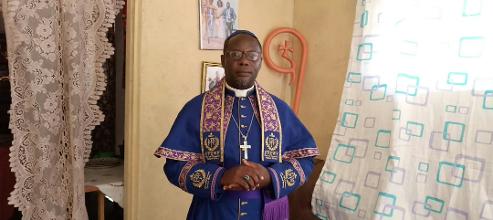
Tag: Abp Bagambaki

  • Archbishop Bagambaki Mugume Preaches Moriah: When the Promise Becomes the Sacrifice.

    Archbishop Bagambaki Mugume Preaches Moriah: When the Promise Becomes the Sacrifice.

    If theology is ‘Faith Seeking Understanding’, then philosophy is ‘the language’ in which it learns to think, because without philosophy, theology can only repeat what it has heard, whereas with philosophy it can ask why it is true, what it means, and whether it can hold together when it is placed under pressure.

    It was on that mountain of reasoned faith that the Ecclesiastical Patriarch of the Five-Fold Episcopal World Federation (FFEWF) built his latest sermon, in which he argued that God does not test a man before blessing him but after blessing him, precisely to discover whether he loves the gift more than the Giver.

    +The Most Rev. Archbishop Elect Professor Mugume Bagambaki Richard, who is also Archbishop of Upper City Covenant Churches (UCCC) and President and Chancellor of UCCSAT University, preached from Genesis 22:1-24 under the theme The Mountain Where God Will Provide — When the Promise Becomes the Sacrifice, a text he described as the hardest chapter in the Bible because it moves without warning from laughter to silence.

    Genesis 21, he told the congregation, is laughter, for Isaac is born, the covenant at Beersheba is sealed and a tree is planted, while Genesis 22 is silence, for God says, kill the laughter. If Genesis 20 tested Abraham’s integrity and Genesis 21 tested his family, he said, Genesis 22 tests his faith itself, which is why in Hebrew tradition the chapter is called The Akedah — The Binding, the most sacred chapter for Jews and the most prophetic for Christians.

    The Language Behind The Sermon.

    Before he climbed Moriah with the congregation, Archbishop Mugume paused to lay the foundation on which the whole sermon would stand, because the story of Abraham cannot be understood by feeling alone. It needs a language that can carry it.

    Theology, he explained, is the study of God as He has revealed Himself in Scripture, in creation, in history, and supremely in Jesus Christ. The word itself comes from theos, meaning God, and logos, meaning word, reason, or discourse, so theology is literally reasoned speech about God. It is faith seeking understanding, which means it takes what God has said and asks what it means, how it fits together, and how it should shape the way we live.

    Philosophy, by contrast, is the love of wisdom, from philo, meaning love, and sophia, meaning wisdom. It is the disciplined art of asking the deepest questions clearly: What is true? What is real? What is good? What is logical?

    Philosophy trains the mind to define terms before debating them, to distinguish ideas that look alike but are not the same, and to test whether a belief can survive its own contradictions. Where theology supplies the revelation, philosophy supplies the reasoning.

    When we say, therefore, that philosophy is the language of theology, we mean that theology cannot speak clearly without it, because revelation always arrives in human words, and human words need definition, logic, and order if they are to carry divine truth without distortion.

    Theology says God is love, and philosophy asks what love means, how it differs from sentiment, and how it can be both just and merciful at the same time. Theology says God tested Abraham, and philosophy separates a test from a temptation, showing that a temptation pulls a man down in order to destroy him while a test pulls the truth out of him in order to reveal him.

    That distinction became the key to the whole sermon, for to confuse a test with a temptation is to misread Moriah entirely.

    Where Is Moriah?

    A central part of the sermon was historical geography, and Archbishop Mugume traced Abraham’s journey from Beersheba in southern Israel to Moriah, a distance of about 80 to 90 km to the north, which on foot, with a donkey, with wood and with a young man, amounts to exactly a three-day journey, matching Genesis 22:4, where Abraham lifted up his eyes on the third day and saw the place afar off.

    He identified Moriah today as Temple Mount –Haram al-Sharif -in the Old City of Jerusalem, Israel, and he cited 2 Chronicles 3:1 as proof, where Solomon began to build the house of the LORD at Jerusalem in Mount Moriah, where the LORD had appeared unto David his father.

    Today, he noted, that site holds the Dome of the Rock, which Jewish tradition holds to be the rock on which Abraham bound Isaac and which Muslim tradition holds to be the place from which Mohammed ascended, while the same Moriah range includes Calvary (Golgotha), where Jesus carried His cross.

    “The mountain Isaac carried wood up is the same mountain Jesus carried His cross up,” the archbishop said, adding that some scholars believe Isaac was bound on the exact spot where Jesus would later be crucified. He explained the name Moriah as coming from Moreh (Teacher), Yah (Yahweh), Ra’ah (to see) and Yireh (to provide), a meaning confirmed in Genesis 22:14 as YHWH Yireh — The LORD Will Provide / Will Be Seen.

    A Test After Blessing.

    Theologically, the Archbishop argued that God does not test before blessing but after blessing, in order to see whether a person loves the gift more than the Giver, and he grounded that claim in the Hebrew word in verse 1 for “tempt,” which is nissah– to test as gold is tested in fire, rather than to lure to sin as in James 1:13. God, he said, was not seeking information He lacked but proving in history what faith looks like when it is fully formed.

    It was here that he answered the question that hangs over the whole chapter: does faith seek God or does faith seek reason? Faith, he said, seeks God. Reason seeks to understand the God whom faith has already found.

    That is the classical order behind Anselm’s definition of theology as fides quaerens intellectum , faith seeking understanding, and not understanding seeking faith.

    Faith is first relational. It is trust, surrender, and encounter. Abraham did not climb Moriah because he had reasoned his way to God. He climbed because God had spoken, and he trusted the Speaker even when the command made no sense, which means faith moved before reason could explain it.

    Reason comes second, but it is not second-rate, for once faith has found God, reason asks who this God is, whether He is coherent, whether He is good, and whether we can speak of Him without contradicting ourselves.

    If faith seeks reason alone, it becomes philosophy without worship — clever, but cold. If faith seeks God without reason, it becomes feeling without foundation — warm, but easily misled. But when faith seeks God and reason seeks understanding, then Moriah makes sense, for Abraham believed God could raise Isaac from the dead (Hebrews 11:17-19) before resurrection had ever happened. Faith trusted. Reason followed. And the ram was revealed only after both had done their work.

    He drew attention to Genesis 22:2, “Take now thy son, thine only son Isaac, whom thou lovest,” and asked why God calls Isaac the only son when Ishmael existed, answering that in covenant terms Ishmael had been sent away and God counts only the promise, not the flesh. “Whom thou lovest,” he added, is the first mention of ahav, love, in the entire Bible, and it is a father’s love for a son.

    He described Abraham’s obedience in verses 3-6 as mature faith, noting that Abraham argued for Sodom in Genesis 18 and negotiated in Genesis 20 but does not argue here, because he has learned that obedience delayed is disobedience, which is why he rose up early in the morning.

    Isaac, he noted, was no longer a baby but a young man in Jewish tradition, between 25 and 37, who carried the wood up Moriah just as Jesus would carry His cross up the same mountain in John 19:17.

    Where Is the Lamb?

    The heart of the sermon was the dialogue in verses 7-8, in which Isaac asks, “Where is the lamb?” and Abraham answers, “God will provide himself a lamb,” a sentence which in Hebrew, Elohim Yireh Lo HaSeh, can mean both that God will provide FOR Himself a lamb and that God will provide HIMSELF as the lamb, two meanings that are both true and are fulfilled in John 1:29, “Behold the Lamb of God!”

    This is philosophy at work inside the story itself, for one sentence carries two meanings that do not cancel each other out, since God provides the sacrifice and God is the sacrifice, and the grammar itself holds the gospel. Without philosophy, we would flatten that mystery. With philosophy, we can hold it, explain it, and defend it.

    He then walked the congregation through the binding in verses 9-10, the intervention in verses 11-12, the provision of the ram caught in a thicket in verses 13-14, and the covenant oath in verses 15-24, noting that the ram’s horns caught in the thicket prefigure the crown of thorns and that the ram was a substitute for Isaac just as Christ is substitute for humanity.

    Quoting verse 12, “Thou hast not withheld,” he asked what the congregation was withholding from God, whether money, church or title, and insisted that God wants nothing withheld.


    The archbishop closed with four applications for FFEWF, UCCC, UCCSAT University and the wider Body of Christ, and he did not present them as isolated points but as one journey up the same mountain, where each lesson prepares the heart for the next.

    First, God tests after promise, not before, because after Isaac is born, after the church grows and after the title is given, God asks for it back, not because He is cruel but because He wants to know whether we love the gift more than the Giver. This is the foundation of the whole sermon, for until we understand that blessing invites testing, we will mistake every test for punishment and miss the purpose behind it.

    From that testing, we move to the second lesson, which is obedience that rises early, because once God has spoken, Abraham does not consult Sarah or call a council meeting, since some obedience cannot be shared, and the two young men are left at the bottom of the mountain because Moriah is lonely and only father and son go up. The test reveals the heart, but obedience proves it, and true obedience does not wait for permission, applause, or consensus.

    And when obedience has taken us up the mountain, we discover the third lesson, which is that Jehovah Jireh is not in Beersheba but in Moriah, because in Beersheba Abraham dug a well and planted a tree, which is provision by effort, while on Moriah God provides a ram, which is provision by sacrifice, and a man will not see the ram until the knife is raised, since provision comes at the point of total surrender.

    In other words, Beersheba teaches us to work for provision, but Moriah teaches us to surrender for it, and the church that only knows Beersheba will always be tired, while the church that knows Moriah will always be supplied.

    That surrender then leads us to the final lesson, which is that the Lamb question still echoes, because the world still asks where the lamb is to stop war in Gaza and to heal Uganda, and the answer is that God HAS provided Himself a Lamb, for Jesus died on Moriah, so no more Isaac is needed and no more child sacrifice is required. The journey that began with a test ends with a Lamb, and the God who asked for Isaac becomes the God who gives His own Son, so that what Abraham could not finish, God finished Himself.

    Moriah In 2026: The Ancient Mountain In A Modern War.

    Moriah has never stopped being Moriah. In 2026 it remains the most contested piece of land on earth, a 35-acre ridge in Jerusalem where Temple Mount, Al-Aqsa, the Dome of the Rock, Jewish longing for a Third Temple, Muslim guardianship, Christian pilgrimage, and international politics all collide on the same rock where Abraham once raised a knife.

    It is a mountain that the world cannot divide, cannot ignore, and cannot fully possess, because every faith claims it, every army has fought over it, and every headline still returns to it, as if history itself is still circling the place where God said, “In the mount of the LORD it shall be seen.”

    But Archbishop Mugume insisted that Moriah is not only a place on a map in Israel. It is also a place in every heart, for every believer has a personal Moriah where God asks for the Isaac that has become too precious. For him, he said, it was surrendering ambition to be recognized as Patriarch, while for a pastor in Luweero with a church of 10, it is offering that church back to God, and for a mother, a businessman, or a bishop, it is laying down whatever has quietly taken God’s place.

    “We must build altar on Moriah — not in Gerar fear, not in Beersheba comfort, but in Jerusalem surrender,” he said.

    Conclusion: The Altar That Still Speaks.

    Genesis 22 does not end with a death. It ends with a resurrection. Isaac, who died three days in Abraham’s heart, walked back down the mountain alive. The ram died so that Isaac could live. Christ died so that we could live. And that is why Moriah still speaks.

    It speaks to the man who has built his life around a gift and forgotten the Giver. It speaks to the church that has mistaken growth for God’s approval. It speaks to a generation that wants provision without surrender, blessing without binding, and a crown without a cross.

    But Moriah will not be cheapened. It demands the knife before it reveals the ram. It demands the altar before it reveals the provision. It demands the laying down before it permits the lifting up.

    So, the question that Isaac asked his father on the way up the mountain is still the question God is asking His church on the way up today: Where is the lamb? And the answer is still the same: God will provide Himself a Lamb, and He already has.

    Lay Isaac down. Raise the knife. Do not withhold. For the God who asked Abraham for his only son did not withhold His own, and the mountain where Abraham wept is the mountain where the world was redeemed.

    The service ended with the declaration: My Moriah Is My Altar Of No Withholding.

    +The Most Rev. Archbishop Elect Professor Mugume Bagambaki Richard is Patriarch of FFEWF, Archbishop of Upper City Covenant Churches, and Chancellor of UCCSAT University. WhatsApp +256775050183.
     

  • When The Pulpit Becomes the Shrine: Prof. Bagambaki Deconstructs the African Apostolic Ego.

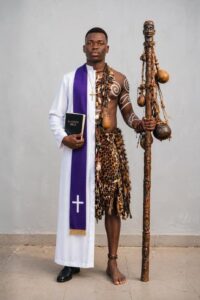
    It is the image that has unsettled WhatsApp groups, pulpits and theological classrooms in equal measure in recent weeks, a clergyman in a sharp suit and clerical collar standing behind a sacred pulpit with a weathered Holy Bible clutched tightly in one hand while his other hand is raised high holding a beaded traditional gourd staff adorned with cowrie shells.

    Many who saw it called it syncretism, and they were not wrong, yet according to one of Uganda’s most acclaimed theologians and philosophers, the Church has only diagnosed the surface symptom while ignoring the far more dangerous disease spreading beneath the skin of African Christianity.

    That theologian is The Most Rev. Archbishop Elect Professor Mugume Bagambaki Richard, the Ecclesiastical Patriarch of the Five-Fold Episcopal World Federation and President and Chancellor of UCCSAT University, who in his newly released Patriarchal Theological Dissertation Volume 7 titled Syncretism of Leadership — When The Pulpit Becomes The Shrine argues that the real crisis is no longer about a preacher who holds the gourd but about a generation of preachers who have themselves become the gourd.

    Before unpacking that crisis, Prof. Bagambaki pauses to remind the ordinary reader what the pulpit actually is and why it is deliberately higher, especially in mainstream and historic churches.

    The word itself comes from the Latin pulpitum, which means a raised platform or scaffold, and from the earliest centuries of Christianity it was designed to be a place of proclamation that physically lifts the Word above the people so that the voice of God, not the personality of the man, could be heard clearly.

    In Anglican, Catholic, Lutheran, Presbyterian and Methodist traditions, the pulpit is intentionally built higher for reasons that have survived centuries, for audibility because before microphones the preacher’s voice could only travel across a stone cathedral if he stood above the crowd, for visibility because the congregation needed to see the reader as a sign that the Word was coming from outside themselves, and most importantly for theology because elevation symbolizes that the message does not originate from the preacher’s charisma but from above, from heaven itself, which is why Reformers like John Calvin and Thomas Cranmer emphasized that height not to exalt the preacher but to exalt Scripture, and why many ancient pulpits are carved with the words Verbum Dei Manet in Aeternum — the Word of God endures forever — with a heavy Bible chained to it as if to say this platform belongs to the Book, not to the man.

    That is why, Prof. Bagambaki argues, when the pulpit becomes the shrine the tragedy is double, because a sacred space architecturally designed to show that God’s Word is above man is now being used to show that man is above God’s Word, and a platform historically built to make the preacher small and Christ big is now being used to make the preacher big and Christ small, and in African traditional thought where height means authority, where the chief sits higher than his subjects and the shrine is always elevated on a hill, when an apostle refuses to leave the pulpit and places his own portrait or his own anointing oil on it, he unconsciously reverts to that ancient kingship code where height means ownership and the pulpit stops being a place of proclamation and becomes a personal throne.

    In this masterful dissertation, Prof. Bagambaki introduces a phrase he believes will define theological debate in Africa for the next decade, a phrase he calls Syncretism of Leadership, which he defines not as the old mixing of Christianity with African Traditional Religions(ATRs) where a man goes to church on Sunday morning and to the shrine on Sunday night, but as the far more subtle replacement of the final authority of Scripture and the internal witness of the Holy Ghost with the final authority of the anointed leader’s own calling, elevation and personal experience.

    It is that dangerous shift where the leader’s story becomes more authoritative than the Bible’s story, where what God supposedly told him privately in his bedroom is treated as more binding than what God has already said publicly in His Word, and where the question ordinary believers are no longer allowed to ask is the most biblical question of all, which is where is it written.

    This, Prof. Bagambaki argues with deep historical and philosophical grounding, is not apostolic at all but royal, not Pentecostal but monarchical, because it is a direct importation of pre-colonial kingship into ecclesial life where traditional or cultural leaders in Uganda and Africa were once regarded as unquestionable, where their word was law precisely because they were chosen by ancestors and therefore could not be challenged by commoners.

    What happened at conversion, the Professor contends, is that Africa never fully dismantled that throne, we only changed the title of the man sitting on it and replaced the royal crown with a clerical collar, so that today the Apostle sits exactly where the kings once sat, unquestioned, uncorrected and final, while the congregation, conditioned by centuries of monarchy, still bows.

    That kingship syncretism, he further explains, manifests itself in ways every churchgoer can recognize, at the level of doctrine where a leader claims his private revelation is superior to Scripture and that Paul had revelation for his time but he now carries seven dimensions of grace for Africa, which is nothing less than a rebirth of ancient Gnosticism, at the level of practice where a leader’s personal habit is elevated into law so that if he drinks water during the sermon all his sons must drink water the same way, and at the deepest level of identity where the leader no longer points people to Christ but presents himself as the mediator through whom blessings must flow.

    Once that identity syncretism has taken root, the next stage is always commercialization of access, because the same leader who teaches that you are cursed if you do not tithe will soon teach that you need a special seed for a visa, a special anointing for a plot of land, a special sacrifice for a car, and a special prophetic declaration for marriage, and in that moment the pulpit stops being a place of proclamation and becomes a shrine where the priest must be paid before the deity can be accessed, where people are no longer discipled to pray in the name of Jesus but conditioned to pay through the name of the man of God.

    To prove that this is not merely a modern Ugandan problem but a biblical problem as old as the Church itself, Prof. Bagambaki transports his readers back to the year 49 AD, to a small but explosive crisis in Antioch that nearly split the early Church and which theologians often describe using the German phrase Sitz im Leben, meaning the real-life situation behind the text.

    On one side stood Peter, who was of the 12, who had walked with Jesus in the flesh, who held the keys of the Kingdom, who preached the first sermon at Pentecost and who had received the historic vision of Cornelius in Acts 10 where God told him in Acts 10:15 what God has made clean do not call common.

    On the other side stood Paul, a latecomer by every human standard, a former persecutor of the Church, not of the 12, whose gospel came through revelation in the Arabian desert.

    The Bible records in Galatians 2:11-14 that when Peter first came to Antioch he ate freely with Gentile believers, but when certain influential men came from James, who was Bishop of Jerusalem and the brother of Jesus and who belonged to what was called the circumcision party, meaning devout Jewish believers who taught that yes Jesus is Messiah but you must also be circumcised and keep the Law of Moses to be truly saved, Peter withdrew and separated himself and stopped eating with Gentiles, and the text adds painfully in Galatians 2:13 that even Barnabas was carried away with their hypocrisy.

    Why would Peter bow, and Prof. Bagambaki argues that Peter succumbed to fears identical to what African pastors face today, the fear of the seniority system where James was senior and from the mother church, the fear of the establishment where Jerusalem was wealthy and powerful while Antioch was merely a missionary outpost, and the confusion of authority where Peter elevated delegated human authority from men who came from James above the divine authority of the Holy Spirit who had already given him his own vision.

    Is this not Uganda today, the Professor asks with pastoral anguish, where a young prophet may know the truth about grace yet when a Papa with ten thousand members arrives who teaches that if you do not tithe you are cursed, the young prophet withdraws and begins preaching tithe-curse himself simply to keep favor and platform, and then adds visa-curse and plot-curse and car-curse because that is what the big ministry does.

    Yet Paul won, and the Professor explains how a junior apostle managed to correct a senior pillar who walked with Jesus and still be vindicated by history and by Council, by deploying weapons Africa must urgently recover, beginning with the primacy of canonical revelation over seniority where Paul declared in Galatians 2:6 that those who seemed influential added nothing to me because God shows no partiality, which means anointing does not equal authority and a bishop with thirty years can be wrong while a young evangelist with two years can be right if he is biblical.

    Paul also deployed the courage to oppose face to face, captured in the Greek phrase kata prosopon which means to his face, in his presence, because Paul opposed Peter to his face in Galatians 2:11 rather than gossiping behind his back, unlike the current African practice where ecclesial wars are fought through WhatsApp groups and pulpit subliminals, and he added the wisdom of appeal to council rather than to personality, because he refused to make the battle about Peter versus Paul and said let us go to Jerusalem, and in Acts 15:6 the apostles and elders gathered and the final decision was not made by Peter alone or Paul alone but by Scripture when James quoted Amos 9:11-12, by the Holy Spirit when the Council declared in Acts 15:28 it seemed good to the Holy Spirit and to us, and by collective eldership, and this, Prof. Bagambaki says, is the theological reason for the existence of the Five-Fold Episcopal World Federation, because Africa does not need apostolic monarchs but Acts 15 councils where no single man is final.

    And Paul kept his focus on gospel truth rather than tribal triumph, because his motive was not to shame Peter but to ensure believers were not acting in line with the truth of the gospel as stated in Galatians 2:14, and if blessing comes by Papa’s blessing, the Professor paraphrases Galatians 2:21 and Galatians 5:2, then Christ died for nothing and will be of no advantage to you.

    The dissertation closes with a declaration that has stunned many precisely because it comes from a man with dozens of peer-reviewed works, when he declares publicly that he himself is not final authority, that the Bible alone is final authority and that he remains merely a servant of the Bible who, if he teaches contrary to Scripture, should be withstood to his face and corrected.

    He says he chooses not to be Peter who withdrew in Galatians 2:12 but Peter who later repented and wrote in 2 Peter 3:15 that our beloved brother Paul also wrote to you according to the wisdom given him, proving that true leadership ultimately repents and honors truth above ego.

    Prof. Bagambaki has announced that Volume 8 will be a practical manual on how to organize an Acts 15 Council in every district as a way of de-monarchizing the African Church, ahead of his historic Patriarchal Consecration slated for 14th December 2026 at Kimaka Faith Ministry International Cathedral in Jinja City.

    For pastoral and academic engagement, the Patriarchal Office remains reachable on WhatsApp +256775050183 and fivefoldepiscopalworldfederati@gmail.com


  • When Pride Meets Grass: Archbishop Bagambaki Warns That God Still Humbles the Proud.

    For the past months, His Grace +The Most Rev. Archbishop-Elect Professor Mugume Bagambaki Richard, Ecclesiastical Patriarch of the Five-Fold Episcopal World Federation and Archbishop of Upper City Covenant Churches, has been serializing a carefully selected series of texts for the formation of leaders in both Church and state.

    Moving through books that confront pride, purify worship and restore governance, he has taken the Church and the nation through defining seasons of prophetic instruction, calling leaders in every sphere, whether political, academic, commercial or ecclesiastical, back to righteousness, mercy and the fear of God.

    He now enters the Book of Daniel, a book of thrones and dreams, of furnaces and fields, of empires measured and humbled by heaven. In this latest installment, the archbishop draws from Daniel Chapter Four, the only chapter in Scripture written by a pagan king, to deliver a piercing word for Uganda in 2026, that the Most High still rules over the kingdoms of men.

    Text: Daniel 4:1-37.

    Preacher: +The Most Rev. Archbishop Elect Professor Mugume Bagambaki Richard

    There is a chapter in the Bible that was not written by a prophet hiding in a wilderness cave, but by a president dictating from the roof of his own palace.

    Nebuchadnezzar, the builder of Babylon, the man who believed his dominion would never be interrupted, finally picked up a pen and wrote his own confession to every nation under heaven.

    He had commanded armies that erased kingdoms and built a city the world called a wonder, yet it took being driven into the open field to eat grass like an ox for him to understand what every leader must now understand without having to taste grass, that no throne is secure when heaven decides to humble it.

    This is the core message the archbishop is lifting before the nation. The Most High rules over the kingdoms of men. Not strategists. Not money. Not crowds. Not titles. Not the volume of applause that surrounds a leader.

    Key Verse: Daniel 4:17 “The Most High rules the kingdom of men and gives it to whom he will and sets over it the lowliest of men.”

    Key Verse 2: Daniel 4:37 “Those who walk in pride he is able to humble.”

    The Core Message: From the Furnace to The Field.

    The archbishop anchors his message in a divine progression that every leader must discern. In Daniel 2, God reveals a mystery to a king. In Daniel 3, God delivers His faithful people through a furnace. In Daniel 4, God humbles the king himself in a field. God first speaks, then He shows His power to save, and finally He touches the pride that refuses to bow.

    The burden of this message is not historical curiosity. It is a prophetic summons to all who hold influence, whether in politics, business, academia or the Church, that all can build Babylon and all must learn to lift their eyes to heaven before heaven forces them to.

    Why What Happened Centuries Ago Is Still Happening Today.

    Because God is omnipresent and omniscient, He is not limited by the calendar we live by or the map we draw. What He does in one generation, He watches over in every generation. Time does not weaken His Word. Geography does not dilute His authority. He is in Jinja, Lira, Mbarara, Kisoro or Arua and Masindi as fully as He was in Babylon. He sees the palace in 580 BC and the office in 2026 with the same eye.

    And because, as Isaiah declares, His Word is like rain, “So shall my word be that goes out from my mouth; it shall not return to me empty, but it shall accomplish that which I purpose, and shall succeed in the thing for which I sent it“ – Isaiah 55:11.

    The Word that fell on Babylon did not evaporate in Babylon. It is still falling. Like rain, it never returns without causing effect. It soaks the soil of every generation. It finds every seed of pride and either waters it into repentance or washes it away in judgment.

    This means what happened to Nebuchadnezzar centuries ago is not merely history that is archived and forgotten. It is a living verdict that is not inhibited by time or geography. The God who judged pride on the roof of Babylon in 573 BC is the same God who watches pride on the rooftops of our cities today. The decree that drove a king into the field is not locked in the past. It travels like rain, it waters every season, it searches every heart that says “my power” and “my majesty.”

    Daniel 4 therefore is not a story about a strange mental illness of an ancient king. It is a pattern, a spiritual law, a rain that has never stopped falling. Wherever pride raises a golden image, wherever power repurposes a furnace to punish the faithful, wherever a leader begins to believe that he built his own Babylon, that same Word returns to accomplish its purpose again. God does not need to write a new law for each proud generation. The old rain is still effective. Those who walk in pride He is still able to humble, whether in ancient Mesopotamia or in modern Uganda.

    For The Reader Who Is Not Familiar With The Background

    Who was Nebuchadnezzar and how did he become king? He was the son of Nabopolassar, a Chaldean general who ended the Assyrian Empire.

    According to antiquity, ancient Assyria was the cruel superpower before Babylon, centered in what is today northern Iraq around Mosul and the Nineveh Plains, with extensions into southeastern Turkey, northeastern Syria and northwestern Iran. Its capitals were Ashur and Nineveh, cities built on terror and tribute. In 612 BC Nabopolassar, in alliance with the Medes, destroyed Nineveh and ended Assyrian dominance forever. It was one of the most decisive turnovers in world history.

    His son Nebuchadnezzar secured that victory by crushing Egypt at the Battle of Carchemish in 605 BC, a battle that made Babylon the sole superpower of the known world. When his father died that same year, Nebuchadnezzar rushed across the desert and was crowned king. He reigned forty-three years until 562 BC, longer than most modern presidencies and far more powerful.

    How does the world remember him? Secular history remembers him as the greatest builder king of antiquity, the man who built the Ishtar Gate with its deep blue glazed bricks and golden lions, the Processional Way, the great ziggurat Etemenanki, and the Hanging Gardens said to have been built for his homesick wife. Every brick in Babylon was stamped, “I am Nebuchadnezzar, King of Babylon.” Military history remembers him as the conqueror who destroyed Jerusalem and Solomon’s Temple in 586 BC and carried Judah into seventy years of exile. But Scripture remembers him for one sentence he finally learned after grass had been his food, that those who walk in pride, God is able to humble.

    How did the furnace in Daniel 3 come about and what was it for? The furnace began as wounded pride from Daniel 2. Daniel had told Nebuchadnezzar that his kingdom was only the head of gold and that other kingdoms would arise after him, inferior to his, until God Himself would set up an everlasting Kingdom that would crush all kingdoms.

    Offended by the thought that his empire would not last forever, Nebuchadnezzar built an image of gold ninety feet tall and nine feet wide, all gold from head to foot, as if to say my kingdom will be all gold forever, there will be no succession. He summoned all his leaders, satraps, prefects, governors, counselors, treasurers and magistrates to the plain of Dura, which was like a vast national stadium for public ceremonies, and commanded that at the sound of the horn, flute, zither, lyre and harp, all must fall down and worship the image or be thrown immediately into a burning fiery furnace.

    That furnace was originally an industrial kiln for baking bricks for his endless construction projects. He repurposed an instrument of development into an instrument of destruction, which is always what happens when power becomes idolatrous. It was meant for enforced unity through fear, for testing true worship, and ultimately for revealing that there is a God who walks with His people in fire. The three young men who refused to bow came out without even the smell of smoke upon them, because the fire that was meant to destroy them only revealed the fourth man walking with them. The same king who heated that furnace seven times hotter for others would later be humbled in the field himself, because God would rather let a king eat grass than let him keep burning people to prove he is god.

    The Warning Dream – God Always Speaks Before He Strikes

    This is the heart of the Archbishop’s warning to all leaders. Nebuchadnezzar dreamed of a great tree, tall and strong, visible to the ends of the earth, giving shelter to beasts of the field and lodging to birds of the heavens, with abundant fruit for all. That tree was his empire, beautiful, dominant, providing shade for many nations.

    Then a holy watcher, an angel commissioned from heaven, came down and issued a decree that is still preached today. Chop down the tree, strip its branches, scatter its fruit, but leave the stump bound with a band of iron and bronze in the tender grass of the field. Let his mind be changed from a man’s mind and let a beast’s mind be given to him for seven periods of time.

    God is merciful because He sends interpretation before He sends judgment. He sent Daniel, and Daniel was appalled for a full hour and said, my lord, may the dream be for those who hate you. True prophets do not celebrate the downfall of leaders. They weep first before they warn, because they love the leader and they love the nation enough to tell the truth.

    Every leader, every organization, every great ministry, every thriving business is that great tree for a season. God allows you to grow tall, to become visible, to provide shade and fruit for many. But the moment you convince yourself that the height came from your own roots and that the shade belongs to you and not to Him, the decree goes out from heaven to cut it down to size. The band of iron and bronze around the stump is mercy, it means God preserves the root for restoration, but He will cut down the pride that grew above it.

    We do not suffer from a lack of strategy in our institutions. What we suffer from in every sector is a lack of weeping Daniels, leaders who have enough courage and enough love to look at power, whether political, corporate or ecclesiastical, and say it is you who must repent.

    The Counsel Of Mercy – The Only Way To Lengthen A Reign

    When Daniel finally spoke, he did not advise the king to build higher walls, to organize more rallies, to hire more advisors, or to tighten his intelligence network. He gave him the only counsel that can lengthen any reign in any nation or any church. He said, “Therefore, O king, let my counsel be acceptable to you: break off your sins by practicing righteousness, and your iniquities by showing mercy to the oppressed, that there may perhaps be a lengthening of your prosperity.” Daniel 4:27.

    And then God, in staggering patience, gave him twelve months to repent. For twelve months heaven waited.

    This counsel must reach every seat of power, because pride is universal and mercy is the only antidote that works everywhere.

    Practicing righteousness means allowing justice to flow without interference, allowing institutions to be truly free, refusing to use instruments of state or instruments of the Church for personal revenge, and calling corruption what it truly is, which is sin against God and against the people. It means preparing to be a better tree, not spending all your energy cursing the present tree while secretly planning to do the same oppression once your time comes.

    Showing mercy to the oppressed means remembering the unemployed youth who hustle in our towns, slums and trading centres, from Kisenyi and Katwe in Kampala to Mafubira and Namulesa or Bugembe in Jinja, from Gulu to Arua, the farmer in Teso, Lango and Acholi whose produce rots for lack of market and whose children drop out for lack of fees, the prisoner whose file has disappeared from the system and whose case has not been heard for years, and the young person who has become voiceless because no one will listen without payment.

    For twelve months, Nebuchadnezzar saw nothing happen. Babylon still glittered. The economy still boomed. Building continued. Applause continued. Every leader today is living inside that dangerous twelve-month window where God’s silence must never be mistaken for God’s endorsement. Delay is not approval. Patience is not absence.

    For Upper City Covenant Churches and for UCCSAT University, this is the central key the archbishop is emphasizing. Education without righteousness produces polished Nebuchadnezzars, men and women who can build impressive cities but cannot govern their own hearts. We must train leaders who practice righteousness and show mercy, not just leaders who can quote constitutions, canons, and policies.

    The Judgment of Pride – When A King Eats Grass Like an Ox.

    Twelve months later, Nebuchadnezzar was walking on the roof of his royal palace in Babylon and boasting, “Is not this great Babylon, which I have built by my mighty power as a royal residence and for the glory of my majesty?” Daniel 4:30. Notice the pronouns, my power, my majesty, my residence, I have built. This is plagiarism of glory, taking credit for what heaven merely allowed, stealing ink from God’s pen and writing our name on His work.

    While the word was still in his mouth, while the sentence was not yet finished, judgment fell. The voice came from heaven. He was driven from among men and made to eat grass like an ox. His body was wet with the dew of heaven till his hair grew as long as eagles’ feathers and his nails were like birds’ claws. This is divine de-creation. In Genesis, man made in God’s image rules over beasts. In Daniel 4, the man who wanted to be God becomes like a beast.

    This text must now reach every cathedral, every office, every boardroom, every cabinet room and every pulpit where leaders preside, because spiritual pride is more dangerous than political pride, for it uses God’s holy name to build its own Babylon. The leader who says my organization, my network, my ministry, my university, my anointing, is speaking Nebuchadnezzar’s language behind a different microphone.

    God opposes the proud. Scripture says He resists them. He does not ignore them. He actively resists them. For the public leader, grass can look like public humiliation, electoral shock, health failure, or the sudden collapse of trust that no public relations can restore.

    For the spiritual leader, grass can look like scandal that strips titles and reveals character, or like a ministry that still has crowds but has lost the presence of God. God would rather let us eat grass for a season than let us preach Christ while living for our own glory.

    Was This Just A Mental Health Crisis?

    One reading this story today might be tempted to rush into a quick clinical conclusion, that Nebuchadnezzar simply suffered a severe psychotic break and needed a quick ride to Butabika National Referral Mental Hospital, and that modern psychiatry would have handled him well with diagnosis, medication and therapy, or if it persisted, he would have been flown to the best global hospitals in India, Germany or the USA for advanced neuropsychiatric care.

    Let it be clearly known that we thank God for science. Science has done a lot and continues to do more wonders. Doctors, psychiatrists, psychologists, nurses and researchers are gifts of God to preserve life and restore dignity.

    The Church does not despise medicine. Luke was a physician. Butabika saves lives. Hospitals in India, Germany, the USA and here in Uganda save lives. We honor them.

    Yet science belongs to God, and God is beyond science. What happened to Nebuchadnezzar was not merely a chemical imbalance in the brain. It was a divine verdict upon a moral imbalance in the heart. It was not just insanity. It was heaven’s discipline.

    The best hospital in Babylon could not cure him because his sickness did not start in his mind. It started on the roof of his palace when he said, “my power, my majesty.” The problem was not in his neurons. It was in his pronouns.

    Modern science can manage symptoms. Only God can judge pride. Science can tranquilize a man who thinks he is an animal, but only God can restore a man who thought he was God. That is why no physician was summoned in Daniel 4. No physician was relevant. The One who had issued the decree was the only One who could lift it.

    This is why the text says his reason returned when he lifted his eyes to heaven, not when he lifted his hands to medicine. His cure did not come from a prescription from below. It came from worship directed above. Psychiatry could have sedated Nebuchadnezzar. Only repentance could restore Nebuchadnezzar.

    So yes, take your medication if you need it. Go to Butabika if you must. Fly to India, Germany or the USA if you can. But do not miss the voice behind the condition. Some collapses are not merely medical, they are theological. Some breakdowns are actually heavens breaking in to break pride before pride breaks you completely.

    God is not against science. Science is a servant in God’s house. But science cannot humble a proud king, and it cannot restore a humbled one. When God says “those who walk in pride He is able to humble,” He does not need a medical report to do it, and He does not need a medical report to reverse it.

    The Restoration of Worship – Sanity Returns When Worship Returns.

    The most hopeful verse in the entire chapter is this. “At the end of the days I, Nebuchadnezzar, lifted my eyes to heaven, and my reason returned to me, and I blessed the Most High and praised and honored him who lives forever.” Daniel 4:34.

    Sanity did not return when he called a better cabinet meeting or a sharper strategy session. Sanity returned when worship returned. He lifted his eyes. Worship reordered vision. Worship restored reason.

    He blessed the Most High, and his kingdom was restored to him with even greater glory than before, because God never restores you to the same level of pride. He restores you to a deeper humility and therefore to a greater capacity to steward influence.

    This is the hope for all leaders today. The world cancels people in order to destroy them. God humbles people in order to restore them. The stump that was bound with iron and bronze was not uprooted. It was preserved for regrowth, but regrowth under a new acknowledgment that heaven rules.

    Prophetic Keys for This Hour.

    The Most High rules, not men. Elections, boards, synods, appointments, wealth and social media following do not ultimately determine the future. God does. Stop worshipping the instruments that make leaders and start worshipping the Lord who lifts leaders.

    Pride is the root of every fall. By my mighty power I built is the seed of every downfall in leadership, in business, in academia and in ministry. Ministry success, university growth, corporate expansion and public influence can become our own golden image if we do not cut it down ourselves before God does.

    God always gives warning before judgment. Daniel wept before he spoke. True fathers and true patriots warn because they love, not because they hate. That kind of weeping warning is true covering for a nation.

    Mercy is the antidote to pride. Show mercy to the oppressed. Let every plan, every manifesto and every budget be audited not by how beautiful its promises sound, but by how deep its mercy reaches to widows, orphans, prisoners and the voiceless.

    Restoration comes through lifted eyes. When institutions face shaking, the answer is not more Babylonian building. The answer is worship that lifts eyes from Babylon to heaven, because when eyes are lifted, reason returns.

    Three Questions for Every Leader In Modern Time.

    Who gets the credit for what we see? Is it I built this, or is it God established this? Does our speech betray plagiarism of glory?

    Are we practicing righteousness and mercy, or are we merely building impressive programs, massive crowds, beautiful buildings and personal empires while the oppressed remain forgotten?

    Where are our eyes fixed in this moment? Are they fixed on Babylon and all its glitter, its gold, its applause and its power, or are they fixed on the King of heaven whose dominion is everlasting and whose Kingdom has no end?

    Nebuchadnezzar lost his mind in order to finally gain his soul. God would rather break our pride than lose our worship. He would rather let us eat grass for a season than let us burn others in a furnace forever.

    Conclusion: You May Not eat Literal Grass, But the Warning is Loud and Clear.

    The proud and arrogant in our generation may not go literally insane and eat grass like Nebuchadnezzar did. God does not always repeat the method, but He never abandons the principle.

    You may not lose your mind, but you may lose your peace. You may not sleep in the field but you may watch everything you built grow hair like eagles’feathers,but you may grow a reputation that no longer reflects the anointing you once carried.

    For some, grass looks like public humiliation that no advisor nor public relation officer can spin away. For others, grass is the silent erosion of trust where people still clap for you in public but no longer believe you in private.

    For the leader in office, grass can be a health crisis that remind you that the body you neglected is not made of gold. For the leader in ministry, grass can be a stage that is still full but a prayer room that is empty, crowds that still gather but a presence that has already departed. For the leader in business and academia, grass can be expansion without satisfaction, degrees without wisdom, profit without purpose.

    God does not need to drive you to the field to humble you because he can humble you right on the roof of your own Babylon while the words “my power, my majesty, my throne, my achievement and success story”, are still in your mouth.

    That is why the warning is loud and clear and why the rain of Isaiah 55 is still falling. The same Word that said, “Those who walk in pride He is able to humble”, has not returned empty. It is still accomplishing its purpose in parliaments ts and pulpits, in boardrooms and chambers, lecture halls, in State Houses and Church houses and palaces.

    The question is not whether God still humbles the proud because does anyway. The question is whether e will humble ourselves before He has to do it for us.

    For Nebuchadnezzar, reason did not return until worship returned. He lifted his eyes to heaven and sanity came back. That remains the only way back for any leader today. Lift your eyes, give back the glory you plagiarized, break off your sins by practicing righteousness and show mercy to the oppressed.

    Because the Most High still rules. His dominion is not contested in heaven, and it will not be contested forever on earth. The stump is preserved only for those who are willing to learn that heaven rules.

    Humble yourself today. Before the grass becomes your diet, let worship become your reason.

    Those who walk in pride he is able to humble. Humble yourself today, whatever office you hold, whatever title you carry, whatever influence you command. Lift your eyes to heaven now, before heaven forces you to look down to eat grass. The Most High still rules over the kingdoms of men. His Word, like rain, is still falling, and it will not return without accomplishing its purpose.

    Benediction.

    For his dominion is an everlasting dominion, and his kingdom endures from generation to generation. All the inhabitants of the earth are accounted as nothing, and he does according to his will among the host of heaven and among the inhabitants of the earth; and none can stay his hand or say to him, what have you done?

    To the King of Heaven be all glory in Uganda and forever. Amen.

    +The Most Rev. Archbishop Elect Professor Mugume Bagambaki Richard.


  • The Thousand Years, The Final Battle, And the Great White Throne: Archbishop Mugume Preaches God’s Final Acts Of History.

    That was the central thesis delivered this week by +The Most Rev. Archbishop Elect Professor Mugume Bagambaki Richard, Ecclesiastical Patriarch of the Five-Fold Episcopal World Federation and Archbishop of Upper City Covenant Churches, in a sermon titled “The Thousand Years, The Final Battle, And The Great White Throne” Based On Revelation 20:1-15.

    Addressing clergy and students of Upper City Covenant Seminary and Theological Bible University, UCCSAT, Archbishop Mugume framed Revelation 20 as God’s answer to three existential questions: “What happens to Satan? What happens to the saints? What happens to everyone?”

    He said the chapter reveals the end of time in four movements, taking humanity from cosmic war to final justice.

    The Binding of Satan: The Limits of Evil.

    Archbishop Mugume began with Revelation 20:1-3, where an angel binds Satan for “a thousand years” and casts him into the bottomless pit “so that he might not deceive the nations any longer.”

    Theologically, the Patriarch argued, this dismantles two heresies. First, that Satan is omnipresent. “He can be bound. He can be chained. Evil is not eternal.”
    Second, that the gospel cannot advance globally. “During this time, the nations will hear without global demonic deception. The Church must believe the gates of hell will not prevail.”

    Philosophically, he noted that binding precedes judgment. “Justice in God’s economy begins with restraint. Before the final verdict, the accuser is silenced.”

    For the Five-Fold Episcopal World Federation and the body of Christ, the key is this: Satan is not omnipresent. The gospel will go to the nations.

    The Thousand Year Reign: Theology of Leadership.

    In verses 4-6, John sees thrones and “the souls of those who had been beheaded for the testimony of Jesus” who “came to life and reigned with Christ for a thousand years.”

    “This is the first resurrection,” the archbishop stated, citing verse 5. “Blessed and holy is the one who shares in the first resurrection! Over such the second death has no power. They will be priests of God and of Christ, and they will reign with him for a thousand years.”

    For Upper City Covenant Seminary and Theological Bible University, he drew a leadership principle: “We reign as priests. Academic and governmental training now is preparation to rule justly with Christ.”
    He argued that martyrdom is not defeat but enthronement. “The blood of the saints is not wasted. It is seed. It is qualification to reign.”

    This, he said, reframes Christian education. “UCCSAT does not just train preachers. It trains governors. Because Revelation says we will reign.”

    The Final Rebellion: The Problem of The Human Heart.

    After the thousand years, Satan is released to deceive “Gog and Magog” who surround “the camp of the saints and the beloved city.” Fire then comes down from heaven and consumes them, and the devil is thrown into the lake of fire.

    Here Archbishop Mugume issued his sharpest philosophical warning: “External peace does not change the heart. Only the new birth does.”
    “Even in a perfect environment, with Christ reigning visibly for a thousand years, rebellion is still possible. Why? Because sin is not primarily environmental. It is ontological.”

    He called it a rebuke to utopian political theory. “You can have perfect governance and still have rebellion. That is why Upper City Covenant Churches must preach regeneration, not just reformation.”

    For the body of Christ, the key is clear: Guard the heart. A perfect environment cannot save a fallen nature.

    The Great White Throne: The Final Audit.

    The sermon climaxed at verses 11-15. “Then I saw a great white throne and him who was seated on it. Earth and heaven fled.”

    Two sets of books are opened: The Books of Deeds — “the dead were judged by what was written in the books, according to what they had done” — and The Book of Life.

    “Degrees, titles, and positions won’t save,” the archbishop declared. “The only passport is this: ‘Is your name written in the Lamb’s Book of Life?’”
    Those not found in it face “the second death,” being thrown into the lake of fire.

    Biblically, he tied this to accountability. “Every sermon, every lecture, every decision is recorded. Live today as if the Great White Throne is tomorrow.”

    For Five-Fold Episcopal World Federation and the body of Christ, the key is this: The only way to escape the second death is the first resurrection. Be born again now.

    Prophetic Keys for The Church and Nation.

    Closing, Archbishop Mugume gave prophetic keys from Revelation 20 for FFEWF, Upper City Covenant Churches, the Body of Christ, and UCCSAT.

    Reign Now, Rule Later: Faithfulness in small things qualifies us for future governance. Five-Fold Episcopal World Federation and the body of Christ must disciple leaders who can govern.

    Why Five-Fold? & How It Differs from Three-Fold

    Following the sermon, Archbishop Mugume Bagambaki addressed questions on the name Five-Fold Episcopal World Federation. He rooted the term in Ephesians 4:11-12 And he gave the apostles, the prophets, the evangelists, the shepherds and teachers to equip the saints for the work of ministry”.

    “Five-Fold is not a title but a function given by Christ, it exists to equip the Church for maturity, mission and governance. If we are to reign with Christ, then leadership training now is preparation for that reign”, he explained.

    He noted that the Three-Fold Ministry-bishop, priest, deacon rooted in 1 Timothy 3 focuses on governance and sacraments. It asks: Who Oversees the Church?

    The Five-Fold Ministry- Apostle, Prophet, Evangelist, Pastor and teacher focuses on equipping and expansion. It asks “Who prepares the saints for the work?”

    “FFEWF is Episcopal because we keep historic oversight through the bishop. We are Five-Fold because we believe the Church must be equipped to discern deception, guard doctrine and reign with Christ, you can have perfect governance and still have rebellion, that is why we must preach regeneration”, he explained.

    Martyrdom is Not Defeat: “Souls of those who had been beheaded for the testimony of Jesus” reign. The blood of saints is seed for the Kingdom.

    Deception is Satan’s Last Weapon: Upper City Covenant Seminary and Theological Bible University must train discerners. Even after a thousand years of peace, nations can still be deceived. Guard doctrine.

    The Books Will Be Opened: Every sermon, every lecture, every decision is recorded. Live today as if the Great White Throne is tomorrow.

    The Book of Life is the Only Passport: Degrees, titles, and positions won’t save. “Is your name written in the Lamb’s Book of Life?”

    Conclusion: Two Resurrections, Two Destinies.

    Archbishop Mugume contrasted the First Resurrection for the saints with the Second Death for the lost. “Blessed and holy” are those in the first. “The lake of fire” awaits those not in the Book of Life.

    “Between these two is our time now — the day of salvation.”

    He gave an altar call: “He who has an ear, let him hear. Surrender to the King before you stand before the Judge. Ensure your name is in the Book of Life today.” Citing Luke 10:20.

    He ended with the benediction from Revelation 20:6 and Exodus 15:18: “Blessed and holy is the one who shares in the first resurrection! Over such the second death has no power. The Lord reigns forever and ever.”

    For more information contact: Five Fold Episcopal World Federation / Upper City Covenant Churches. Tel/WhatsApp: +256775050183. Email: fivefoldepiscopalworldfederati@gmail.com or uppercitycovenantchurches@gmail.com


  • Fake Dollars, Fake Bottled Water, Fake Gospel: Archbishop Mugume Bagambaki Warns Church Against Counterfeit Word And Economic Compromise In Last Days.

    The world is being prepared for a system of worship and control that mimics God, and the Church must raise believers who “cannot be bought, cannot be threatened, and will not bow,” The Most Rev. Archbishop-Elect Professor Mugume Bagambaki Richard has warned.

    Preaching from Revelation 13:1-18 during a special teaching for Five-Fold Episcopal World Federation (FFEWF), Upper City Covenant Churches, and Upper City Covenant Seminary and Theological Bible University (UCCSAT), the Ecclesiastical Patriarch said the chapter reveals how Satan wages war not directly, but through two beasts that form a counterfeit trinity.

    When The Dragon Gives Authority.

    Archbishop Bagambaki told the congregation that Revelation 12 ends with the dragon furious and making war on the remnant, while Revelation 13 shows the method of that war.

    “Revelation 13 is about counterfeit trinity and global control,” he taught. “The Dragon imitates the Father who gives authority. The Beast from the Sea imitates the Son who is worshipped. The Beast from the Earth imitates the Holy Spirit who points people to worship. But it is all a lie designed to steal worship from the Lamb who was slain.”

    Citing Revelation 13:8 as the key verse, he said, “And all who dwell on earth will worship it, everyone whose name has not been written before the foundation of the world in the book of life of the Lamb who was slain.”
    “That verse is our anchor,” the archbishop said. “Before the beast was, your name was written. If you belong to the Lamb, you will not bow.”

    The Beast from The Sea: Political Power That Demands Worship.

    Teaching on the first beast rising out of the sea with ten horns and seven heads, Archbishop Bagambaki explained that the sea represents nations and peoples, and points to a world empire patterned after Daniel 7.

    He noted the beast’s mortal wound that was healed, describing it as a counterfeit resurrection designed to make the world marvel, and the 42 months of authority given to it, the same 3.5 years given to God’s witnesses, to show that even persecution is under God’s limit.

    “The most dangerous part is verse 7,” he said. “It makes war on the saints and conquers them. Persecution is real.”

    In a direct application to the Church today, the Patriarch said any government or system that demands what belongs to God is operating in the spirit of antichrist.
    “This beast demands worship in verses 4 and 8, and blasphemes God in verse 6. When a political system demands allegiance that belongs to Christ alone, that is the spirit of the sea beast,” Archbishop Bagambaki stated.

    The Beast From The Earth: Religious And Economic Deception.

    The second beast, rising out of the earth with two horns like a lamb but speaking like a dragon, was identified by the Archbishop as the False Prophet.

    “He looks religious but speaks demonic,” he said. “This is the deadliest weapon, because Satan doesn’t just attack with politics. He attacks with false signs and false worship.”

    Just as we have fake dollars, fake pounds, fake yen, and fake shillings in circulation today, and just as we have counterfeit shirts, trousers, jean skirts, tops, and even bottled drinking water that looks exactly like the original, Archbishop Bagambaki warned that the same is happening with the Word of God.

    “Sometimes it is very difficult to notice the difference until you test it, the bottle looks the same. The label looks the same. The taste is almost the same. But one will hydrate you and the other will poison you”, he said.

    In the same way, there are people whose assignment is to counterfeit God’s Word. They use Bible verses, they use the name of Jesus, they perform signs and they speak with a lamb’s voice. But the spirit behind it is the dragon.

    Their goal is not to lead you to the Lamb who was slain. Their goal is to lead you to the image of the beast. That is why we must carry the original. We must know the Word, know the Spirit, and know the character of Christ, so that when the counterfeit comes, we can detect it immediately.”

    He walked through how the earth beast exercises all the authority of the first beast, performs signs including fire from heaven, and sets up an image that is given breath.
    “It causes all who do not worship the image to be killed,” the archbishop emphasized. “That is idolatry with power. That is religion without truth but with enforcement.”

    For UCCSAT and the body of Christ, he warned that miracles without doctrine and signs without the Word are the signature of the false prophet. “We must test every spirit. A lamb’s appearance with a dragon’s voice is deception.”

    The Mark: When Economics Becomes A Tool Of Worship.

    The sermon reached its most practical point in verses 16-18, where the earth beast causes all people to receive a mark on the right hand or forehead so that no one can buy or sell without it, and introduces the number 666.

    “This is total control: commerce, identity, and loyalty,” Archbishop Bagambaki taught. “The system will pressure believers: Worship, or you cannot buy, sell, or survive. The number 666 is the number of men, man trying to be God without God. This calls for wisdom.”

    He told FFEWF, Upper City Covenant Churches, and UCCSAT that the Church must prepare saints to live holy even in lack.
    “We serve Jehovah Jireh, not the system. Economics will be used to compromise the Church. But our provision is not in the beast’s economy. Our provision is in the Lamb,” he said.

    Five Prophetic Keys For The Church Today.

    From the text, Archbishop Bagambaki gave five keys for believers, ministers, and institutions:

    First, the dragon counterfeits the trinity. Just as the Father gives authority, the Son is worshipped, and the Spirit points to the Son, Satan mimics this structure. “We must know the real to reject the fake,” he said.

    Second, worship is the central issue. The battle is not first political or economic. It is worship. “Who do we bow to?” he asked.

    Third, persecution will target faithfulness. Quoting verse 10, he said, “If anyone is to be taken captive, to captivity he goes; if anyone is to be slain with the sword, with the sword must he be slain. Here is a call for the endurance and faith of the saints.”

    Fourth, economics will be used to compromise the Church. FFEWF must teach believers financial faithfulness and dependence on God.

    Fifth, the Book of Life is the believer’s security. “Before the foundation of the world, your name was written if you are in Christ. That is why you can stand when pressure comes,” he declared.

    Whose Mark Are You Carrying?

    In his conclusion and altar call, Archbishop Bagambaki said the world is pushing for two marks.
    “There is the Mark of the Beast, on hand and forehead. That is work and mind given to the system. Then there is the Seal of God in Revelation 7:3, on the forehead. That is mind and life given to the Lamb,” he said.

    “Revelation 13 is not to create fear. It is to create faithfulness,” he continued. “The beast will rise. The pressure will come. But the Lamb was slain before the foundation of the world. And His blood still speaks.”

    He charged Five-Fold Episcopal World Federation, Upper City Covenant Churches, the body of Christ, and UCCSAT to raise a generation with discernment.
    “Let us raise a people who cannot be bought, cannot be threatened, and will not bow,” the archbishop said.

    He ended with a benediction from Revelation 13:10 and Revelation 2:10: “Here is a call for the endurance and faith of the saints… Be faithful unto death, and I will give you the crown of life.”

    The Most Rev. Archbishop Elect Professor Mugume Bagambaki Richard is Ecclesiastical Patriarch of Five-Fold Episcopal World Federation, Archbishop of Upper City Covenant Churches, and President & Chancellor of UCCSAT University. Contact: Tell/Whatsapp +256775050183. Email: fivefoldepiscopalworldfederati@gmail.com, uppercitycovenantchurches@gmail.com

    The Exposure Uganda(TEU)-We Expose, You Decide.


  • Kimaka’s Muwanga & Biwoye: Silver Jubilee Celebrated As Testament To 25 Years Of Divine Faithfulness.

    On Tuesday 21st July 2026, the church gathered not merely to mark a date on the calendar, but to bear witness to a theological sign of covenant and mercy in the lives of Bishop Professor Muwanga Daniel and Mrs. Victo Lillian Biwoye Muwanga as they celebrated 25 years of marriage and ministry.

    The Silver Jubilee and Thanksgiving Service, delivered by +The Most Rev. Archbishop Elect Professor Mugume Bagambaki Richard, Ecclesiastical Patriarch of the Five-Fold Episcopal World Federation, Archbishop of Upper City Covenant Churches, and President and Chancellor of UCCSAT University, was anchored on the theme “25 Years of God’s Faithfulness: From Ebenezer to Legacy” drawn from 1 Samuel 7:12.

    It was held at Kimaka Faith Fellowship Ministry International, adjacent to the Kimaka Aerodrome commonly referred to as Jinja airport, a civilian and military facility managed by Uganda Civil Aviation Authority (UCAA).

    Apart from a theologically rich and well-presented sermon, the service was made even more lovely and memorable because the archbishop-elect demonstrated a rare combination of academic depth and liturgical sensitivity to the glory of God.

    He is well equipped and anointed in all departments of ministry, including music and worship and he ably led and punctuated both the service and the sermon with hymns that lifted the soul of the congregants into worship.

    The sanctuary resounded with “Tukutendereza Yesu”-the iconic popular anthem of the East African Revival which originated in the 1930s among the Balokole (Saved People/Born Again) from Uganda and Rwanda.

    This was followed by the classic “To God Be The Glory” and “Blessed Assurance, Jesus Is Mine”,” I Surrender All” and a number of local worship and praise tunes in both Lusoga and Luganda and helped to uplift the soul of some who rarely attend Sunday services.

    During the service, even some Anglicans who attended remarked that they felt as though they were in their own cathedral, because archbishop Bagambaki celebrated the Holy Eucharist in a solemn and orderly manner that followed the Biblical account with reverence and clarity.

    Unlike the casual approach often seen in some Pentecostal settings where the sacrament is treated lightly as if serving dry tea to guests, the archbishop administered the Eucharist with scriptural order, prayerful dignity and pastoral care which deepened the sense of sacredness for the entire congregation.

    This is rooted in 1 Corinthians 11:23-26 “For I received from the Lord what I also delivered to you, that the Lord Jesus on the night when he was betrayed took bread….” Do this in remembrance of me”. In the same way also, he took the cup….” Do this, as often as you drink it, in remembrance of me”. For as often as you eat this bread and drink the cup, you proclaim the Lord’s death until he comes”.

    Archbishop Mugume later pegged the occasion to Leviticus 25:10, describing the Silver Jubilee as a biblical season of liberty, restoration, and thanksgiving, and reminded the congregation that while culture often measures life by speed and productivity, Scripture invites believers to see time through God’s eyes.

    He observed that when Moses was 80 and Aaron 83 God still used them, and when Caleb was 85, he testified that he was still as strong, therefore at 25 years of ministry and marriage this moment is not retirement but refueling for the next 25, especially in light of 2 Peter 3:8 which teaches that with the Lord one day is as a thousand years and a thousand years as one day.

    Drawing from Psalm 103:1-5, the archbishop developed the first movement of the message around remembrance, noting that God has been faithful in calling Bishop Muwanga not because he was already qualified but in order to qualify him, and that the journey from lecture halls to pulpits and from UCCSAT to the nations reflects Philippians 1:6 that He who began a good work will bring it to completion. He also celebrated the faithfulness evident in marriage, citing Proverbs 18:22 and Ecclesiastes 4:9 to describe 25 years of prayer together, ministry together, tears together and victories together as a covenant witness in a generation where homes are easily fractured.

    He further acknowledged faithfulness through trials, affirming Job 42:2 that no purpose of God can be thwarted, and he urged the congregation to raise an Ebenezer today by writing down three things God has done in the last 25 years and turning them into thanksgiving.

    The second movement shifted from memory to mission, using Psalm 145:4 to speak about legacy as the responsibility of one generation to commend the works of God to another.

    A Silver Jubilee, he explained, is therefore not only about looking back with nostalgia but about launching forward with purpose, and in that sense, he commended Bishop Professor Muwanga for a ministry of teaching, ordination, church planting and discipleship that reflects 2 Timothy 2:2 of entrusting truth to faithful people who will teach others also, a model that the Five-Fold Episcopal World Federation has honored for its integrity.

    The archbishop also lifted up the couple’s commitment to education, saying that through academic work and institutional leadership they have raised scholars for Christ and demonstrated that the mind and the spirit must go together, and he specifically noted their hunger for knowledge as evidence of a new generation in Africa that has embraced scholasticism.


    This posture, he says stands in contrast to a past stereotype that jokingly suggested that if you wanted to keep secrets from an African you should put them in books, because today God is raising many African scholars, writers and thinkers who refuse the false divide between faith and learning.

    He also honored Mrs. Victo Lillian Biwoye Muwanga for hospitality, prayer and steadiness, referencing Proverbs 31:26 and describing the home as the first pulpit where children and grandchildren learn what covenant looks like, and he reminded the church that silver in Scripture speaks of redemption according to Exodus 30:12, which means the last 25 years represent redeemed time that God now intends to multiply.

    The final movement was built on Hebrews 13:15 and Psalm 50:23 as a call to thanksgiving as a sacrifice that pleases God, because thanksgiving honors Him, unlocks further grace according to Philippians 4:6, and silences the accuser.

    The archbishop then turned to the present cultural moment and lamented what he called a thankless spirit, where couples fail to appreciate each other, children do not thank parents while parents remain critical, citizens grumble even when they see government action, and sports fans condemn teams that have given their best without offering encouragement, and he insisted that a grateful church is a growing church and that thanksgiving must become culture and not just a once-in-a-while event.

    In giving thanks today the church acknowledged health and strength to continue serving, a marriage covenant that has remained unbroken for 25 years, ministry fruit in souls saved and leaders raised, and divine protection from accidents, attacks and scandal.

    Standing on Deuteronomy 33:25 and Psalm 92:12-15, Archbishop Mugume pronounced a prophetic declaration over Bishop and Mama Muwanga, that as their days so shall their strength be and that the next 25 years would be stronger than the first, that the righteous flourish like the palm tree and grow like a cedar in Lebanon and will bear fruit even in old age, and that the Lord will bless the work of their hands according to Deuteronomy 28:12 so that every project they touch shall prosper.

    The archbishop also specifically commended Bishop Professor Muwanga for leading a scandal-free life and ministry over the last 25 years, noting that in a season where the church is constantly in the news for the wrong reasons, such consistency is itself a testimony.

    He observed with grief that many men and women of God today are either walking under the heavy cover of sexual and moral compromise, or have had their ministries publicly exposed and shattered.

    He warned that Satan delights in seeing anointed and charismatic leaders bogged down by sin, because that is the only way the enemy feels safe — when those called to preach, teach, and lead with power are silenced, distracted, or discredited.

    Therefore, he called the entire church to take seriously their responsibility to pray for their spiritual leaders, to cover them, and to uphold them, so that the work of God may continue without reproach and the next generation may inherit ministries that are both powerful and pure.

    He concluded with a charge to the church and to the couple, urging them to keep the fire burning as in Leviticus 6:13, to keep pouring into others because the greatest sermons are the leaders they raise, and to keep their first love as warned in Revelation 2:4 so that ministry does not degenerate into machinery, and he reminded the congregation of 1 Timothy 5:17 to give double honor to elders who rule well. The service ended with a prayer of blessing and the benediction from Jude 1:24-25.

    The Exposure Uganda (TEU)Explainer: Understanding the Language of the Sermon.

    For many readers, some of the terms used in the message may sound academic, and so, a brief explanation helps the story to land more clearly.

    Ontology is simply the study of being and reality, and when the archbishop spoke of marriage as having an ontology, he meant that marriage is not just an agreement but a real state of being where two people become one life before God.

    Teleology refers to purpose, and the message was that a Jubilee must be read teleologically, meaning we ask what God intends this milestone to accomplish for the next generation and not only what it remembers from the past.

    The distinction between chronos and kairos was also important, with chronos meaning clock time and kairos meaning God’s appointed season, and the call was to stop being enslaved by calendars and to discern the season God is opening.

    Doxology means turning life experiences into praise, so that even deserts and trials can be offered back to God as worship. Apostolic succession was used not in a narrow institutional sense but to describe the passing of faith, character and doctrine to the next generation as in 2 Timothy 2:2.

    Public theology describes faith that is visible in everyday spaces, especially in the home, and scholasticism describes the intentional embrace of both deep spirituality and serious scholarship, which the archbishop said is now rising across Africa as God raises thinkers who will write, teach and build institutions for the Kingdom.

    Why Celebrating Milestones Matters.
    The importance of celebrating marriage anniversaries was also underscored, because such celebrations function as an Ebenezer that helps a community remember God’s faithfulness and resist the temptation to forget, they provide a living curriculum for the next generation who learn covenant by watching, and they renew the vows publicly in a way that strengthens the home against cultural pressure.

    In a time when quick separations are normalized and gratitude is scarce, a Silver Jubilee stands as a counter-witness that long obedience in the same direction is both possible and beautiful.

    25 Years Down. The Best is Yet to Come.


  • “Walking In Light, Love and Truth”: Archbishop Bagambaki Urges Church to Hold to Assurance in The Last Hour.

    The Most Rev. Archbishop-Elect Professor Mugume Bagambaki Richard, Ecclesiastical Patriarch of the Five-Fold Episcopal World Federation FFEWF, Archbishop of Upper City Covenant Churches, and President & Chancellor of UCCSAT University, has called believers back to the three marks of genuine faith: Light, Love, and Truth.

    Preaching from 1 John 2:1-29 under the theme “Walking In Light, Love and Truth”, the Archbishop described John’s letter as a father’s letter. “He is not writing to scold. He is writing to protect and to give assurance,” he said. “If Genesis is the book of Beginnings, 1 John is the book of Assurance — that we may know we have eternal life.”

    Defining Light, Love and Truth.

    The archbishop paused to answer the three questions directly, noting that “even Pontius Pilate asked, ‘What is Truth?’” John 18:38.
    “A word can have more than one meaning,” he taught. “But in Scripture, context gives it meaning.”

    Renowned scholar D.A. Carson affirms this principle of interpretation: “A text without a context is a pretext. Meaning is determined not by a dictionary but by context.” (Exegesis Fallacies, 1996).

    So, what did John mean by Light, Love, and Truth to his audience?

    Light is God’s holiness, purity, and truth. To walk in light means to live with no hidden sin. “God is light, and in him is no darkness at all” 1 John 1:5. Light exposes, heals, and guides.

    Love is God’s nature lived out in relationships. “God is love” 1 John 4:8. To walk in love is to choose unity over bitterness, people over pride, and the family of God over the system of the world.

    Truth is reality as revealed in Christ and confirmed by the Spirit. Truth is not an idea. It is a Person — Jesus Christ “the way, the truth, and the life” John 14:6. To walk in truth is to hold to sound doctrine and reject lies.

    The Context: John Writing to A Greek World.

    Archbishop Bagambaki explained that John wrote around 85-95 AD to churches in Asia Minor, most of them non-Jewish Greeks.

    This was a culture that boasted in wisdom, philosophy, and secret knowledge. The rise of Gnosticism was teaching that the body was evil, Jesus could not have come in flesh, and one could have “special knowledge” and still live in sin.

    “That is why John’s language is philosophical,” he noted. “He answers them with contrasts they understood: Light vs Darkness, Truth vs Lie, knowing vs Not Knowing. And he opens with Logos (Word), because to Greeks, that meant ultimate Reason. He was telling them: The Wisdom you seek has a name — Jesus Christ.”

    Gnosticism was a false teaching and movement that was a big problem in the early church, especially in Asia Minor around 85-95 AD-the exact time John wrote 1 John.

    The word Gnosticism comes from the Greek gnosis which means ‘secret knowledge’. Gnostics claimed they had special, hidden spiritual knowledge that ordinary Christians did not have. They taught that salvation came not by faith, but by unlocking this secret knowledge.

    The three main things Gnostics taught were that the body is evil, the spirit is good and so they believed everything physical or material was created by an inferior god, meaning the body was a ‘prison’ for the spirit.

    They also taught that Jesus seemed to have a body called ‘Docetism’ from dokeo which means ‘to seem’. And so, to them, if the body is evil, God could never take on a body. This is exactly what John attacks in 1 John 4:2-3.

    Lastly Gnostics also taught that because the body was evil anyway, what you did with your body did not matter. You could sin physically but still be ‘spiritually enlightened’. John answers this is 1 John 1:6: “If we say we have fellowship with Him while we walk in darkness, we lie and do not practice the truth”

    Why John Wrote Against It.

    Bible scholar F.F. Bruce observed that “John’s Gospel and Letters are addressed to a world that thought in Greek categories, and he meets them with the claim that in Jesus the Logos has become flesh.”

    He put it this way: “John is combating an early form of Gnosticism which denied the reality of the incarnation and separated knowing from doing”. So, John answers them with contrasts Greeks understood very well. He opens with Logos which is word to tell them that gentlemen look here, the true wisdom and reason you are looking for is not secret knowledge. It is a Person-Jesus Christ who came in flesh.

    In one sentence Gnosticism taught:” Save your spirit, ignore your body and chase secret knowledge”. John answers them: “Walk in the Light, Love one another and hold to the Truth that Jesus came in flesh”. And that is why 1 John is called “the book of Assurance” because John was protecting believers from teachings that looked spiritual but denied Christ.

    Readers should take note that Asia Minor, today’s Turkey, where cities like Ephesus and Smyrna are located.

    Walking In The Light: Our Advocate And Our Obedience.

    From verses 1-11, the archbishop taught that sin must be handled, not hidden.
    “My little children, I am writing these things to you so that you may not sin. But if anyone does sin, we have an advocate with the Father, Jesus Christ the righteous” v1

    On the Advocate: In the Roman-Greek legal system, an advocate or paraklētos was one “called alongside” to defend you in court. A client had to admit guilt. The advocate would then argue the case before the judge based on law, mercy, and payment made.

    “That is Christ,” the archbishop said. “He does not deny our sin. He presents His blood. He is also the propitiation v2 — He satisfied God’s wrath. Not for us only, but for the whole world.”

    New Testament scholar I. Howard Marshall explains 1 John this way: “The purpose of the letter is pastoral assurance. John gives tests so believers may know that they know God.”

    On obedience: “By this we know that we have come to know him, if we keep his commandments” v3. Carson again warns here: “We must not read our modern definitions into ancient words. Obedience in John is not legalism, it is the evidence of a relationship with the Father.” (The Letters of John, PNTC).
    “Whoever says he abides in him ought to walk in the same way in which he walked” v6.

    On love: “Whoever hates his brother is still in darkness” v9.
    FFEWF & UCCSAT Charge: “Theology without love is darkness. We can be doctrinally right and relationally wrong.”

    Walking In Love: Knowing Your Stage And Resisting The World
    Verses 12-17 address the family of God in three stages: Children, Young Men, and Fathers.
    Children know forgiveness. Young Men are strong, the Word abides in them, and they have overcome the evil one. Fathers know Him who is from the beginning — they carry depth and stability.

    “We need all three in the church,” the archbishop said. “Children for joy, Young Men for warfare, Fathers for wisdom.”

    He then warned: “Do not love the world or the things in the world” v15.
    He defined “the world” as the system opposed to God, not God’s creation. He identified its traps as the lust of the flesh, the lust of the eyes, and the pride of life.
    “The world is passing away along with its desires, but whoever does the will of God abides forever” v17.

    Commenting on this, theologian John Stott wrote: “The world is not God’s beautiful creation, but the godless society which is in rebellion against God.”
    Upper City Covenant Churches Charge: “We are in Kampala, but we must not be of Kampala’s value system. Set your heart on eternal things.”

    Walking In Truth: Discerning The Antichrist And Abiding In Christ
    Verses 18-29 were presented as the most urgent word for 2026.
    “Children, it is the last hour” v18.
    An Antichrist is anyone who denies that Jesus is the Christ, the Son of God v22. John said “they went out from us, but they were not of us” v19 because they were never rooted.

    But believers are not left defenseless: “You have been anointed by the Holy One, and you all have knowledge” v20.
    The Holy Spirit is the teacher. “You don’t need to chase every new doctrine. Test it with the Word and the Spirit.”

    The goal is to abide: “And now, little children, abide in him, so that when he appears we may have confidence and not shrink from him in shame” v28.
    “Everyone who practices righteousness has been born of him” v29.

    On this, Karen Jobes, a scholar of the Johannine letters, notes: “To abide is to remain in fellowship with Christ. Assurance is not a feeling but the result of a continuing relationship marked by obedience, love, and truth.”

    Prophetic Applications for The Church.

    The archbishop charged FFEWF, Upper City Covenant Churches, and UCCSAT to return to biblical priorities. He said pastors must preach for transformation and not mere information. Young ministers must arm themselves with the Word to overcome the evil one. The Church must guard love because division and bitterness is darkness. And this generation must practice discernment because many antichrists and false teachings are already here.

    Conclusion: The Three Marks of Genuine Faith:
    John gives a threefold test: Moral Test: Do you obey? — Walking in Light
    Social Test: Do you love? — Walking in Love
    Doctrinal Test: Do you confess Christ? — Walking in Truth

    If these are present, you can have assurance.

    Altar Call: “Are you in darkness or light? Are you loving the world or loving the Father? Are you abiding in Christ or have you drifted? Come back to the Advocate. Come back to the Word. Come back to Love.”

    Benediction: “And now, little children, abide in him, so that when he appears we may have confidence…”

    Contact:
    +The Most Rev. Archbishop Elect Professor Mugume Bagambaki Richard
    Five Fold Episcopal World Federation | Upper City Covenant Churches | UCCSAT University
    WhatsApp: +256775050183
    Email: fivefoldepiscopalworldfederati@gmail.com / uppercitycovenantchurches@gmail.com


  • Archbishop Mugume Defends Biblical Giving Amid Debate Over Tithe And Offerings.

    The Most Rev. Archbishop-Elect Professor Mugume Bagambaki Richard has waded into the heated debate over tithing, saying the Church must not throw away biblical giving because of abuse, but must teach it with truth, grace and accountability.

    Speaking during Part 2 of his series “Biblical Principles Challenging a Christian Life”, the Ecclesiastical Patriarch of Five-Fold Episcopal World Federation and Archbishop of Upper City Covenant Churches said the growing claim that tithe and offerings are outdated “Old Testament taxes” with no spiritual value is both misleading and dangerous.

    The Theology of Stewardship: Nothing Is Ours.

    At the heart of the teaching, Archbishop Mugume placed the question of stewardship. “We came into this world with nothing, and we will leave with nothing, everything belongs to God. He has simply appointed us as stewards to serve Him and to serve humanity,” he said.

    That, he explains, is why giving is not about losing, but about returning. Tithe acknowledges God’s ownership. Offering expresses our love and gratitude. Both remind believers that money, time, and talents are not personal property but resources entrusted to us.

    “The question is never ‘how much of mine should I give to God?’ The question is ‘how much of God’s should I keep for myself?’” the archbishop says.

    Understanding The Terms.

    To bring clarity, Archbishop Mugume returned to the Hebrew. Ma’aser or Dekate means “a tenth” — 10% and it was fixed. Leviticus calls it holy to the Lord, meaning it already belonged to God before it was given. Korban or Dorea means “a gift, a voluntary present.” It had no fixed amount.

    Historically in Israel, Ma’aser sustained the Levites who had no land, supported the Temple, and provided for the poor every third year. Korban was brought when someone wanted to worship, give thanks, make a vow, or restore fellowship. One addressed covenant duty. The other expressed covenant love. “Tithe trains us in priority, offering trains us in sacrifice,” the archbishop maintains.

    Addressing The Criticism.

    In recent years, some scholars and theologians have argued that tithing belonged only to Israel’s Temple system and Levitical priesthood. With no Temple today, they say the practice expired.

    Others have been harsher and they argue that whatever believers give as tithes or offerings never reaches God, but only ends up with reverend fathers, pastors and lay readers. Some dismiss the Church altogether as a social club or business entity employing workers called clerics.

    They quote(out of context) John 4:24 — “God is spirit and those who worship Him must do so in truth and spirit” — to say money has no place in worship.

    Archbishop Mugume does not dismiss the concern. He agrees that pressure, guilt and secrecy have wounded many believers.

    “When accounts are hidden and the poor are ignored, that is not worship. That is exploitation. Critics are right to be angry at abuse. But they are wrong to throw away Scripture because of it,” he said.

    He explains that biblically, giving has always passed through human hands to accomplish God’s purposes. In the Old Testament, grain, animals and money did not ascend to heaven. They fed priests, sustained the Temple, and cared for widows and strangers. Yet Scripture calls it “a pleasing aroma to the Lord.”

    “God chose to work through people, when you support the House of God, the Man of God, and the Poor, you are giving to God,” he says.

    Jesus Himself affirmed this in Matthew 25: “Whatever you did for the least of these, you did for me.” The New Testament does not command dropping money from the sky. It teaches support for those who labor in the Word and for those in need. “The worker deserves his wages” 1 Corinthians 9:14.

    On the claim that the Church is a business, the archbishop draws a distinction. “A business exists to make profit. The Church exists to make disciples. A social club exists for members only. The Church exists to serve the world.” He warns leaders against treating members as customers and offerings as revenue.

    What Offerings Were For In The Old Testament.


    Archbishop Mugume teaches that offerings were never primarily about money but are about relationship. They provided atonement for sin to restore fellowship, worship and thanksgiving for God’s provision, dedication and covenant to consecrate people to God, fellowship where families ate before the Lord, and provision for ministry and the poor. “It was and should be a lifestyle of worship, not a transaction.”

    Who Was Supposed To Pay?


    In Israel, offerings were open to all: rich and poor, men and women, individuals, families, and the whole nation could bring them. Even foreigners were allowed. The requirement was not wealth but willingness — “from a willing heart.” That same principle carries into the New Testament where every believer is called to present themselves as a living sacrifice. The widow with two mites remains the model, not because of the amount, but because of the heart.

    Who Benefited?

    The beneficiaries were layered, God received the worship, the priests and Levites received portions to sustain full-time service. The worshiper and family ate from fellowship offerings. The poor, widows, orphans and strangers were provided for through gleanings and first fruits. “That same order should guide us today: The House of God, the Man of God, and the Poor.”

    The Types And Timing.

    The five main offerings in Leviticus spoke to different needs. The Burnt Offering was total dedication. The Grain Offering was thanksgiving for daily work. The Peace Offering celebrated fellowship. The Sin Offering dealt with unintentional sin. The Guilt Offering required restitution. Beyond these were freewill offerings, first fruits, wave offerings, vow offerings, and the Temple tax.

    Timing was constant. Daily morning and evening offerings, weekly Sabbath offerings, monthly New Moon offerings, annual feasts, and offerings as needed when someone sinned or made a vow. The Temple never stopped. Giving was woven into the rhythm of life.

    Tithe And Offerings in The New Testament.

     
    The archbishop says the New Testament does not re-impose the Levitical tithe on the Church, but it does not cancel the principle of proportion and priority. Abraham tithed before the Law. Jesus affirmed generosity while condemning hypocrisy. The apostles taught systematic, proportional giving on the first day of the week, and emphasized cheerfulness over compulsion.

    “The early church practiced radical generosity. They gave as they purposed in their heart. Paul’s instruction was clear: give willingly, cheerfully, and not under compulsion,” he said. “That is the shift from law to grace. From obligation to devotion. From 10% to 100% surrender.”

    Accountability, Transparency and The Danger of Coercion.

     
    Archbishop Mugume then turned to one of the most painful areas in the current debate: how church resources are used and how believers are treated.

    He condemned practices where Christians are coerced into giving or made to feel guilty if they do not meet financial targets.

    “Christians should not be coerced into giving or tithing. They should be taught. God loves a cheerful giver, not one who gives because he is afraid or embarrassed,” he said.

    The archbishop expressed concern over reports that in some churches, reverends and lay readers are punished through transfers or denied allowances because they have not met targets set by leadership. He also decried the culture of multiple baskets and constant appeals during Sunday services that leave believers strained.

    “When people leave church more anxious about money than they came in, we have undermined the purpose of Sunday fellowship. Worship becomes a marketplace,” he said.

    He called for full accountability and transparency in the utilization of resources given by Christians. Churches must publish budgets, explain expenditures, and allow questions. Leaders must show that money is used for the House of God, the Man of God, and the Poor — in that order.

    “If we demand faith from the people, we must also demand integrity from ourselves. Transparency builds trust. Secrecy breeds suspicion,” Archbishop Mugume said. “Any leader who uses fear, threats, or manipulation to extract money is not representing Christ.”

    Accountability, Transparency And the Danger of Coercion.

    The most pointed part of the address deals with how church resources are used and how believers are treated.

    Archbishop Mugume condemned practices where Christians are coerced into giving or made to feel guilty for not meeting financial targets.

    He expresses concern over reports that some clergy are punished through transfers or denied allowances for failing to meet financial targets called quotas. He also criticizes the culture of multiple baskets and repeated appeals during services.

    “When people leave church more anxious about money than they came in, we have undermined the purpose of Sunday fellowship. Worship becomes a marketplace,” he said.

    He calls for full transparency saying that churches must publish/announce budgets, explain expenditures, and welcome questions. “If we demand faith from the people, we must also demand integrity from ourselves, transparency builds trust. Secrecy breeds suspicion, any leader who uses fear, threats, or manipulation to extract money is not representing Christ”, he counsels.

    Academic Backing: Scholarship on Malachi 3:6-12.

    The archbishop’s position finds support in recent scholarship. In a 2026 study published by Dr. Job Oluremi Okunoye of the Department of Religion and Development Studies at Ajayi Crowther University, Nigeria, the researcher argues that Malachi 3:6-12 must be read within its covenant context.

    Dr Okunoye writes that for ancient Israel, tithe was tied to agricultural produce and its failure affected the entire community’s wellbeing. The “storehouse” existed to provide for ministry staff and for widows, orphans, foreigners and the poor.

    Applying what he terms “principlism,” Okunoye contends that the Church today should not copy-paste agrarian law, but should retain the underlying values: sustenance for ministry, care for the poor, and acknowledgment of God’s ownership.

    He argues that in the New Testament, tithing is subsumed into the broader principle of giving that is voluntary, generous and cheerful as taught in 2 Corinthians 9:7.

    For context: principlism is an approach to applying Old Testament laws to today’s context. It says extract the enduring principle behind the law, then apply that principle in a new covenant way.

    Writing against the backdrop of economic decline, poverty and inflation, Okunoye urges the Church to reclaim giving as a tool for poverty alleviation and job creation, not just for institutional survival. He also warns against preaching Malachi legalistically to create fear of curse.

    Pastoral Application.

    Archbishop Mugume closed with an appeal to both believers and leaders. Teach both tithe and offering without manipulation, he said. Tithe teaches that God owns everything. Offerings reveal the posture of the heart.

    “God is not after your money. He is after your heart. When the heart is right, stewardship follows. We are managers, not owners. We serve a God who gave everything, so we give back in worship,” he said.

    “The problem is not the tithe. The problem is sometimes the heart of the giver, and sometimes the heart of the receiver. Let us correct both. We don’t give to get. We give because Christ gave all for us. That is the gospel of generosity.”

    For teachings contact:


    The Most Rev. Archbishop Elect Professor Mugume Bagambaki Richard
    Ecclesiastical Patriarch, Five-Fold Episcopal World Federation
    Archbishop, Upper City Covenant Churches
    Tel: 
    +256 775 050183 | Email: fivefoldepiscopalworldfederati@gmail.com

    Reference
    Okunoye, J. O. (2026). The exegetical and theological significance of tithe and offering in Malachi 3:6-12 for the survival of the Church in a declining economy. Department of Religion and Development Studies, Ajayi Crowther University, Oyo, Nigeria.

  • Ugandan Theologian & Academician Prof Mugume Bagambaki Digs Deeper Into Easter’s Historical and Spiritual Meaning of Easter As Some Ugandans Prepare For Party After Party.

    As Easter sets in, Archbishop-Elect Professor Mugume Bagambaki Richard the Ecclesiastical Episcopal Conference Archbishop of Upper City Covenant Churches wades into the annual bunny-versus-resurrection debate similar with the calm of a four-star general.

    The academically and theologically decorated professor who is also President of Five-Fold Episcopal World Federation and President/Chancellor of UCCSAT University counsels Christians to spend less energy policing eggs and more joyfully proclaiming an empty tomb.

    At The Exposure Uganda (TEU), We Expose, You Decide, and we bring you our esteemed readers his Easter reflection in full:

    Easter Sunday, also called Resurrection Sunday, is one of the most significant Christian holidays on the calendar.

    The day commemorates the resurrection of the Lord Jesus Christ, who showed Himself alive after three days in the tomb.

    The first Easter Sunday changed everything, and every Easter Sunday after that reflects the joy, amazement, and worship those early disciples had when they first saw the risen Lord.

    St Luke gives the account of what transpired that first Easter Sunday as the women followers of Jesus discovered the empty tomb: “On the first day of the week, very early in the morning, the women took the spices they had prepared and went to the tomb.

    They found the stone rolled away from the tomb, but when they entered, they did not find the body of the Lord Jesus. While they were wondering about this, suddenly two men in clothes that gleamed like lightning stood beside them.

    In their fright the women bowed down with their faces to the ground, but the men said to them, ‘Why do you look for the living among the dead? He is not here; he has risen!’” (Luke 24:1–6).

    The Bible teaches that the resurrection of Jesus Christ was a physical raising of His body back to life (see Luke 24:39).

    In Christian belief, Easter Sunday proved Jesus’ deity, confirmed His prophecies, validated the Scriptures, triumphed over the forces of evil, provided for our justification (Romans 4:25), and guaranteed the resurrection of all who trust in Christ.

    Like Christmas, Easter Sunday is observed in various ways, religious and secular. On the secular side, Easter Sunday involves visits from the Easter Bunny (or the Easter Bilby in Australia); dyed eggs, hidden to be found later (or hung from trees in Germany); new clothes; family meals; and lots of candy.

    On the religious side, Easter Sunday is about worshiping Jesus, attending church—including sunrise services—singing praises, and reading Scripture.

    Christians often refer to Easter Sunday as Resurrection Sunday to emphasize the reason for the day’s observance.

    Easter Sunday comes in the spring of each year (or in the autumn in the southern hemisphere) in March or April (or, in the Eastern Orthodox Church, in April or May).

    Easter always roughly corresponds to the Jewish celebration of Passover, since Jesus was slain at Passover time (Luke 22:15; John 13:1; cf. 1 Corinthians 5:7) and rose again three days later.

    Indeed, Easter is sometimes called Pascha, a word derived from the Hebrew pesach, meaning “Passover.”

    Easter Sunday marks the end of Holy Week, the end of Lent, and the last day of the Easter Triduum (which starts the evening of Monday, Thursday and continues through Good Friday, Holy Saturday, and Easter Sunday).

    On the liturgical calendar, Easter Sunday marks the beginning of the Easter season, a 50-day period that includes the Easter octave (the first eight days of the Easter season), the following five Sundays, the Ascension of the Lord, and Pentecost Sunday.

    Various churches, including Roman Catholic churches, Anglican, Pentecostal, among others observe everything from Lent through Pentecost.

    Other churches observe Easter Sunday and possibly mark Good Friday. It’s not a matter of legalistic obligation but of conscience: “One person considers one day more sacred than another; another considers every day alike. Each of them should be fully convinced in their own mind” (Romans 14:5).

    Whatever date Easter falls, it is always on a Sunday. All of the Gospels state that Jesus rose from the dead on the first day of the week (Matthew 28:1; Mark 16:2; Luke 24:1; John 20:1, 19). And that event is foundational to all we believe as Christians:

    “If Christ has not been raised, our preaching is useless and so is your faith. . .. And if Christ has not been raised, your faith is futile; you are still in your sins” (1 Corinthians 15:14, 17).

    Jesus’ resurrection is certainly worthy of being celebrated (see 1 Corinthians 15).

    Whether we use the term Easter or Resurrection Day or Pascha, it is good to commemorate the event that sealed our salvation and changed the world forever.

    However, we choose to celebrate Easter Sunday, we should not allow the associated fun and games to distract our attention from what the day is truly all about—the glorious resurrection of Jesus from the dead.

    Christ Himself should be celebrated every day, not just Easter Sunday. He is the Resurrection and the Life (John 11:25), and He is worthy of praise more than once a year.

    Why should we a must celebrate Easter?

    Easter is celebrated in countries throughout the world. For some, the traditional festivities center on welcoming the spring season, whereas in other countries the festivities are more religious in tone.

    For many, Easter is simply a cultural holiday, a time to enjoy other people and eat festive food.

    Church attendance might be part of the Easter celebrations of many, even if such religious observance is not a regular part of their lives.

    For many Christians, Easter is a celebration joyfully anticipated throughout the year. It is often a time when those who don’t know Jesus Christ become curious about who He is.

    Easter is a time when it might feel easier to share the good news of the salvation He brings. It is also a corporate celebration of the reality of Jesus’ resurrection and the life we have in Him.

    Though we celebrate that reality all year long, Easter is a special time of remembering.

    While the word Easter may have pagan origins and certain Easter traditions have absolutely nothing to do with the Bible, the real reason to celebrate Easter is to remember the work of Jesus Christ on the cross and to celebrate the reality of His resurrection.

    Celebrating Easter is about rejoicing in the risen Christ. In the days leading up to Easter, we recount His horrific death on the cross. It is a death Jesus died willingly (Mark 10:45; John 10:18).

    He came to earth as a baby in order to live a perfect human life and one day die as the sacrifice for sin.

    At Easter time, generally on Good Friday, we remember His sacrifice and thank Him for it.

    But it is not only Jesus’ death on the cross that is important. Jesus’ resurrection proclaims His victory over sin and death. Jesus was crucified, died, and was buried. Then He rose back to life, proving He is who He says He is and that He accomplished what He came to earth to accomplish.

    Jesus Christ is fully God, fully human, and our only Savior. It is because He is risen that we can trust in His sacrifice for our sins and receive new life in Him.

    His resurrection also demonstrates that His promise to resurrect us one day will come true.

    The apostle Paul wrote, “For what I received I passed on to you as of first importance: that Christ died for our sins according to the Scriptures, that he was buried, that he was raised on the third day according to the Scriptures, and that he appeared to Cephas, and then to the Twelve.

    After that, he appeared to more than five hundred of the brothers and sisters at the same time, most of whom are still living, though some have fallen asleep. Then he appeared to James, then to all the apostles, and last of all he appeared to me also” (1 Corinthians 15:3–8).

    It is this important reality that we pause to focus on and rejoice in at Easter.

    Easter is the time to celebrate Jesus’ victory and to celebrate the new life He gives. All can have their sins forgiven and experience new life in Him if they will receive Him in faith. It is fitting that Easter occurs in the springtime.

    Much like spring is the time when new life grows after the death brought about by winter, so Jesus brings new life to those who were formerly dead in sin (Ephesians 2:1–10).

    The life Jesus brings is eternal. We celebrate the reality of His death and resurrection every day, and especially at Easter. We can trust Him and worship Him all year through because He is risen!

    Is it in order now Christians to celebrate Easter Sunday?

    Yes, here we are, Easter Sunday approaching, and some days we receive more questions about the Easter bunny than we do about the death and resurrection of Jesus Christ.

    Among Christians, there is a significant divide in convictions regarding Easter Sunday. Some Christians have the conviction that the Easter bunny and Easter eggs are innocent cultural traditions that can be incorporated into Easter Sunday. Other Christians are vehemently opposed to the Easter bunny and Easter eggs, pointing to horror stories involving pagan rituals and child sacrifices to spring fertility goddesses.

    It is entirely true that the Easter bunny and Easter eggs traditions have decidedly non-Christian origins. There is some debate as to the precise origins, but it is pretty much universally accepted that their origins are in spring fertility rituals.

    Why bunnies? Bunnies are very fertile creatures. Why eggs? Eggs symbolize new life about to blossom. Why spring? Winter symbolizes death, spring symbolizes a fresh start.

    While there were undeniably some evil practices in some cultures regarding spring, and of course these practices should be completely avoided, the core concepts behind celebrating the arrival of spring are not inherently evil.

    In a sense, spring can even be understood to symbolize the resurrection. Where there was once death (Jesus’ death and burial), there is now new life (Jesus’’ resurrection).

    So, while Christians should never allow bunnies and eggs to become the focus of Easter Sunday, I do not think Christians should crusade for the absolute abolishment of such things. We must remember that the non-Christian world around us is just that — non-Christian.

    We should not expect non-Christians to have the same beliefs, practices, and traditions as Christians.

    Non-Christians see Christians boycotting Easter eggs due to spring fertility rituals that occurred 1000+ years ago as inane. Non-Christians inherently view the things of God as foolishness (1 Corinthians 2:14).

    We do not need to add to this spiritual blindness (2 Corinthians 4:4) by behaving foolishly ourselves.

    It is sad to see some Christians fighting so strenuously against Easter Sunday that they do not have time to celebrate what the day is supposed to be all about — the resurrection of Jesus Christ.

    Fine, let’s start calling it Resurrection Sunday. But, if we are going to do that, shouldn’t we actually focus on celebrating the resurrection? Maybe if non-Christians see us joyfully and wholeheartedly celebrating the resurrection instead of harassing anyone who dares to paint an Easter egg or eat a chocolate bunny, maybe, just maybe, they might be curious as to what is different about us.

    Imagine that! Christians being called peculiar for celebrating our relationship with Jesus Christ (1 Peter 2:9).

    Christians being identified by their love for God and love for each other (John 13:35; 1 John 2:7-17).

    Christians being known for what they stand for, not for what they stand against.

    Ugandans have long been described as joyful party animals who celebrate anything from births, rains, promotions, birthdays of security officers, of boda-boda riders and Easter is another golden opportunity.

    For Archbishop Mugume Bagambaki, that energy or zeal is not the issue, it is the way Ugandans remember and repeat: He is risen! He is risen indeed! Hallelujah!

    About the author:

    Archbishop-Elect, Professor Mugume Bagambaki Richard, heads the Ecclesiastical Episcopal Conference Archbishop of Upper City Covenant Churches, President of Five-Fold Episcopal World Federation, and serves as President/Chancellor UCCSAT University.

    He is a prolific author with over 370 Christian books, literatures and teaching materials with works widely translated into more than 100 languages and circulated through Upper City Covenant Churches and UCCSAT University.

    The same profile calls him “the most widely translated Ugandan author” in some institutional notes with writings on theology, discipleship and practical spirituality.